Sunday, February 19, 2017
The simple truth: Coal-fired generators have no future in Australia
Lots of high quality energy and climate articles in he Australian press this week.
* The simple truth: Coal-fired generators have no future in Australia
Tuesday, February 7, 2017
Malcolm Turnbull - Energy Magician
Malcolm Turnbull really isn't having a good time of things lately. If he'd actually done something positivie in the last couple of years I'd have more sympathy but as it is he seems to have been reduced to a servant of the coal industry.
At least he is finally rid of Cory Bernardi...
* Malcolm Turnbull - Energy Magician
* Standing Up To The Bully
* How Things Change When You Really Want To Be Prime Minister...
Remember in 2010 when @TurnbullMalcolm threw his support behind 100% renewable energy supply within a decade? #npc https://t.co/HDNJ6WLJPc
— Kristina Keneally (@KKeneally) February 1, 2017
Thursday, January 26, 2017
Revisiting Australia's ground-breaking first commercial solar power plant at White Cliffs
The ABC has a look back at Australia's first commercial solar thermal power plant, at White Cliffs in NSW - Revisiting Australia's ground-breaking first commercial solar power plant at White Cliffs.

Located about 250 kilomtres east of Broken Hill, the $1.9 million plant generated electricity from 1982 until 2005, using two different technologies.Initially, the solar thermal power station concentrated the sun's energy to produce steam from water which was used to drive a steam engine/generator system. In 1997 it was transformed using the latest photovoltaic (PV) technology, with the cells directly converting the concentrated sunlight to electricity.
A look back at Australia's first commercial solar power plant https://t.co/Hff4Q1dzcu via @ABCNews
— Big Gav (@biggav) January 26, 2017
Monday, December 19, 2016
ARENA solar farms begin to come online
The Guardian has an article on an ARENA funded 20 MW solar farm at Barcaldine - Queensland's largest solar farm plugs into the grid a month early.
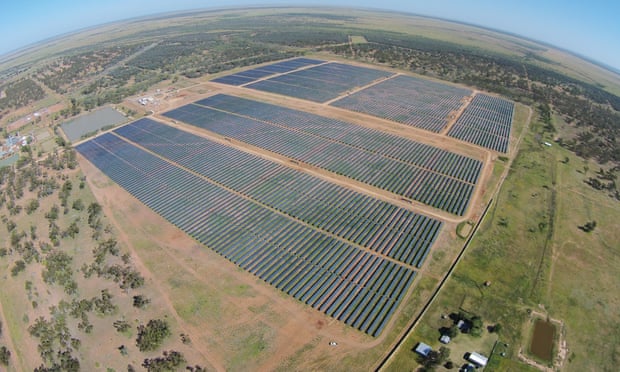
The early delivery of the 20 megawatt plant, one of the first in the country to be funded by the Australian Renewable Energy Agency, was evidence of the growing speed and proficiency of big solar developers, said Arena’s chief executive, Ivor Frischknecht. It is to be followed by a dozen new large-scale solar farms to be built across Australia by the end of 2017. ...Arena has committed $1.1bn in funding to developers of more than 270 renewable energy projects, who are expected to at least match that investment. This includes $20m to Origin Energy’s 107 megawatt Darling Downs solar farm at Dalby, set to be Australia’s largest operating plant by the end of next year. Another project, Genex Power’s 50 megawatt Kidson solar farm west of Townsville, will be built on an old goldmine site.
Thursday, December 8, 2016
Australian Government killed emissions scheme despite knowing it could shave $15 billion off electricity bills
The Australian government seems to be copping a lot of bad press over their failed energy policies, backflipping on a rare attempt at common sense on carbon pricing earlier this week and now being asked to explain why they are keeping energy prices artificially high.
* Australian Government To Reintroduce Carbon Pricing ?
* Australian Government killed emissions scheme despite knowing it could shave $15 billion off electricity bills
Saturday, April 2, 2016
Update
TOD ANZ is pretty much as dead as The Oil Drum these days, however I still have the occasional burst of energy at Peak Energy.
Some recent articles with an Australian slant include:
Redflow launches home solar storage battery to take on Tesla Powerwall
Protean begins deployment of 30 wave energy devices
Browse Floating LNG Project Shelved
Heating, fresh water and electricity from seawater and sunlight
Message To Australia: 'Hands Off Timor's Oil'
Port Augusta Pushing For Solar Thermal Power To Replace Coal
BioPower wave power unit deployed in Southern Ocean
Protean begins deployment of 30 wave energy devices
Browse Floating LNG Project Shelved
Heating, fresh water and electricity from seawater and sunlight
Message To Australia: 'Hands Off Timor's Oil'
Port Augusta Pushing For Solar Thermal Power To Replace Coal
BioPower wave power unit deployed in Southern Ocean
Tuesday, September 17, 2013
What happened to advanced biofuels ?
I've got a post up at Peak Energy in developments in the realm of advanced biofuels, with cellulosic ethanol plants beginning to appear in the wild - What happened to advanced biofuels ?.

Sunday, September 15, 2013


Thursday, September 12, 2013
Wind Power Makes Hydrogen for German Gas Grid
Hydrogen is often derided as a replacement fuel for vehicles but I think the idea that it can be used as a complement or substitute for natural gas is a good one, especially where excess wind power or solar power is available - Wind Power Makes Hydrogen for German Gas Grid.
Is The Syrian War About Gas Pipelines ?
I've got a post at Peak Energy looking at theories that the conflict in Syria is being driven by gas pipeline politics - Is The Syrian War About Gas Pipelines ?.
Peak Coal In China ?
I've got a post at Peak Energy on a new report from Citibank predicting peak coal demand in China by 2020 - Peak Coal In China - with obvious implications for Australian coal mines and exports.
Saturday, September 7, 2013
Australian Election 2013: Abbott government could be worse than we feared
Cross posted from Peak Energy.
Judging by the polls it seems that tomorrow's election is going to result in us having a turnip for Prime Minister for the next 3 years (barring some sort of miracle that results in Malcolm Turnbull replacing Abbott during that period). The Murdoch media and the sorry remnants of the Fairfax press have been fervently supporting this result for the entire campaign (with the lone exception of The Age) which I tend to think has tipped the outcome from closely fought to a comfortable win to the LNP coalition.
The result of the last election was pretty much perfect from my point of view, with Greens and principled independents like Rob Oakeshott, Tony Windsor and Andrew Wilkie (along with occasionally entertaining mavericks like Bob Katter and Nick Xenophon) holding the balance of power in both the lower and upper houses of parliament, preventing the Liberals from governing and ensuring that Labor couldn't give in to it's own worst instincts too often (though they did manage to backstab Wilkie along the way).
Things are still looking relatively hopeful in the Senate, with a reasonable chance of the balance of power still being held by the Greens and Independents which means the election will still be of some interest (and Abbott may yet be hobbled when he gets into power - I wonder if he'll be parroting Paul Keating's "unrepresentative swill" comments this time next week) - and if that doesn't work out you can always play a drinking game.
The Economist and The Guardian are the only other periodicals I could find recommending the current government be re-elected (which is unsurprising given their basically flawless economic track record over the past 6 years), though I don't imagine they'll be swaying too many voters tomorrow.
The Guardian has a last minute poll showing the gap is closing (hopefully its accurate) after the coalition released their policy costings a day before the election, trying as hard as possible to avoid any policy scrutiny beyond their endless "stop the boats" nonsense.
Its been a recurring dream of mine that someone would put billboards up along every freeway showing how many legal immigrants were allowed in under the Howard government compared to the number of refugees who arrived by boat - perhaps the 1 million+ legals to a few thousand illegals disparity might make the gullible closet racists of the outer suburbs realise they are being hoodwinked by this tripe.
The opposition leader, Tony Abbott, and the Coalition have chosen to treat the democratic process with contempt, presumably because the polls, clearly pointing to their victory, make them believe they can. They have comprehensively evaded scrutiny, with no policy costings until 48 hours before the ballot. For months, there has been a blank space where their policies should be; candidates have been discouraged from speaking to the media and even from attending forums in their own communities; access has been denied to journalists who don’t toe the party line.ReNew Economy thinks that Abbott will eviscerate clean energy programs if he gets the chance - Election13: Abbott government could be worse than we feared.The Coalition has been steadied by a new Tony Abbott whose ruthless focus is in contrast to his past reputation for ill-discipline. His paid parental leave scheme, which rewards the wealthiest most, is at least an attempt to rectify his poor record when it comes to women. But really the Coalition has been relying on the exhausted electorate’s distrust of Labor after their self-obsessed infighting, and the view that it’s time someone else had a go. But do those voting for Tony Abbott really prefer Christopher Pyne to Bill Shorten, Andrew Robb to Penny Wong, Peter Dutton to Tanya Plibersek? Are they really happy to lay waste to Australia’s unique environment, just because it feels like someone else’s turn? Are they not alarmed by hints at spending cuts that go as far as austerity, which has wreaked such devastation in Europe?
Oh dear. This could be worse than we thought.Over the past year, RenewEconomy has been highly skeptical about the Coalition’s approach to clean energy and climate change policies. In July last year we wrote of “the scary vision of the right” regarding future energy policies. Two months ago, we caught Opposition leader Tony Abbott dog-whistling to climate change deniers. In August we warned people not to be fooled by bipartisan targets.
That was just a small sample of our reservations. This week came the proof in the pudding: The Direct Action policy is not designed to meet any emission reduction at all, and Abbott confirmed he still thought the science was crap, despite the various leaks coming from the IPCC. Renewables do not even get a single positive mention in the Coalition’s newly released energy policy.
Were we being too pessimistic, as many people suggested? Depressingly, we don’t think so.
The bitter frustration is that – with a very few exceptions – none of this was investigated or probed by the mainstream media, which has retained a myopic obsession over forward estimates, the outlying budget forecasts that surely must rank as the most irrelevant and unreliable metric that has ever been centre stage of an election campaign.
In the end, some of the main policies were indistinguishable between the major parties, to the point where Tony Abbott is now longer promising to stop the boats, just to slow them down (and to keep them off Sydney’s freeways). The budget savings outlined by Joe Hockey are so insignificant it makes a mockery of the budget scare campaign that obsessed the media, and provided cover for Abbott’s empty rhetoric. The only real difference came in climate and clean energy, and Labor was so terrified of playing that card that nobody noticed.
This myopia was reflected in the editorial endorsements published today. Extraordinarily, the Australian Financial Review, the Sydney Morning Herald, and The Australian (along with every other Murdoch tabloid) endorsed Abbott without making a single mention of climate change or clean energy policies. So much for it being a referendum on the carbon price. Only The Age made mention of it, noting the Coalition’s disgraceful “back-tracking” on climate. It endorsed Labor.
Are we obsessed with niche interests? Maybe. But the cost of carbon and electricity were central to the cost-of-living scare campaign that will contribute to the Coalition’s victory. Climate change and the transition to a low carbon economy will be central to Australia’s future economic performance. ...
So now we find ourselves at the eve of an election victory and the introduction of a policy that remains a mystery. Does anyone know what Direct Action is? No. Has it been costed? No. Will it be able to meet more ambitious climate policies? Of course not. Was it ever designed to? Don’t be silly.
Of more immediate concern is the future of the large scale renewables industry, which could be worth more than $20 billion in the next few years, but which is now surely in limbo.
In July, we itemised five ways that Abbott could kill renewables in Australia. And he’s just about there. Repeal the carbon price? Tick. Review the renewable energy target with a view to diluting it or delaying it? Tick. Dissolve the Climate Change Authority? Tick. Dissolve the Clean Energy Finance Corporation? Tick. Slash funding for the Australian Renewable Energy Agency? Tick.
Abbott may not get to be able to achieve all those things immediately, but his intentions are clear. The energy document produced this week made no mention of renewables apart from a desire to do something about wind energy. Its focus was entirely on extractive fossil fuels – coal, gas, oil, LNG, and thorium. Dig, baby, dig. Burn, baby burn. And it wanted to make the coal-fired generators profitable again.
The energy policy document makes no mention at all of the major themes that are and will impact most on the energy industry (particularly the coal generators). They are: reduced demand, the push for efficiency, and the proliferation of rooftop solar and other forms of distributed generation. These will, as surely as night follows day, challenge the centralized business model so treasured by the incumbents and their conservative mouthpieces.
The entire power base of the Coalition seems wedded to a utopian dream from the 1960s. It seems the only thing that can deny them is their access to capital that the centralized generation and vast networks require. Residential-scale solar and distributed energy happens in increments that are, at most, a couple of tens of thousands of dollars. Australian households have already put $8 billion, and are prepared to invest billions more.
These bets are 100,000 times smaller, and it brings millions of competitors into the electricity game. This is where the issue of costs and equity will be fought in coming years. The fact that the Coalition does not even mention this in its flagship energy document suggests it is completely ill prepared. Or it will simply defend the conservative state owned governments that are trying to sell their impaired assets.
Sunday, September 1, 2013
A Floating LNG revolution in Western Australia
I've got a post at Peak Energy on Woodside's decision to build 3 floating LNG plants for the Browse basin project off northern Western Australia - Floating an LNG revolution in Western Australia.
Monday, August 19, 2013
Our Clean Energy Future
Cross posted from Peak Energy - Our Clean Energy Future.


Following on my recent post bidding Farewell to The Oil Drum, I'd like to have a look at what I view as our longer term future for energy production and consumption.
As noted in my previous post, for the time being the combination of unconventional oil extraction and the ramping up of extraction of natural gas (from both conventional and unconventional sources) has continued to push the point of peak oil production out into the future, defying the predictions of the more pessimistic peak oil observers. During this period we have seen a boom in the research and development of solutions to help us eliminate our dependency on fossil fuels, which I'll explore in this post.
Solutions can be divided into 3 groups :
- Renewable energy - solar power, wind power, geothermal power, hydro power, ocean energy and biomass derived power (including biofuels)
- Distribution of renewable energy - energy storage and the electricity grid
- Adopting alternatives to oil and other fossil fuels - electric transport, bioplastic, alternatives to fossil fuel based fertiliser and new models for manufacturing, construction and agriculture
Renewable Energy
The graphic below shows the energy available from renewable energy sources annually compared to global energy consumption. The numbers are intended to give a rough idea of relative scale - for any given energy source a wide range of estimates can be found in the literature so the numbers are indicative.

These numbers in some ways understate the amount of energy potentially available (ignoring solar power potential at sea or in space, for example, or wind power at high altitudes or far offshore, or geothermal power deep below the surface of the earth) but still serve the demonstrate that the renewable energy available to us is orders of magnitude larger than our current global energy consumption.
The contribution made by renewable energy to our energy needs is expected to exceed that made by gas (and double that made by nuclear power) by 2016, though progress needs to be accelerated if we wish to create a sustainable energy system.
Solar power
Solar power is the largest energy source available to us, dwarfing all other sources - renewable and non-renewable. Approximately 36,000 Terawatts of power could be captured by land based solar power generation - compared to current global energy use of around 16 TW. As a result, most of the plans floated for shifting to 100% renewable energy (examples include proposals by Mark Jacobson and Stuart Staniford and local plans for countries like Germany and Australia) rely primarily on solar power.
Solar power is not only the largest energy source available to us but it is also the fastest growing energy source, with solar power generation increasing by over 58% in 2012.
There are a number of options for harnessing solar power - power generation using solar photovoltaic (PV) cells and solar thermal arrays along with passive solar techniques such as solar hot water heaters.
I have been of the view that solar thermal power generation (also known as concentrating solar power or CSP) would become our most important source of power in the longer term. This view was based on a number of advantages that solar thermal possesses - it does not require rare or expensive materials (enabling it to scale without hitting resource limits), it can be built on (and is best suited to) arid land that has few other uses, it can incorporate energy storage (thus avoiding the intermittency issue), it is compatible with the existing centralised generation model and it can be combined with traditional sources of power generation (coal or gas) in hybrid power plants that allow an easy transition using existing connections to the electricity grid.
An area of desert around 250 km by 250 km covered with solar thermal power generation could supply all the world's current electricity demand.
To my continuing dismay, this hasn't happened yet (though it was our fastest growing energy source in 2012) - primarily due to the lack of progress in pushing down costs - the LCOE (levelised cost of energy) of solar thermal still being around twice that other renewable energy options.
I retain some hope given that solar thermal technology remains relatively immature - there was a very long gap between the original plant (SEGS) built in California in the 1980s and the next generation of plants built in Spain beginning in 2007 and the south west of the US shortly afterwards.
Construction of plants is now spreading around the globe, with plants being built in Abu Dhabi, Kuwait, Saudi Arabia, Egypt, Israel, Morocco, Algeria (though at this point the immense Desertec proposal has fallen off the radar), South Africa, India, China and Chile.
While there are encouraging signs for solar thermal power, by and large it has been eclipsed by solar PV in recent years, with solar panel prices plummeting and manufacturing capacity surging. While thin film solar has also become competitive it is traditional silicon based solar PV that has dominated after years of being dismissed as being too expensive.
Research into improving solar PV remains vibrant, with new materials and concentrating solar power techniques looking to push the cost of solar PV below that of coal or gas fired power (the holy grail of solar grid parity).
Wind power
Wind power is the second largest renewable energy source available to us, with the potential supply also exceeding current global energy demand.
Wind power has also seen rapid growth over the past decade, with generation increasing by over 18% in 2012 and accounting for more than half of new renewable energy supply. In Denmark it now supplies more than 28% of electricity consumption.
Wind power is now the cheapest source of renewable energy, with the LCOE being competitive with coal or gas fired power in many locations. Thanks to the merit order effect, wind power can also help lower the cost of power paid by consumers. While wind power is now a relatively mature technology, advances in turbine size and electromagnet technology along with optimisation of wind farm sites are allowing the overall efficiency of generation to increase further.
Like solar power, wind power can coexist with other uses of land - and large wind farm developments can also be located offshore.
Also like solar power, wind power is criticised for its intermittency. While geographical diversity of generation (along with diversity of energy sources and expanded grids, which will be discussed later) can help to address this, energy storage can also be built into wind turbines, a technique used in new models from GE.
Hydro power
Hydro power is the most mature source of renewable energy (the burning of wood aside) and still accounts for more electricity production than solar, wind, and geothermal combined - however it has a growth rate (around 3% in 2012) lower than most other renewables.
Hydro power current provides 16% if global power generation - the 4 largest power stations in the world are all hydro power projects.
Large scale hydro power doesn't have a lot of room for growth in the developed world, though the Himalayan region and Africa both still have significant room for growth.
Microhydro power is an alternative that is underdeveloped and often has an LCOE quoted that makes it competitive with wind power and with fossil fuels - however I've never seen any useful figures outlining the energy potential from this source (if you look at some designs you'd guess that this is something that could be deployed very widely).
Geothermal power
Geothermal energy is unusual compared to other large renewable power sources, in that it provides "baseload" power (thus placating those suffering from the "baseload fallacy") unlike other more intermittent sources like solar, wind and ocean power. The potential supply of geothermal energy is approximately equal to current global energy demand.
The first geothermal power generation plant was constructed in 1904 in Larderello, Italy, followed by Wairakei, New Zealand in the 1950's then the Geysers in California in the 1960’s. In 2012, 24 countries operated geothermal plants for electricity production, generating around 12 GW in total.
In 2012, growth in geothermal power was less than 3%, leaving it very much a niche energy source. Geothermal power generation is currently concentrated in geologically active areas - the western US, Indonesia, The Philippines, New Zealand, Iceland, Costa Rica, El Salvador and east Africa.
As well as active power generation from traditional geothermal power sources (including low temperature geothermal, ground source heat pumps can be used to provide direct heating.
The great white hope for geothermal power generation is known as "Enhanced Geothermal System" (EGS) (or sometimes Hot Dry Rock or Hot Fractured Rock) - generating power by drilling holes deep into the earth's crust to circulate water through. The energy potential for this type of geothermal energy is vast, however progress so far in terms of producing commercial power has been very disappointing.
Some early experiments were built in Switzerland but have been shut down due to concerns about earthquakes being caused by the drilling. The most promising experiment is being performed by GeoDynamics in Australia's outback - progress has been extremely slow, with numerous setbacks occurring before a 1 MW pilot plant was finally commissioned this year. On a positive note, operation of the pilot is beating expectations.
Ocean energy
Energy can be tapped from the oceans in 3 different ways - tidal power, wave power and the little known OTEC (Ocean Thermal Energy Conversion).
While there is a significant potential resource in ocean energy - broadly equivalent to our current energy use - the technology for exploiting all 3 forms of energy remains immature and costly. Tidal power has been commercially generated since the 1960's, with France's 240 MW "La Rance" power station only recently being eclipsed in size by a South Korean project. South Korea is looking to greatly expand tidal power production over the next 5 years and a range of projects are proposed for the UK, Australia and the United States - however it appears unlikely that we will see large scale tidal power production in the next couple of decades.
Wave power and OTEC are even less advanced, however pilot projects are at various stages of development for both of them and interest will no doubt slowly build in size over time. Another even more exotic alternative is the generation of electricity using differences in salinity between bodies of water.
Biomass, Biogas and Biofuel
Photosynthesis provides a steady stream of material that can be used for energy - with the caveat that there are limits before this impacts on our ability to produce food and maintain a healthy environment.
There are a range of ways of harnessing organic material for energy (other than the traditional approach of burning it for heat - which the REN21 (pdf) report on renewable energy notes is still the dominant use for biomass - contributing almost 7% of global energy supply) - using biomass to generate power, producing biogas which can be used for heat, power generation or for transport, producing biofuels that can replace or supplement traditional liquid fuels and for pyrolysis which can generate biodiesel, fertiliser and biochar.
Biofuels have been the subject of widespread criticism (critics citing competition with food production and low EROI) and seem unlikely to be able to replace a significant proportion of our oil consumption. Production of ethanol and biodiesel has stagnated in recent years, with production declining by 0.4% in 2012.
Other advanced biofuels such as cellulosic ethanol and algae based biofuels have failed to be produced in significant quantities thus far.
Biomass based power generation also has its critics, though most seem to agree that it is preferable to biofuel production. Global biomass power generation capacity was 58 GW in 2011 and is expected to grow to 86 GW by 2021. The industry seems to be suffering some headwinds, with the largest biomass power plant (Tilbury in the UK) recently being mothballed. Another large scale project in the UK (Drax still seems to be going ahead, and generation of power from waste is booming in Europe.
Biogas is the most promising of the biomass based energy generation approaches, with far fewer criticisms being leveled at it (most importantly, there is limited competition between food production and biogas production - the two are often complementary in fact - and the net energy available from biogas far exceeds that of biofuels). It can either be extracted from landfills or produced using "digesters" that process agricultural waste (or occasionally by exploiting natural sources of biogas).
The upper limits for biogas production are not clear, though some studies claim vast amounts can potentially be produced - for example, one European study said that all of Europe's gas needs could be met with biogas. Biogas power generation apparently produced about 14.5 GW in 2012.
Biogas is not only the most environmentally friendly of the biomass based energy alternatives it is also the most versatile, with the gas being able to be used for heat, power (or a mix of both - combined heat and power) or transport.
One last use for biomass is the production of biochar. Producers of biochar take dry biomass and bake it in a kiln to produce charcoal. Biochar is the term for what is left over after the energy is removed: a charcoal-based soil amendment. This process is called pyrolysis. Various gases and oils are driven off the material during the process and then used to generate energy. The charcoal is buried in the ground, sequestering the carbon that the growing plants had pulled out of the atmosphere. The end result is increased soil fertility and an energy source with negative carbon emissions.
Distribution of renewable energy
Smart Meters and Smart Grids
Renewable energy (primarily solar and wind power) is often criticised for being intermittent.
In the traditional model of electricity generation and distribution, large, centralised power stations were built with sufficient capacity to handle expected peaks in demand - with significant amounts of capacity idle during non peak parts of the day / year (and brownouts occurring if demand did happen to exceed supply). Consumers were charged a regulated price that ignored fluctuations in supply and demand - instead supply was adjusted as far as was practicable to meet demand.
Adopting a more dynamic (market based) pricing mechanism would allow energy users to have an incentive to shape their energy use to the available supply, thereby enabling fluctuations in supply to be dealt with.
The keys to making this possible are to provide electricity consumers with smart meters and the ability to alter their energy usage based on market price fluctuations. Smart grids are required for electricity distributors to create a more flexible grid incorporating a much more diverse range of power generators.
Supergrids and The Global Energy Grid
As well as making the grid more dynamic, interconnections between grids need to be expanded to enable a greater diversity of suppliers to be available across a wide region - this helps further address the issue of intermittency of supply - the sun may not be shining and the wind may not be blowing in one region however this won't be true across all regions making up a greater grid.
Proposals for extending regional grids into continent wide ones (usually by building HVDC connections between existing grids) tend to be dubbed "supergrids" - examples can be found for North America, Germany and the whole of Europe and between Europe and North Africa.
Buckminster Fuller took this idea to its logical endpoint and recommended the creation of a "global energy grid" as a step towards ending our dependency on fossil fuels.
Energy Storage
The final piece of transforming the electricity grid to distribute 100% renewable energy is building in sufficient energy storage to ensure that suppliers have the ability to react to swings in demand as well as vice versa.
Traditionally energy storage has been available in greater or lesser amounts (depending on what grid you are connected to) in the form of pumped hydro storage.
A wide range of other options have been proposed and explored over the years, ranging from Compressed air energy storage to batteries to flywheels to generating hydrogen (pumped hydro even has an ocean equivalent which is one of the more promising options).
Most battery storage being implemented today involves either lithium ion batteries or flow batteries - however further cost reductions are viewed as being necessary to enable wider availability of energy storage services.
One option receiving a lot of attention recently has been a proposal by MIT Professor Donald Sadoway to build liquid metal batteries.
Adopting alternatives to oil
While it is clear that we can replace all the energy we currently get from fossil fuels with renewable energy, the problem remains that electricity is not a direct substitute for liquid fuels - and that fossil fuels have some other important uses other than providing energy.
Transport
The most important use of liquid fuels is in transport. Increasing fuel efficiency of vehicles (around 3% per year) and substitution of natural gas for oil as a fuel for heavy vehicles has been constraining the growth of oil consumption for road transport in recent years, however this can only ever be a temporary solution - in the longer term we need to use either electricity .
Electrifying as much of the transport system as possible is the first step, with biofuels being used for those forms of transport that cannot be electrified (either liquid biofuel such as ethanol or biodiesel, or compressed biogas) such as large planes and ships.
Hybrid electric vehicles (including plug in hybrids and solar hybrids) are a maturing technology with over 5 million vehicles on the roads now.
These are providing the stepping stone to fully electric vehicles (which are already outselling plug in hybrids in the US). The journey towards fully electric cars has been a slow one with the star example so far being Tesla Motors (other promising projects such as Better Place have fallen by the wayside in recent years, though manufacturers such as Nissan are competing at the lower end of the market and a raft of car makers are building high end electric sports cars.
Three problems are holding up the transition to electric vehicles at this point - slow recharge times, "range anxiety" and the relatively high cost of electric vehicles compared to legacy internal combustion engine based vehicles. Tesla are looking to address both of the first two issues by pursuing both fast recharge technology (with various other schemes being implemented around the globe) and a battery swap system similar to that pursued by Better Place.
The IEA has set a target of 20 million electric vehicles by 2020, with further 50% increase in battery performance a key to achieving this goal, following on the 50% increase achieved in the past 3 years.
Cars aren't the only type of vehicle that requires fuel of course - heavier forms of of transport also consume oil. We are now starting to see electric trucks, electric buses and electric boats begin to appear out in the marketplace. Where heavy vehicles such as buses follow the same route on a regular basis they become candidates for recharging while in transit.
Of course, we don't have to simply substitute electric vehicles for existing liquid fuel powered ones. There is a wide range of alternatives available including:
- Walkable communities
- Cycling. Many journeys do not need to be made by car, particularly if cities are designed to enable transport by cycle (both by pedal powered bicycles and electric bikes) as well as by foot or rail transit.
- Transit oriented development
- Rail transport. Rail transport can be electrified where it isn't already and can provide both transit within cities and long distance travel as well (preferably via a high speed rail network)
- Exotic options such as Personal rapid transit and Elon Musk's proposed Hyperloop
Bioplastic
Nearly all the plastics sold today come from petroleum, accounting for up to 5% of global petroleum consumption by some estimates. Recycled plastics are a good first step towards reducing oil consumption, however they can only be recycled two to four times, and only around 25% of plastics are actually recycled.
The sustainable alternative to traditional plastic is bioplastic. The cost of producing bioplastic has been falling thanks to improved processes, requiring lower temperatures. Combining this with the increasing cost of crude oil has made bioplastic prices competitive with regular plastics.
Bioplastic production is expected to reach 1 million tons in 2015, out of total global plastics production of around 300 million tons.
Leading manufacturers include Avantium, BASF, Braskem, Cereplast, Metabolix and Natureworks. Bioplastic feedstocks include vegetable oil, corn starch, plant cellulose and mycellium.
Bioplastic doesn't necessarily need to replace all current uses of plastic - other alternatives are materials that have been replaced by plastics in recent decades, including steel, wood, aluminum, glass, cardboard and paper.
Agriculture
Agriculture obviously requires transport to grow and distribute food products, however it also requires fertiliser (at least if we continue to follow the green revolution model), which is usually produced using natural gas.
This can be addressed via a range of techniques - by being more efficient with fertiliser use (which would have many environmental and health benefits), by adopting organic farming techniques, by growing food near where we live, by generating ammonia using air, water and renewable energy - or by getting to the root of the problem and enabling plants to fix nitrogen themselves.
Another way of reducing energy consumption from agriculture is to find new ways of producing food - efforts to produce artificial meat (or "cultured beef", as it is sometimes known) have the potential to reduce the amount of energy required to produce meat by 45%.
Manufacturing and Construction
Manufacturing is a major consumer of energy and raw materials. The amount of energy and other raw materials devoted to manufacturing can be reduced by optimising for recycling - in particular by adopting "cradle to cradle" design and manufacturing techniques.
Distributed manufacturing and 3D printing also have potential for reducing the amount of energy required to distribute manufactured goods.
The construction and ongoing operation of buildings is another major consumer of energy, with "green buildings" and energy efficient devices such as LED lighting that minimise energy consumption being an important part of our clean energy future.
Conclusion
The aim of this post was to demonstrate the following (or at least provide food for thought to irredeemable skeptics) - I hope you've found it thought provoking.
- There is more than enough renewable energy available to meet all our needs - primarily using solar and wind power - and this can be done at a reasonable cost
- The keys to shifting to renewable energy are to expand the interconnectedness of our electricity grids, to make electricity demand more dynamic (responding to changes in electricity supply / price) and to put more energy storage in place
- That we need to be aware of the areas where we use fossil fuels and transform these to use renewable energy - to electrify our transport systems, to adopt alternatives to traditional plastics and to adapt our agricultural, manufacturing and construction processes to reduce the amount of energy required and to eliminate dependencies on fossil fuels
Sunday, August 11, 2013
A Farewell To The Oil Drum
While TOD is shutting down TOD ANZ isn't necessarily following suit (although it is admittedly very dormant at this point). The post below is reposted from Peak Energy and will (hopefully) soon appear at TOD.
I started blogging (at Peak Energy) about peak oil in late 2004, having become interested in the topic over a period of years. I'd first started thinking about oil depletion when working on systems for collecting and managing large volumes of oil exploration data in the mid 1990's. Not long afterward I worked for Woodside Energy at a time when their main development project was the Laminaria / Corallina floating oil production facility in the Timor sea. A few years later production from this project had dropped below 50,000 barrels per day from an early peak of 180,000 bpd. Around the same time I came across the writing of Colin Campbell and Ken Deffeyes and began to consider what the global oil depletion picture looked like (the war in Iraq and the steadily rising oil price also added to the interest factor).
2004 was the year where blogging exploded in popularity and a vast range of writers emerged from obscurity. A number of these began mentioning peak oil and a loosely knit community of bloggers quickly formed around the topic. At the time the traditional observers of the topic were mostly retired geologists from the oil industry and academia following in the footsteps of M King Hubbert (such as Jean Laherrerre, Walter Youngquist and Ali Samsam Bakhtiari as well as Campbell and Deffeyes), along with some writers such as Richard Heinberg and a vibrant (albeit wildly pessimistic) online community of neo-malthusians hanging out at forums such as the "Running On Empty" groups, "Energy Resources" and "Alas Babylon" - usually heavily influenced by Jay Hanson's infamous "dieoff.org" site - and various fringe websites like Mike Ruppert's "From The Wilderness" and Mark Robinowicz's "Oil Empire". There were also 2 news aggregation sites focusing on the topic that had started up - Energy Bulletin (now Resilience.org) and PeakOil.com - both of which assembled a steady stream of news on peak oil and related topics.
In 2005 The Oil Drum appeared, with Prof Goose (Kyle) and Heading Out (Dave) quickly building a large following that eclipsed that of the other sites commenting on the subject. I was pleased to be invited to join as a contributor in 2007 and spent a very enjoyable 3+ years writing for the site on a regular basis and co-editing the TOD ANZ site with Phil Hart.
After a time I found a combination of factors led me to become less active and eventually stop writing original work for TOD - in no particular order a couple of changes of job, moving house twice, getting divorced, having a couple of kids who required more of my time and a general depletion of interest caused by writing on the same broad topic for more than 5 years.
It has been disappointing to see some of the commentary about TOD's closure claiming that it indicates "fracking has killed peak oil". Personally I've been amazed TOD has lasted as long as it has, which has been a credit to the editors and staff, especially with so many contributors drifting away over the years.
If I look back to when I first started, none of the peak oil blogs around at the time are still publishing - the ones that come immediately to mind include Past Peak, Mobjectivist, Peak Energy (US), The Energy Blog, Jeff Vail's A Theory Of Power, Peak Oil Optimist, Life After The Oil Crash, Karavans and a myriad of temporary blogs created by a guy calling himself the "Flying Talking Donkey" - all of which ceased for the reasons cited by the TOD board (or due to ill health on the part of the author). This isn't a phenomenon unique to peak oil blogs - none of my favourite blogs from 2004 still exist today - the best sustainability blog of the time, WorldChanging, closed down several years ago, Bruce Sterling's "Viridian Design" did the same as did Billmon's "Whiskey Bar" and Jeff Well's "Rigorous Intuition".
So from that point of view TOD has done remarkably well to have lasted for more than 8 years.
The decision to narrow the focus of the site some years back didn't help in my view but I suspect the end result would have been the same regardless - though I tend to think allowing all of the "Limits To Growth" to be analysed may have kept the energy levels of the contributors up for longer and perhaps encouraged a wider range of contributors to participate.
It is true, however, that global oil production has not declined in the way that many (if not all) of the peak oil writers of 10 years ago predicted. While the predictions can be qualified ("conventional oil production has peaked" or "oil production per capita has peaked") the "total liquids" number clearly hasn't yet and this is the important one along with the oil price.
There are 4 obvious avenues open for dealing with peaking conventional oil production:
- 1. Find more conventional oil
- 2. Exploit unconventional oil sources
- 3. Become more efficient in our use of oil
- 4. Switch to alternatives
Over the years a lot of peak oil analysis has tended to focus on how far the first item can be pushed and what could happen once the limit is reached, with short shrift being given to the other 3 avenues (unless "powerdown" counts as "more efficient use of oil") - and even the amount of conventional oil available being somewhat underestimated (Iraq being the example I always used).
The ability of the oil industry to expand unconventional oil production (the shale oil boom being the obvious example though production of tar sands and heavy oil deposits are also increasing) has been the key factor in pushing the date of the peak out further into the future (I liked Stuart Staniford's quip that this could possibly be characterised as the "frantic scraping of the bottom of the barrel").
The dawning of the "gas age" has also kept fossil fuels in the picture for time being, with substantial unexploited conventional natural gas reserves being developed and unconventional gas production growing strongly.
While these developments have thus far dashed the hopes of the doomer community the fact remains that even if the whole world was made of oil, there would still be a finite supply of it - and thus at some point we will need to transition to alternative sources of energy, assuming the temperature of the planet hasn't risen to a point that makes it uninhabitable in the meantime.
It's this transition to alternative energy which captured most of my attention when writing - and which I'll make the topic of my second parting post for TOD - "Our Clean Energy Future" - which I hope to have ready soon.
Monday, February 18, 2013
Sinogetically stuffing the basins?
Pulling a few strands months apart together, is there a link between Paul Sheehans story (below) about how the expansion of Coal Seam Gas production is going to impact water availability for downstream food producers with last years agreement to sell Cubbie station to a Chinese consortium (now completed).
Well, how much water are we talking about here? The ABC has the numbers.
Which by a happy coincidence is about the same amount as the combined tradable water entitlement of Cubbie Station
Should the CSG bound for China stuff up the Great Artesian Basin, the new imperial overlords owners of Cubbie Station are free to sell (or lease) their water to whomever they so choose. The presence of other large Chinese interests in the area that might be interested in tradable water rights is purely coincidental.
OF course water from Cubbie would never be pumped back upstream in the "unforseen" event that farmers could not use Great Artesian Basin water - which is no ones fault - not even the imperial over owners of Cubbie. What affected farmers upstream could receive is the right to have the water.
Just speculation of course, but I'm reminded of Russ Hinzes convergence of interests.
We'll reap what we deserve
Paul Sheehan, SMH
Consider this remarkable statistic: according to the maps published by the Queensland Murray-Darling Basin Authority, the area covered by mining leases in Queensland's Murray-Darling catchment area is now 40 per cent.
Think about that. Mining is water intensive. It consumes as much water as agriculture. It is going to be impossible for extensive new mining operations in Queensland not to impinge on the production of food downstream.
Last week, the Federal Minister for the Environment, Tony Burke, granted approval to expand coal seam gas projects in NSW that represent a potential 500 per cent increase in the state's coal seam gas production.
Last month, Cubbie Station, the vast cotton-producing and water-diverting farm operation in the head of the Murray-Darling catchment area in southern Queensland, was sold to a Chinese-led consortium for $240 million.
This was a golden opportunity missed. According to the CSIRO, the cotton industry uses about 1600 litres of water to generate $1 of output. During a 12-year drought, in 2009, Cubbie went into voluntary administration with a debt of $320 million.
Well, how much water are we talking about here? The ABC has the numbers.
How much water will the CSG industry use?
Jun 28, 2012
Australia's Great Artesian Basin and its underground aquifers are a vital source of water; farmers and other bore users are given allocations for their use.
By 2014, the Commonwealth will have spent nearly $150 million under the Great Artesian Basin Sustainability Initiative, capping bores and fixing pipes to conserve water.
The coal seam gas industry is entitled to remove massive amounts of water from groundwater systems.
The Queensland Government says that if CSG mining causes groundwater levels to drop below specified "trigger" points then companies must "make good" to affected water users. The trigger points are:
a five-metre drop in bore-water levels for sandstone and fractured rock aquifers;
a two-metre drop in bore-water levels for alluvial aquifers; and
a 20-centimetre drop in the water table surrounding springs.
While the Queensland Government has set out the make-good arrangements, there is concern over how these will actually work in practice.
There is a fierce debate about the amount of water the coal seam gas industry will extract from underground, and what impact it may have on the sustainability of the Great Artesian Basin.
The industry suggests it will pull out somewhere between 126 gigalitres and 280 gigalitres a year, while the National Water Commission puts the figure above 300 gigalitres a year.
Others, including the Water Group advising the Federal Government, suggest it is higher still.
Which by a happy coincidence is about the same amount as the combined tradable water entitlement of Cubbie Station
Should the CSG bound for China stuff up the Great Artesian Basin, the new
OF course water from Cubbie would never be pumped back upstream in the "unforseen" event that farmers could not use Great Artesian Basin water - which is no ones fault - not even the
Just speculation of course, but I'm reminded of Russ Hinzes convergence of interests.
Monday, December 31, 2012
New Zealand’s double dealing and special pleading over the second Kyoto Protocol period: part the second

As the New Zealand Government decided not to join a second commitment period of the Kyoto Protocol, today is the last day New Zealand has an international greenhouse gas obligation. To mark the end of the Kyoto first commitment period, Robin Johnson's Economics Web Page provides the second of two posts on New Zealand's Kyoto opt-out.
Is New Zealand's Minister for Climate Change Issues Tim Groser a Kyoto pariah? Or a Kyoto visonary? A global emissions reduction emissary or is he tar-sanded with a Canadian brush? I once more try to make sense of New Zealand's double dealing and special pleading over the Kyoto Protocol second commitment period and the Doha hooha. This time with the aid of the man himself. Tim Groser has written an opinion editorial in the New Zealand Herald.
Tim Groser, New Zealand's most forthright Minister for Climate Changes, has a shocker of an Op Ed in the New Zealand Herald.
When I first read it, I wrote down my responses to what seemed the most misleading claims. The headline shocker is that either Tim Groser is so out of touch with his portfolio that he has no idea what the current price of carbon in New Zealand, or he is so incompetent that he can't tell US dollars from NZ dollars.
But there are shockers for all of us. I present Groser's quotes in italics and in indented blockquote format, followed by my response in plain text and no indents.
TG: "It's time to move past Kyoto agreement"
Canada o Canada. Groser is channelling Canadian Minister of Environment Peter Kent "Kyoto for Canada is in the past."
TG: "The unrelenting emphasis (on Kyoto) has sucked energy out of debate, diverting attention from the real problem."
This is a classic PR spin tactic of diversion. Groser wishes to divert attention towards the USA, China and India and away from New Zealand's double dealing.
TG "The science, as I interpret it, remains pretty clear"
Yes, Tim Groser does not deny the science, it's just that National and Mr Groser have no intention acting domestically in any way consistent with the science. Perhaps that makes him a 'policy denier'
TG "The international community needs to develop a more robust approach involving far more of the major emitting countries. Whatever New Zealand does will be completely irrelevant unless the major emitters participate."
Canada o Canada "We support a new international climate change agreement that includes commitments from all major emitters. That is the only way we are going to achieve real reductions and real results" Canadian Minister of Environment Peter Kent.
TG "some of the confusion has been deliberate"
Ah the old fifth column within, the extreme green economic traitors, those awkward truth telling ecologists like Mike Joy, Ha I can just find some with other opinions.
TG "First, the ETS has not been "gutted" by the changes passed recently in Parliament"
No, because the NZETS was "gutless" from day 1, as it has no cap, and it always allowed unlimited importing of international units. In 2012, National did defer indefinitely agriculture's entry and extend indefinitely the provisions for half-price emissions for emitters (2-for-1 deal).
TG "No New Zealander - no household, no company - has to pay more, or subsidise anyone because of this decision"
Except New Zealand Aluminium Smelters Limited and Norske-Skog Tasman.
TG "Our top priority is to strengthen the recovery in extremely difficult international economic times."
That really means Groser's top priority always was to have an emissions trading scheme with a more-or-less zero carbon price.
TG "the (NZETS) legislation was, in effect a , a one-way bet taken on the last day of the Labour Government's life in 2008 that the 2009 Copenhagen Summit would deliver a 'single, comprehensive and ratifiable climate change agreement' (the political mantra of the day)."
That statement is a totally revisionist Chairman Mao-like rewrite of history to suit a political agenda. The staggered entry of sectors dates back to Helen Clark's MOU with agriculture signed after the Belch Tax debacle. It also reflects political lobbying by Business NZ and the need to find votes of support from Peter Dunne to get the legislation passed.
TG "We no longer have to pass amending legislation to avoid an automatic ramping up of the scheme, irrespective of either economic conditions or international progress."
By saying this Groser lets us know that for National the delayed entry dates and the apparent all-sectors design were a "Potemkin village". National never had any intention of bringing agriculture into the NZETS.
TG "At current low international carbon prices - they move around but they are clustered around $5 - there is indeed little petrol in the ETS tank. But that is exactly the way it was designed - to be aligned to world prices, whatever world prices are, up to a cap"
To me this is so gobsmacking it's...Hekia Parata. Groser has no idea what the current NZ carbon price is! Groser can't even read the price of a New Zealand unit (NZU) off the Bloomberg website without confusing US dollars and NZ dollars. What an idiot!

Here is the chart Groser can't read
The NZU price is NOT "around $5" Its around $NZ2.50/tonne
So Tim Groser says the NZETS is designed to import the international carbon price and thats a good thing. If it is so good being wedded to international prices, why has he taken us out of the Kyoto Protocol second commitment period?
TG "The domestic political debate has confused the structure of the policy with the international drivers of the carbon price."
Thats just adding insult to financial injury to the Kyoto forestry sector where some have has lost 80% of the value of the post-1989 Kyoto forests. It's a double blow, as the Government is keeping forestry removal units (earned for the same forests) to itself to fudge the Kyoto net position.
TG "watch what happens to the carbon price when the international recession is over and the EU moves to strengthen carbon markets and, hopefully, more countries start adopting carbon policies. You will then hear, no doubt, the exact opposite of the current political debate. Foresters will be happier as the carbon they sequester becomes more valuable (paper profits unless they sell them) and emitters will be less happy as they pay a higher carbon price."
Thanks for lecture on prices, Tim. By the time the Eurozone has dealt with the over-allocation their carbon markets, and if they ever do, it will be way past 2015 or 2016, and New Zealand won't even be in Kyoto's second commitment period and Tim Groser will probably have canned the NZETS by then anyway!
TG "NZ continues to make remarkable progress in increasing the share of our electricity coming from renewable energy - it is 77 per cent and climbing."
Tim Groser is taking credit for past Ministry of Works hydro projects. Does he really think the public are so stupid as to see that argument as in any way relevant to climate change mitigation? Meanwhile the younger generation are calling for the power shift to 100% renewable electricity. How long until Groser calls them 'extreme greens'?
TG "So is this a great time to put new costs on our major exporting industry when we have a huge need to increase our exports?"
I could say how else could a carbon price work if it is not a real cost? How can any NZ carbon price policy be effective if half the economy is out? This is Groser's and National's real policy bottom-line. Exports uber alles! Exports above all else! National truly and obviously have no intention of pricing New Zealand's domestic greenhouse gas emissions.
TG "Our agriculture sector is, by and large, the most carbon efficient agriculture sector in the world."
Thats very Bruce Wills of him. So agriculture will be fine with a no-exceptions emissions trading scheme or carbon tax.
TG "This is the Global Research Alliance on Greenhouse Gas Emissions, which we lead."
Great but what pays for it? Thats right, taxpayers. So that's a subsidy, then. Having agriculture in the emissions trading scheme would help pay for it.
TG "A few days ago we joined another international initiative on climate change - the Climate and Clean Air Coalition"
Great! so now we mitigate climate change by friending someone's Facebook page. I think I will let William Nordhaus know he doesn't need to run carbon pricing on the DICE global model anymore as it's all on Facebook.
TG "It is time to move beyond Kyoto and find a solution that can have a real environmental impact."
Canada o Canada. "Kyoto for Canada is in the past..","Copenhagen and Cancun agreements, which were negotiated in 2009 and 2010 as the world stared down the end of Kyoto, are the future." Peter Kent, Canadian Minister of Environment.
TG "We are on track to meet or exceed our Kyoto commitment to 2012."
Only because of the "Kyoto escalator" of the gross 1990 baseline for the net target forest fudge.
From 1990 to 2010, New Zealand's gross emissions grew by 20%, from 60 million tonnes (mt) to 72mt. Net emissions grew by 59% (from 32mt to to 52mt (data New Zealand's Greenhouse Gas Inventory 1990-2010) So both gross and net greenhouse gas time series show a relentless upward trend.
So for my conclusion, I might just recycle some from a previous post. But with one difference.- When we hear Tim Groser talking of focusing on a global climate solution that involves 86% of the emitters that can have a real environmental impact, we now know he is just recycling speech notes from Canadian Minister Peter Kent and diverting attention from New Zealand's policy shambles.
- Tim Groser and National have absolutely no intention doing anything domestically to reduce emissions of greenhouse gases.
- Tim Groser and National also have absolutely no intention of imposing any real carbon price on New Zealand's industrial and agricultural emitters.
New Zealand’s double dealing and special pleading over the second Kyoto period: part the first

As the New Zealand Government decided not to join a second commitment period of the Kyoto Protocol, today, the 31st of December 2012 is the last day New Zealand has an international greenhouse gas obligation. To mark the end of the Kyoto first commitment period, Robin Johnson's Economics Web Page provides the first of two posts on New Zealand's Kyoto opt-out.
Is New Zealand Climate Change Minister Tim Groser a Kyoto pariah? Or a Kyoto visonary? Is he a global emissions reduction emissary or is he tar-sanded with a Canadian brush? I try to make sense of New Zealand's double dealing and special pleading over the Kyoto Protocol second commitment period and the Doha climate change talks hoo-ha.
I am very confused about New Zealand's climate change policy since the Doha international climate change talks (COP18) and New Zealand opting out of a second period of the Kyoto Protocol back on 9 November 2012.
The Kyoto part two opt-out is described as a lose-lose decision that shuts New Zealand out of the Kyoto international carbon markets and is a shambles and a disgrace.
So I have a question for all readers.
If New Zealand Minister of Climate Change Tim Groser is serious about New Zealand's 2020 greenhouse gas target, why would he forego formally lodging the 2020 target into the existing Kyoto Protocol framework (where the national institutions and arrangements are already up and running), in favour of pledging to meet the target on a voluntary basis?
Let me break that question down into several parts.
- Imagine you are the Minister for Climate Change in the government of a small developed nation.
- This nation has signed an international treaty with a few other nations which states a short-term national target for emissions of greenhouse gases (GHGs).
- This nation enacts the treaty by creating some new institutions; a national register for emissions units, national inventories of greenhouse gas emissions, national surveys of afforestation, and a process of reporting the predicted progress towards the national target.
- The nation has adopted several policies relying on the treaty institutions; an emissions trading scheme, forest sink schemes, research alliances, and international trading of emissions units.
- The nation has a second publicly stated medium-term target for reducing greenhouse gas emissions for the years following the expiry of the first target.
If you are serious about that second greenhouse gas emissions target, why would you pledge the target on a voluntary basis, when you could have formally lodged your target into the existing treaty (where the national institutions and arrangements already exist)?
Any answers? Anyone? Would you like to phone a friend?
Okay, here's a hint. The Parliamentary Commissioner for the Environment has said that New Zealand is on track to exceed the 1990 greenhouse gas baseline by 30% rather than meet the 2020 target of reducing greenhouse gases by 10 to 20% compared to 1990.
Figure 3.2 from page 18 of Parliamentary Commissioner for the Environment, “Lignite and climate change: The high cost of low grade coal”, December 2010. Data from MfE 2009. Fifth national communication under the United Nations Framework Convention on Climate Change, Ministry for the Environment, Wellington.
Now just because New Zealand's net emissions are likely to consistently increase through to 2020 doesn't automatically mean New Zealand would not meet the 2020 target if translated into a Kyoto second commitment period target. We could just buy extra emissions units from the international Kyoto carbon markets.
That is, if there was a sensibly designed emissions trading scheme. Such a scheme would be 100% "emitter pays", with emitters making their own market-based decisions to either reduce emissions or to buy the emissions units. Well we certainly don't have that.
So my conclusion is that it is not just that Tim Groser has absolutely no intention doing anything domestically to achieve the 2020 target of a 10 to 20% reduction in greenhouse gases. Groser and the National Government clearly have absolutely no intention of imposing any real carbon price on New Zealand's industrial and agricultural emitters.
Friday, November 9, 2012
Will the last business lobbyist to leave please turn out the light at the end of the tunnel to an effective NZ emissions trading scheme?
 In this post Robin Johnson's Economics Web Page channels General Westmoreland and his Vietnam flashbacks to look at the National Government's latest change to the New Zealand Emissions Trading Scheme (NZETS). The NZ Parliament has just (8 November) passed amendments that indefinitely defer any greenhouse gas obligations for agriculture and indefinitely discount obligations to industries.This is a 'last helicopters off the Saigon hotel roof' point in the sad history of the always-doomed-to-fail New Zealand Emissions Trading Scheme.
According to cultural folklore the humiliating end of American engagement in the Vietnam war was foreshadowed by graffiti;
Will the last person out of the tunnel please turn out the light?
Or, alternatively
Would the last Marine to leave Vietnam please turn out the light at the end of the tunnel?
This was in frank contrast to the early (with hindsight, unjustified) optimism of General Westmoreland, who had said in 1968 that he could see the light at the end of the tunnel of the war in Vietnam.
So why am I writing about graffiti from a war that ended 37 years ago? Well, to make a 'bonkers' analogy with the New Zealand Emissions Trading Scheme, of course! Getting the NZETS established was of course more or less a civil war, and when the Labour Government in its final days in office in late 2008 finally coalesced a coalition of compromise to pass the Climate Change Response (Emissions Trading) Amendment Act 2008, it seemed there was 'light at the end of the tunnel' in terms of reducing New Zealand's emissions.
However, with the adoption last night (8 November) of the National Government's latest emitter-inspired fiddle; the Climate Change Response (Emissions Trading and Other Matters) Amendment Act, I believe we can now just be honest with ourselves and see the latest amendments to the NZETS as the last helicopter off the hotel roof and the last act of the NZ emissions trading approach, which was futile from the beginning.
I have posted before about the Climate Change Response (Emissions Trading and Other Matters) Amendment Bill, noting that the amendments will;
- indefinitely exclude emissions from pastoral agriculture from the NZETS, instead of including them from 2015, which was already a delay from 2013.
- extend indefinitely the discount to industries, the 'surrender one unit for two tonnes' of emissions (half price!) that was to end this year (“maintain the 1-for-2 surrender obligation after 2012, without specifying an end date in legislation”)
- extend indefinitely the price cap, (“maintain the $25-a-unit fixed price option after 2012, without specifying an end date in legislation”)
And I have previously posted that the worst aspect of the NZETS is not the corporate welfare in the form of excessive free allocation to industries.
For me the worst aspect of the NZETS is it's absolute exposure to the international carbon markets which has the effect of knee-capping the NZ carbon price down to the rock-bottom international carbon price. Today (9 November), the highest offer for a NZU for a tonne of CO2-e is $2.55 (See today's price and trend chart from OMF Ltd).


So I concluded I agree with Jeanette Fitzsimons that the NZETS is so bad at reducing GHG emissions, it no longer matters what amendments are made to it.
That is why I think that the light at the end of the NZETS tunnel was always going to be eventually turned out. The final bit of the Vietnam analogy is who was going to turn out the light. I give that role to the professional big emitter's lobby groups, led by Business New Zealand and its astro-turf subsidiary the Greenhouse Policy Coalition.
Nicky Hager in his Bruce Jesson lecture, describes how lobbyists such as Business NZ and the Greenhouse Gas Coalition have manipulated the under-resourced media to give prominence to ideas pushed by their clients;
"...the public spaces are cluttered with paid spokespeople and commercial agendas" whose technique is to establish "usefully biased ideas" by creating “some common lines that become the ‘mantra’” and then, 'keep repeating it endlessly' " so that "the angle, timing and quotes (in the media), do not come from journalists’ observations or journalists’ questions, but from the calculated efforts of PR and marketing people", and, as a consequence, the political debate is dominated by "endless hectoring from the business lobby groups"
The media 'mantra' pushed by the lobbyists is that if the NZETS establishes an effective carbon price on emitters, then jobs and exports and GDP will be lost (See GPCNZ 2008 and Business NZ 2012). Over the years of the debate over the NZETS, we have been endlessly hectored by business lobbyists that business trade competitiveness will be affected by the NZETS. Ministers Nick Smith and Tim Groser have long ago joined in and 'costs on businesses' is now routinely given as the reason for the lack of any real bite in the NZETS.
The endless hectoring that the "NZETS will affect exports and jobs" has been so successful that the big emitters wound up the the Greenhouse Policy Coalition back in March 2012. I guess they had a helicopter to catch, after they turned out that light in the tunnel.
Subscribe to:
Posts (Atom)