Showing posts with label emissions trading scheme. Show all posts

Monday, December 31, 2012

New Zealand’s double dealing and special pleading over the second Kyoto Protocol period: part the second

As the New Zealand Government decided not to join a second commitment period of the Kyoto Protocol, today is the last day New Zealand has an international greenhouse gas obligation. To mark the end of the Kyoto first commitment period, Robin Johnson's Economics Web Page provides the second of two posts on New Zealand's Kyoto opt-out.

Is New Zealand's Minister for Climate Change Issues Tim Groser a Kyoto pariah? Or a Kyoto visonary? A global emissions reduction emissary or is he tar-sanded with a Canadian brush? I once more try to make sense of New Zealand's double dealing and special pleading over the Kyoto Protocol second commitment period and the Doha hooha. This time with the aid of the man himself. Tim Groser has written an opinion editorial in the New Zealand Herald.

Tim Groser, New Zealand's most forthright Minister for Climate Changes, has a shocker of an Op Ed in the New Zealand Herald.

When I first read it, I wrote down my responses to what seemed the most misleading claims. The headline shocker is that either Tim Groser is so out of touch with his portfolio that he has no idea what the current price of carbon in New Zealand, or he is so incompetent that he can't tell US dollars from NZ dollars.

But there are shockers for all of us. I present Groser's quotes in italics and in indented blockquote format, followed by my response in plain text and no indents.

TG: "It's time to move past Kyoto agreement"

Canada o Canada. Groser is channelling Canadian Minister of Environment Peter Kent "Kyoto for Canada is in the past."

TG: "The unrelenting emphasis (on Kyoto) has sucked energy out of debate, diverting attention from the real problem."

This is a classic PR spin tactic of diversion. Groser wishes to divert attention towards the USA, China and India and away from New Zealand's double dealing.

TG "The science, as I interpret it, remains pretty clear"

Yes, Tim Groser does not deny the science, it's just that National and Mr Groser have no intention acting domestically in any way consistent with the science. Perhaps that makes him a 'policy denier'

TG "The international community needs to develop a more robust approach involving far more of the major emitting countries. Whatever New Zealand does will be completely irrelevant unless the major emitters participate."

Canada o Canada "We support a new international climate change agreement that includes commitments from all major emitters. That is the only way we are going to achieve real reductions and real results" Canadian Minister of Environment Peter Kent.

TG "some of the confusion has been deliberate"

Ah the old fifth column within, the extreme green economic traitors, those awkward truth telling ecologists like Mike Joy, Ha I can just find some with other opinions.

TG "First, the ETS has not been "gutted" by the changes passed recently in Parliament"

No, because the NZETS was "gutless" from day 1, as it has no cap, and it always allowed unlimited importing of international units. In 2012, National did defer indefinitely agriculture's entry and extend indefinitely the provisions for half-price emissions for emitters (2-for-1 deal).

TG "No New Zealander - no household, no company - has to pay more, or subsidise anyone because of this decision"

Except New Zealand Aluminium Smelters Limited and Norske-Skog Tasman.

TG "Our top priority is to strengthen the recovery in extremely difficult international economic times."

That really means Groser's top priority always was to have an emissions trading scheme with a more-or-less zero carbon price.

TG "the (NZETS) legislation was, in effect a , a one-way bet taken on the last day of the Labour Government's life in 2008 that the 2009 Copenhagen Summit would deliver a 'single, comprehensive and ratifiable climate change agreement' (the political mantra of the day)."

That statement is a totally revisionist Chairman Mao-like rewrite of history to suit a political agenda. The staggered entry of sectors dates back to Helen Clark's MOU with agriculture signed after the Belch Tax debacle. It also reflects political lobbying by Business NZ and the need to find votes of support from Peter Dunne to get the legislation passed.

TG "We no longer have to pass amending legislation to avoid an automatic ramping up of the scheme, irrespective of either economic conditions or international progress."

By saying this Groser lets us know that for National the delayed entry dates and the apparent all-sectors design were a "Potemkin village". National never had any intention of bringing agriculture into the NZETS.

TG "At current low international carbon prices - they move around but they are clustered around $5 - there is indeed little petrol in the ETS tank. But that is exactly the way it was designed - to be aligned to world prices, whatever world prices are, up to a cap"

To me this is so gobsmacking it's...Hekia Parata. Groser has no idea what the current NZ carbon price is! Groser can't even read the price of a New Zealand unit (NZU) off the Bloomberg website without confusing US dollars and NZ dollars. What an idiot!

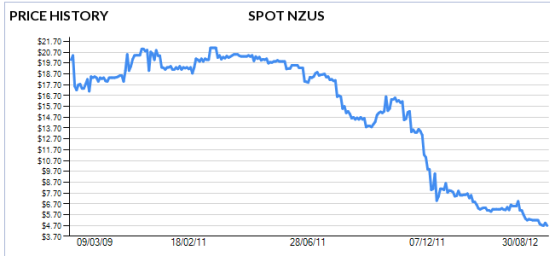
Here is the chart Groser can't read

The NZU price is NOT "around $5" Its around $NZ2.50/tonne

So Tim Groser says the NZETS is designed to import the international carbon price and thats a good thing. If it is so good being wedded to international prices, why has he taken us out of the Kyoto Protocol second commitment period?

TG "The domestic political debate has confused the structure of the policy with the international drivers of the carbon price."

Thats just adding insult to financial injury to the Kyoto forestry sector where some have has lost 80% of the value of the post-1989 Kyoto forests. It's a double blow, as the Government is keeping forestry removal units (earned for the same forests) to itself to fudge the Kyoto net position.

TG "watch what happens to the carbon price when the international recession is over and the EU moves to strengthen carbon markets and, hopefully, more countries start adopting carbon policies. You will then hear, no doubt, the exact opposite of the current political debate. Foresters will be happier as the carbon they sequester becomes more valuable (paper profits unless they sell them) and emitters will be less happy as they pay a higher carbon price."

Thanks for lecture on prices, Tim. By the time the Eurozone has dealt with the over-allocation their carbon markets, and if they ever do, it will be way past 2015 or 2016, and New Zealand won't even be in Kyoto's second commitment period and Tim Groser will probably have canned the NZETS by then anyway!

TG "NZ continues to make remarkable progress in increasing the share of our electricity coming from renewable energy - it is 77 per cent and climbing."

Tim Groser is taking credit for past Ministry of Works hydro projects. Does he really think the public are so stupid as to see that argument as in any way relevant to climate change mitigation? Meanwhile the younger generation are calling for the power shift to 100% renewable electricity. How long until Groser calls them 'extreme greens'?

TG "So is this a great time to put new costs on our major exporting industry when we have a huge need to increase our exports?"

I could say how else could a carbon price work if it is not a real cost? How can any NZ carbon price policy be effective if half the economy is out? This is Groser's and National's real policy bottom-line. Exports uber alles! Exports above all else! National truly and obviously have no intention of pricing New Zealand's domestic greenhouse gas emissions.

TG "Our agriculture sector is, by and large, the most carbon efficient agriculture sector in the world."

Thats very Bruce Wills of him. So agriculture will be fine with a no-exceptions emissions trading scheme or carbon tax.

TG "This is the Global Research Alliance on Greenhouse Gas Emissions, which we lead."

Great but what pays for it? Thats right, taxpayers. So that's a subsidy, then. Having agriculture in the emissions trading scheme would help pay for it.

TG "A few days ago we joined another international initiative on climate change - the Climate and Clean Air Coalition"

Great! so now we mitigate climate change by friending someone's Facebook page. I think I will let William Nordhaus know he doesn't need to run carbon pricing on the DICE global model anymore as it's all on Facebook.

TG "It is time to move beyond Kyoto and find a solution that can have a real environmental impact."

Canada o Canada. "Kyoto for Canada is in the past..","Copenhagen and Cancun agreements, which were negotiated in 2009 and 2010 as the world stared down the end of Kyoto, are the future." Peter Kent, Canadian Minister of Environment.

TG "We are on track to meet or exceed our Kyoto commitment to 2012."

Only because of the "Kyoto escalator" of the gross 1990 baseline for the net target forest fudge.

From 1990 to 2010, New Zealand's gross emissions grew by 20%, from 60 million tonnes (mt) to 72mt. Net emissions grew by 59% (from 32mt to to 52mt (data New Zealand's Greenhouse Gas Inventory 1990-2010) So both gross and net greenhouse gas time series show a relentless upward trend.

So for my conclusion, I might just recycle some from a previous post. But with one difference.
  1. When we hear Tim Groser talking of focusing on a global climate solution that involves 86% of the emitters that can have a real environmental impact, we now know he is just recycling speech notes from Canadian Minister Peter Kent and diverting attention from New Zealand's policy shambles.
  2. Tim Groser and National have absolutely no intention doing anything domestically to reduce emissions of greenhouse gases.
  3. Tim Groser and National also have absolutely no intention of imposing any real carbon price on New Zealand's industrial and agricultural emitters.


New Zealand’s double dealing and special pleading over the second Kyoto period: part the first

As the New Zealand Government decided not to join a second commitment period of the Kyoto Protocol, today, the 31st of December 2012 is the last day New Zealand has an international greenhouse gas obligation. To mark the end of the Kyoto first commitment period, Robin Johnson's Economics Web Page provides the first of two posts on New Zealand's Kyoto opt-out.

Is New Zealand Climate Change Minister Tim Groser a Kyoto pariah? Or a Kyoto visonary? Is he a global emissions reduction emissary or is he tar-sanded with a Canadian brush? I try to make sense of New Zealand's double dealing and special pleading over the Kyoto Protocol second commitment period and the Doha climate change talks hoo-ha.

I am very confused about New Zealand's climate change policy since the Doha international climate change talks (COP18) and New Zealand opting out of a second period of the Kyoto Protocol back on 9 November 2012.

The Kyoto part two opt-out is described as a lose-lose decision that shuts New Zealand out of the Kyoto international carbon markets and is a shambles and a disgrace.

So I have a question for all readers.

If New Zealand Minister of Climate Change Tim Groser is serious about New Zealand's 2020 greenhouse gas target, why would he forego formally lodging the 2020 target into the existing Kyoto Protocol framework (where the national institutions and arrangements are already up and running), in favour of pledging to meet the target on a voluntary basis?

Let me break that question down into several parts.

  1. Imagine you are the Minister for Climate Change in the government of a small developed nation.
  2. This nation has signed an international treaty with a few other nations which states a short-term national target for emissions of greenhouse gases (GHGs).
  3. This nation enacts the treaty by creating some new institutions; a national register for emissions units, national inventories of greenhouse gas emissions, national surveys of afforestation, and a process of reporting the predicted progress towards the national target.
  4. The nation has adopted several policies relying on the treaty institutions; an emissions trading scheme, forest sink schemes, research alliances, and international trading of emissions units.
  5. The nation has a second publicly stated medium-term target for reducing greenhouse gas emissions for the years following the expiry of the first target.

If you are serious about that second greenhouse gas emissions target, why would you pledge the target on a voluntary basis, when you could have formally lodged your target into the existing treaty (where the national institutions and arrangements already exist)?

Any answers? Anyone? Would you like to phone a friend?

Okay, here's a hint. The Parliamentary Commissioner for the Environment has said that New Zealand is on track to exceed the 1990 greenhouse gas baseline by 30% rather than meet the 2020 target of reducing greenhouse gases by 10 to 20% compared to 1990.

Figure 3.2 from page 18 of Parliamentary Commissioner for the Environment, “Lignite and climate change: The high cost of low grade coal”, December 2010. Data from MfE 2009. Fifth national communication under the United Nations Framework Convention on Climate Change, Ministry for the Environment, Wellington.

Now just because New Zealand's net emissions are likely to consistently increase through to 2020 doesn't automatically mean New Zealand would not meet the 2020 target if translated into a Kyoto second commitment period target. We could just buy extra emissions units from the international Kyoto carbon markets.

That is, if there was a sensibly designed emissions trading scheme. Such a scheme would be 100% "emitter pays", with emitters making their own market-based decisions to either reduce emissions or to buy the emissions units. Well we certainly don't have that.

So my conclusion is that it is not just that Tim Groser has absolutely no intention doing anything domestically to achieve the 2020 target of a 10 to 20% reduction in greenhouse gases. Groser and the National Government clearly have absolutely no intention of imposing any real carbon price on New Zealand's industrial and agricultural emitters.

Friday, November 9, 2012

Will the last business lobbyist to leave please turn out the light at the end of the tunnel to an effective NZ emissions trading scheme?

Bruce Crandall's UH-1D In this post Robin Johnson's Economics Web Page channels General Westmoreland and his Vietnam flashbacks to look at the National Government's latest change to the New Zealand Emissions Trading Scheme (NZETS). The NZ Parliament has just (8 November) passed amendments that indefinitely defer any greenhouse gas obligations for agriculture and indefinitely discount obligations to industries.This is a 'last helicopters off the Saigon hotel roof' point in the sad history of the always-doomed-to-fail New Zealand Emissions Trading Scheme.

According to cultural folklore the humiliating end of American engagement in the Vietnam war was foreshadowed by graffiti;

Will the last person out of the tunnel please turn out the light?

Or, alternatively

Would the last Marine to leave Vietnam please turn out the light at the end of the tunnel?

This was in frank contrast to the early (with hindsight, unjustified) optimism of General Westmoreland, who had said in 1968 that he could see the light at the end of the tunnel of the war in Vietnam.

So why am I writing about graffiti from a war that ended 37 years ago? Well, to make a 'bonkers' analogy with the New Zealand Emissions Trading Scheme, of course! Getting the NZETS established was of course more or less a civil war, and when the Labour Government in its final days in office in late 2008 finally coalesced a coalition of compromise to pass the Climate Change Response (Emissions Trading) Amendment Act 2008, it seemed there was 'light at the end of the tunnel' in terms of reducing New Zealand's emissions.

However, with the adoption last night (8 November) of the National Government's latest emitter-inspired fiddle; the Climate Change Response (Emissions Trading and Other Matters) Amendment Act, I believe we can now just be honest with ourselves and see the latest amendments to the NZETS as the last helicopter off the hotel roof and the last act of the NZ emissions trading approach, which was futile from the beginning.

I have posted before about the Climate Change Response (Emissions Trading and Other Matters) Amendment Bill, noting that the amendments will;

  1. indefinitely exclude emissions from pastoral agriculture from the NZETS, instead of including them from 2015, which was already a delay from 2013.
  2. extend indefinitely the discount to industries, the 'surrender one unit for two tonnes' of emissions (half price!) that was to end this year (“maintain the 1-for-2 surrender obligation after 2012, without specifying an end date in legislation”)
  3. extend indefinitely the price cap, (“maintain the $25-a-unit fixed price option after 2012, without specifying an end date in legislation”)
.

And I have previously posted that the worst aspect of the NZETS is not the corporate welfare in the form of excessive free allocation to industries.

For me the worst aspect of the NZETS is it's absolute exposure to the international carbon markets which has the effect of knee-capping the NZ carbon price down to the rock-bottom international carbon price. Today (9 November), the highest offer for a NZU for a tonne of CO2-e is $2.55 (See today's price and trend chart from OMF Ltd).

NZU price per tonne 9 November 2012

So I concluded I agree with Jeanette Fitzsimons that the NZETS is so bad at reducing GHG emissions, it no longer matters what amendments are made to it.

That is why I think that the light at the end of the NZETS tunnel was always going to be eventually turned out. The final bit of the Vietnam analogy is who was going to turn out the light. I give that role to the professional big emitter's lobby groups, led by Business New Zealand and its astro-turf subsidiary the Greenhouse Policy Coalition.

Nicky Hager in his Bruce Jesson lecture, describes how lobbyists such as Business NZ and the Greenhouse Gas Coalition have manipulated the under-resourced media to give prominence to ideas pushed by their clients;

"...the public spaces are cluttered with paid spokespeople and commercial agendas" whose technique is to establish "usefully biased ideas" by creating “some common lines that become the ‘mantra’” and then, 'keep repeating it endlessly' " so that "the angle, timing and quotes (in the media), do not come from journalists’ observations or journalists’ questions, but from the calculated efforts of PR and marketing people", and, as a consequence, the political debate is dominated by "endless hectoring from the business lobby groups"

The media 'mantra' pushed by the lobbyists is that if the NZETS establishes an effective carbon price on emitters, then jobs and exports and GDP will be lost (See GPCNZ 2008 and Business NZ 2012). Over the years of the debate over the NZETS, we have been endlessly hectored by business lobbyists that business trade competitiveness will be affected by the NZETS. Ministers Nick Smith and Tim Groser have long ago joined in and 'costs on businesses' is now routinely given as the reason for the lack of any real bite in the NZETS.

The endless hectoring that the "NZETS will affect exports and jobs" has been so successful that the big emitters wound up the the Greenhouse Policy Coalition back in March 2012. I guess they had a helicopter to catch, after they turned out that light in the tunnel.

Saturday, November 3, 2012

And when I awoke I was alone the exporter had flown Norwegian wood isn't it good

Geothermal Power Plant on Tasman Mill site, Kawerau NZ Norwegian wood and newsprint transnational Norske Skog Tasman (NZ) Ltd 'exports itself'. Robin Johnson's Economics Web Page looks at the flight of another manufacturer and CO2 emitter and exporter as it lays off staff and reduces production. Wasn't the very generous free allocation of units in the New Zealand Emissions Trading Scheme meant to keep exporters like Norske Skog Tasman in New Zealand? Or have we just removed the price signal from exporters for no valid reason and stuffed the NZETS?

The New Zealand Herald reports that the Norwegian-owned newsprint-maker and transnational Norske Skog Tasman NZ has joined the ranks of export businesses like Rio Tinto Alcan NZ/NZ Aluminium Smelters who are exporting jobs off shore. Incidentally Rio Tinto Alcan NZ/NZ Aluminium Smelters have just been described as New Zealand's biggest bludger.

Norske Skog is shutting down one of two newsprint machines at the Tasman Mill, in Kawerau, due to lowered demand for newsprint.

At the same time Norske Skog is investing $A84 million in new plant at the existing Boyer Mill in Tasmania with some substantial help from the Australian Federal government (A$28 million grant) and State government (A$13 million loan).

The NZ Government has been asked "what is being done for jobs"? And the NZ Government's "market will take care of everything" approach has been called naive.

The NZ Herald mentioned the NZ emissions trading scheme (NZETS) only briefly in passing, as they noted the rock-bottom NZ carbon price and the poor despairing carbon foresters.

So that prompted me to look at how Norske Skog Tasman NZ fits into the NZETS. What are the greenhouse gas emissions of the Norske Skog Tasman newsprint mill? Is Norske Skog Tasman regulated by the NZETS? Have they received a free allocation of emission units (like NZ Aluminium Smelters Ltd) to reduce the net number they have to buy? Which is meant to be the point of free allocation; ostensibly to protect their international competitiveness and to keep the jobs in NZ. Is the free allocation of units enough? Is it even a reasonable idea that free allocations of units make any difference to transnationals?

Norske Skog Tasman uses geothermal steam from the Kawerau geothermal field for heating and electricity generation in its newsprint mill. Geothermal steam naturally contains carbon dioxide and methane which are released when the heat energy is transformed.

The use of geothermal steam for energy is covered by the NZETS as an energy sector emission. So Norske Skog Tasman must report its greenhouse gas emissions and obtain and surrender emissions units to comply with the NZETS.

The Ministry for the Environment provides a specific emissions factor in the Climate Change (Stationary Energy and Industrial Processes) Regulations 2009 for calculating the mass of greenhouse gas emissions from Kauwerau's geothermal steam. The factor is 0.0275 tonnes CO2-equivalent per tonne of geothermal steam used.

Norske Skog Tasman's production of newsprint is classified as an emissions-intensive trade-exposed activity. They are therefore eligible for the highest level of assistance; covering "90%" of their production in the form of a free allocation of 0.4911 emission units per tonne of uncoated newsprint.

So far, so much like NZ Aluminum Smelters/Rio Tinto Alcan NZ. Except there is the peculiarity that the free unit allocations are calculated from a different variable from the GHG emissions. Emissions are calculated from tonnes of geothermal steam used, and free units are calculated from tonnes of newsprint.

Let's start with a 'back of envelope' calculation of the units Norske Skog Tasman should surrender (the NZETS gross carbon price).

According to the Kawerau Geothermal Field Background Study, Mighty River Power supplies 285 tonnes of geothermal steam per hour to Norske Skog Tasman, who on-sell 26 tonnes to Carter Holt Harvey Wood Products. So net use is 259 tonnes per hour.

Assuming 24/7 production, the annual use is 259 * 24 * 365 = 2,268,840 tonnes of steam per annum. And 2,268,840 * 0.0275 = 62,393.1 tonnes CO2-e. So in a typical year, Norske Skog Tasman should be surrendering very roughly about 62,000 emission units under the NZETS.

How many free emission units were allocated to Norske Skog Tasman? In both 2010 and 2011, Norske Skog Tasman received the fifth largest free allocation of units (after the Smelter, NZ Steel, Methanex and Fletcher Concrete). In 2010, Norske Skog Tasman received 122,826 New Zealand Units (NZUs) for the six-month 2010 NZETS compliance period. In 2011 Norske Skog Tasman received 237,752 NZUs.

Assuming 24/7 production in 2011, Norske Skog Tasman was allocated 381% more units than it needed to surrender (237752/62393.1 * 100 = 381.0550). Thats a way more excessive free allocation than NZ Aluminium Smelters!

However, I might not have the right numbers. My calculation may be wrong. Why don't I ask the Environmental Protection Authority under the Official Information Act for the exact number of units surrendered by Norske Skog Tasman. Watch this space.

Alternatively lets look at Norske Skog Tasman's annual financial statements (PDF) as filed at the NZ Companies Office for the 2011 calendar year.

Note 24 helpfully records that Norske Skog Tasman received 119,646 units in 2010 and 241,825 units in 2011. They surrendered only 10,754 units and sold 160,000 units, and had 190,717 units left at 31 December 2011.

The accounts show that in 2011 Norske Skog Tasman was allocated 22 times more units than it needed (241,825/10,754 = 22.49). The units allocated to protect jobs and export competitiveness, were not 90% of units surrendered. They were not 100% of units surrendered. The units allocated exceeded the units surrendered by a factor of 22!.

I can still here an echo of voice saying "You have left out the electricity allocation factor! You are wrong wrong wrong!" Well, yes, the industrial free allocation factor of 0.49 units per tonne of newsprint allegedly includes compensation for NZETS-related electricity price increases our manufacturing emitter is subject to. This rationale and the factor of 0.49 units per tonne were approved in this Cabinet paper. However, the cabinet paper provides no explanation of how the factor of 0.49 units per tonne of newsprint was calculated.

The electricity allocation factor has also been the subject of a consulation process and there is an emitters contact group for it as well.

However I think the idea that manufacturing emitters need compensation for NZETS-related electricity price increases is a smoke-screen. Norske Skog Tasman has not had its electricity price increased by the NZETS.

According to the Kawerau Geothermal Field Background Study (PDF), Norske Skog Tasman and Mighty River Power (MRP) have "..a power purchase agreement whereby NST (Norske Skog Tasman) contracted to take a majority of MRPs generation. Due to the fact that MRPs plant is grid tied, this is effectively a financial agreement offering NST price certainty and MRP a customer contracted to take the majority of supply."

The Tasman Mill is not just a plant connected to the grid. It was built to use geothermal power, just as Tiwai Point Smelter was built to use Lake Manapouri's hydro power. The Tasman Mill is joined at the hip to the Kawerau geothermal field. The newest Mighty River Kawerau geothermal generation plant was built on the Tasman Mill site (see picture above). Norske Skog is buying geothermal steam from Mighty River Power and paying MRP as if it was electricity via a financial derivative contract.

To conclude the free allocation part of the analysis; for Norske Skog Tasman, the NZETS free unit allocations are not just a discount of part of the full NZETS carbon price, the allocations are a transfer of substantial corporate welfare. The units allocated exceed the units they have to surrender by an estimated factor of 22.

And in terms of protecting the international competitiveness of Norske Skog Tasman and keeping jobs in New Zealand, the free allocations have not made the slightest difference. Thats in spite of National Party scaremongering back in 2008 that the NZETS would cause the mill to close.

And Catherine Beard of Business New Zealand (formerly boss of the big polluters advocate the Greenhouse Policy Coalition) is still scaremongering in October 2012 that any real cap in the NZETS will cause more job losses Talk about slamming the stable door after the horse has bolted.

Lets look at the real factors affecting whether a transnational commodity manufacturer stays in a country like New Zealand or Australia.

If you are a transnational like Norske Skog, you always have the choice of playing off more than one jurisdiction. The country with the smaller economy, like New Zealand, can't match the money of a larger economy like Australia. If Fletcher Challenge had not sold the Tasman Mill to Norske Skog in 2000, this 'regulatory arbitrage' would not be possible.

Corporate aquisitions that seemed a good idea before the Global Financial Crisis, look much more risky after the Global Financial Crisis. In 2000, Norske Skog paid $NZ5 billion for Fletcher Challenge's paper and pulp assets. Those assets included both the Tasman Mill in Kawearau and the mill at Boyer, Tasmania. In 2011, Norske Skog was faced with falling international demand and prices and it was considering selling some assets to avoid default on its debt.

Incidentally, Rio Tinto Alcan shares most of these international commodity trader issues; the over-priced debt-funded purchase of Alcan and Comalco by Rio Tinto before the GFC, the Rio Tinto's plan to sell Pacific Aluminium (including NZ Aluminium Smelters Ltd), the low demand for aluminium from the stagnant economies of the Eurozone and the USA and the price and supply competition from Chinese smelters in the huge and growing Chinese market.

Imagine a fictional conversation between NZ Prime Minister John Key and the CEO of Norske Skog.

"So, Yon, you don't mind if I call you Yon? For the Tasman Mill, you kiwis are all online, the demand for newsprint is down. You give me quarter of million of these NZ units that are worth $NZ3 each. No other ETS accepts them. Thats pretty low quality carbon credit, Yon. Now, Yulia Gillard, she gives us $A28 million for new plant at the Boyer mill in Tasmania. Can you match that, Yon? Can you?"

That is the bottom-line, isn't it? New Zealand could never have matched $A28 million, either as a direct grant, or through manipulation of the NZETS free allocation provisions.

To me, the Norske Skog Tasman job losses are a good demonstration of how futile it was to have an NZETS designed mainly to completely avoid any carbon price on transnational exporters. The carbon price has not just been reduced or discounted to Norske Skog, the sign has been reversed so that its an off-balance sheet transfer of corporate welfare to them in the form of emission units. Such transfers are no doubt sought by local managers who are rent-seeking, but they will be irrelevant to the international commodity trade movements that will ultimately determine whether these transnationals stay or go.

Sunday, October 28, 2012

Brother can you spare $3.10 for a tonne of carbon dioxide?

In which Robin Johnson's Economics Web Page laments the homelessness and begging now seen each day on Lambton Quay in Wellington. And a lament for both the downward spiral of the NZ Emissions Trading Scheme and the downward spiral of the New Zealand spot price for a tonne of carbon dioxide - now less than the cost of a flat white. Brother, can you spare $NZ3.10 for a tonne of carbon dioxide?


The other day I looked up the old Tin Pan Alley song "Brother can you spare a dime?" The experience of poverty and the Depression in America summed up in a popular song. The lyrics were written by Yip Harburg in 1931, and the music was composed by Jay Gorney. The version by Al Jolson is very well known, but I like this version by Charlie Palloy and his Orchestra.

I looked up "Brother can you spare a dime?" as I was thinking about homelessness and poverty in New Zealand. I am not the only one. Churchs, charities, politicians, experts and academics are also concerned about poverty in New Zealand.

I see homelessness and poverty every weekday in Wellington's main CBD thoroughfare, Lambton Quay. I walk along Lambton Quay looking forward to the first coffee of the day. I usually note how many people are begging. There are almost always a few people begging on Lambton Quay. 'Brother can you spare a dime' is alive and well even on Lambton Quay.

Except it's sad cardboard signs saying 'Homeless and need help'. Also its at least $3 to $4 for a coffee.

The other price thats less than the cost of a flat white is the spot price of carbon dioxide in NZ. The carbon trader OMF reports NZ spot prices each day at CommTrade Carbon. Guess what? On 17 October, the day Parliament's Finance and Expenditure Select Committee reported on the latest amendments to the NZETS, the last trade of a New Zealand Unit ('NZU', a tonne of carbon dioxide) was at $3.10.

OMF also display a chart. It shows the collapse of the international carbon price reflected in our own plucky little battler NZETS. It certainly looks pear-shaped.

As the political philosopher Simon Caney and economist Cameron Hepburn note with a little British understatement, when the demand for permits falls to the extent that the permit price approaches zero, it is difficult to conclude that an ETS is working to reduce emissions.

Can any sane person look at this chart and reach any other conclusion than the NZETS has completely failed as a carbon price policy incentivising reduction in GHG emissions?

OMF originally committed the chart sin of not starting the vertical (price) axis at $0. However, reality has intruded. As the New Zealand Unit (NZU) price has relentlessly declined towards $0, they keep having to move the bottom of their chart closer to zero. That would almost be a small bit of humour in a pretty sad story. If it wasn't the empirical evidence of the failure of the design of the NZETS as a policy to price greenhouse gas emissions.

If the $3.10/tonne NZU price is the death notice of the NZETS, the funeral must be the latest Finance and Expenditure Select Committee process to amend the NZETS. On 17 October 2012, this committee released its report Climate Change Response (Emissions Trading and Other Matters) Amendment Bill

This is the National Government's bill to further weaken the NZ Emissions Trading Scheme. You know, indefinitely delay the entry of agriculture, make the half-price "two-for-one" transition permanent.

If you can quickly recover your will to live after digesting page after page of bureaucratic and political policy denial and excuse-making, and the complete failure of the National Government majority to engage at all with the minority political parties or submitters or ENGOs or the Parliamentary Commissioner for the Environment, download and read the 117-page report.

Otherwise, just read Patrick Smellie's report "No restrictions on foreign-sourced carbon credits confirmed"

"The Climate Change Response (Emissions Trading and Other Matters) Bill was reported back to parliament by the finance and expenditure select committee with only technical amendments, and a decision that capping the use of foreign credits would compromise the emissions trading scheme principle of "least cost of compliance".
The policy has seen major emitters such as oil and electricity companies snap up some of the lowest cost carbon units available on global markets, where prices have slumped to as little as $2 a tonne.
New Zealand Units, issued by the government, continue to be worth slightly more, at around $3 a tonne, but well below the $25 a tonne maximum price put on carbon when the ETS was introduced in 2009."

Or just read the press release from WWF-New Zealand.

This is another nail in the coffin for New Zealand's credibility on climate change and suggests the government has no intention of trying to set this country's emissions on a downward path. Other parties in the UN climate talks will rightly see New Zealand's claims to be doing something to reduce emissions as all spin and no substance."

What a complete shambles! Why didn't we just have a no-exceptions carbon tax in the first place?

They used to tell me I was building a dream,
and so I followed the mob,
When there was earth to plow, or guns to bear,
I was always there right on the job.
They used to tell me I was building a dream,
with peace and glory ahead,
Why should I be standing in line, just waiting for bread?

Once I built a railroad, I made it run, made it race against time.
Once I built a railroad; now it's done. Brother, can you spare a dime?
Once I built a tower, up to the sun, brick, and rivet, and lime;
Once I built a tower, now it's done. Brother, can you spare a dime?

Once in khaki suits, gee we looked swell,
Full of that Yankee Doodly Dum,
Half a million boots went slogging through Hell,
And I was the kid with the drum!

Say, don't you remember, they called me Al; it was Al all the time.
Why don't you remember, I'm your pal? Buddy, can you spare a dime?

Tuesday, September 11, 2012

New Zealand Aluminium Smelter Ltd do a Godfather; Nice smelter you got. Be a shame if something happened to it

The Godfather Robin Johnson's Economics Web Page argues that Rio Tinto-owned New Zealand Aluminium Smelters Ltd, the owner of the Tiwai Point aluminium smelter, is "Godfathering" the smelter, its workforce, the Southland economy, the NZ electricity market, Meridan Energy and the poor critically endangered slow-breeding kakapo, as well as "Godfathering" the NZ emissions trading scheme to get excessive free allocations of emissions units.

I have invented a new term for climate change blogging.

Godfathering!

Its a bit like Grandfathering, which is a bit of jargon from emissions trading. But different. Grandfathering in an emissions trading scheme (an ETS), is giving the emission units for free to the existing emitters in the ETS on a historic pro-rata calculation.

The units of course representing the desired cap on emissions. Alternatively the units could be sold by auction to emitters which is logical if we treat the units as shares in a public commons owned by the Government on behalf of citizens.

Of course our NZETS is not so simple. If our NZETS just applied simple "grandfathering" as outlined, then it would have a real cap, it would not allow importing of unlimited international units, and it would be impossible for any emitter to receive more units than their emissions.

Thats not the case under the NZETS, at least for some emitters. In 2010, the Rio Tinto Alcan subsidiary NZ Aluminium Smelters Ltd, which is roughly New Zealand's third largest point source of greenhouse gas emissions, was a net seller of units, not a net payer. Their free allocation of units was 135% more than the units they needed to surrender for their emissions.

That's excessive. The justification given for this is that in order to maintain their export competitiveness, NZ Aluminium Smelters Ltd needed to be compensated for the rather unfathomable and diluted ETS costs that may flow through their secret contract with Meridian Energy and the electricity wholesale market. I will come back to this later in the post.

Let me update the smelter emissions and unit allocations for the 2011 year.

In 2011, NZ Aluminium Smelter Limited produced 354,030 saleable tonnes of aluminium. The 2011 Ministry of Economic Development Chief Executive's Report shows that the New Zealand aluminium manufacturing sector (a.k.a. NZ Aluminium Smelter Ltd) reported emissions of 601,370 tonnes CO2-e for the 2011 year. We divide by two for the 'two tonnes for one unit' deal, and that results in 300,685 units to surrender.

The NZ Ministry for the Environment allocated 437,681 units to NZ Aluminium Smelter Ltd for the 2011 calendar year.

That's 136,996 more units allocated than surrendered or alternatively the units allocated to NZ Aluminium Smelter Ltd exceeded the units surrendered by 146%.

So that's even more excessive than 2010's 135% over-allocation!

How did NZ Aluminium Smelter Ltd achieve that beneficial treatment under the NZETS? Simple really. They threatened to close the smelter and move production offshore if the NZETS really imposed a real carbon price on them.

"Thats a nice aluminium smelter you got. Be a shame if something happened to it."

Now thats what I call "Godfathering"! But wait there is more.

In July, NZ Aluminium Smelters announced an annual loss.

The smelter CEO Ryan Cavanagh said the smelter's financial difficulties were due to falling world aluminium prices. And that they needed to revise their electricity supply contract with Meridian Energy to get input costs down.

A day later, the parent company Rio Tinto Alcan indicated what may happen to it's unprofitable smelters. They will be shut down. No pressure, Meridian Energy!

"Thats a nice aluminium smelter you got. Be a shame if something happened to it."

According to New Zealand Herald economics editor Brian Fallow, if the smelter closes, there could be a "seismic" knock-on effect on the electricity market. Supply would exceed demand by the 14% of New Zealand's electricity generation used by the smelter. Wholesale electricity prices would react. Some generation assets might be crowded out.

"Thats a nice wholesale electricity market you got. Be a shame if something happened to it."

Brian Fallow notes the electricity contract with Meridian Energy, that the smelter wishes to renegotiate, represents 40% of Meridian's sales. Closure of the smelter or renegotiation of the contract put the spanner of uncertainty into the Government's planned partial sale of Meridian and the other generators.

"Nice plan for partial privatising some state-owned power generators you got. Shame if something happened to it."

The closure of the smelter would also have an impact on the local Invercargill and Southland regional economy.

"Nice regional economy you got. Shame if something happened to it."

Next we hear that the smelter is fast-tracking the redundancies of it's highly-trained and highly-paid workforce.

"Nice well-trained professional smelter labour force you got. Shame if something happened to it."

Strigops_habroptilusAnd NZ Aluminium Smelter also wants to withdraw from partly funding the successful Kakapo Recovery Programme.
"Nice charismatic endangered species programme you got. Shame if something happened to it."

That's a lot of Godfathering!

Let's look at New Zealand Aluminium Smelter's electricity use and costs in 2011. How much do they use? How much do they pay? Does their power cost justify extra allocations of emissions units? Is it realistic for New Zealand Aluminium Smelter to try to get Meridian Energy to give them cheaper power?

New Zealand electricity use data is available from the Energy Data File 2012. The specific data is Spreadsheet G worksheet G.6.a. now at stored Google Docs.

Electricity use by sector 2011

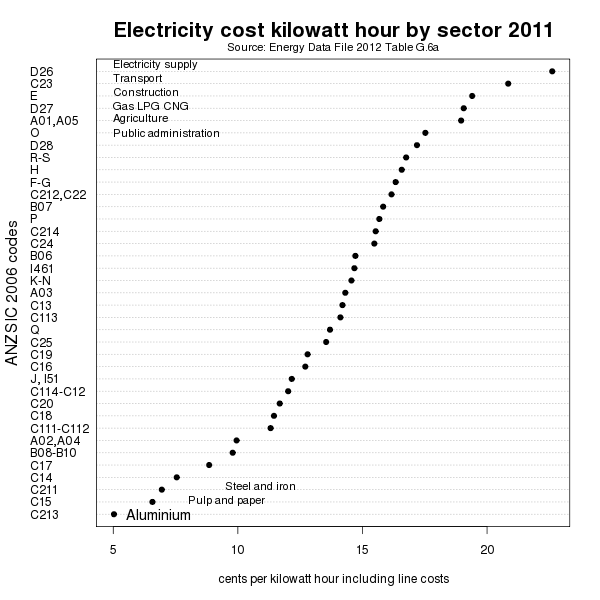
This dotchart is of electricity use data from the sheet G worksheet G.6.a.

The chart makes it very clear that the Tiwai Point Smelter is, by a huge margin, the biggest single consumer of electricity in New Zealand. A single company at a single plant used 5.3 million MWh out of 38.8 million MWh consumed in 2011, or 13.67% of the total consumption. Only the combined 4.4 million people in homes (the residential sector) used more, with 13 million MWh or 33% of the total. If we just look at industrial use of electricity, and leave out the residential sector, the smelter uses 20.6% of all electricity used by industry.

Electricity sales price by sector 2011

This chart shows industrial electricity sectors sorted by average rate (including line costs) in cents per kilowatt hour (i.e. its MWh divided by sales $$ times 100). You need to look at the bottom left hand corner for aluminium smelting, not the top. Thats because NZ Aluminium Smelter Ltd pays the very lowest average rate for electricity in New Zealand; 5.03 cents! Residential users pay 22.6 cents per KWh, or four times as much.

No industry in New Zealand uses more electricity than New Zealand Aluminium Smelters. No industry pays less per unit for electricity than they do. They even get excessively allocated emissions units to help with the lowest priced power contract in New Zealand. And now New Zealand Aluminium Smelters are going for "Godfather" gold by trying to bully their power price even lower.

Monday, September 3, 2012

How fast shall we drive over the cliff? More amendments to the New Zealand Emissions Trading Scheme

How fast shall we drive over the cliff

Robin Johnson's Economics Web Page looks at at the Government's amendments to the New Zealand Emissions Trading Scheme and concludes we are arguing about what gear to drive in as we speed towards the cliff. The Government has kindly given us the opportunity to make a submission about how fast fast we should go over the emissions cliff. Time to fasten your seatbelts.

Back in July, New Zealand Minister for Climate Change Issues Tim Groser announced more watering-down of the New Zealand Emissions Trading Scheme (NZETS).

About a week ago, on 23 August 2012, Groser introduced the amending legislation - the Climate Change Response (Emissions Trading and Other Matters) Amendment Bill.

Consistent with previous New Zealand emissions trading scheme legislation, the bill will be fully and rationally considered by Parliament's Finance and Expenditure Select Committee in an insultingly short period of time - ten working days. The closing date for public submissions is Monday, 10 September 2012.

What does this NZETS amending bill do?

  • It indefinitely postpones the entry of pastoral agriculture into the NZETS.
  • The 'two-for-one' deal, which halved the number of carbon credits each emitter had to surrender for a tonne of carbon dioxide equivalent greenhouse gases, is extended for another three years. It was to end on 31 December 2012, but will now run on at least to 2015.
  • The price cap of $12.50 per tonne ($25 for two tonnes) will also extended. It was to end on 31 December 2012, but will now run on at least to 2015.

What doesn't the bill do?

  • It ignores the recommendation from the 2011 ETS review committee to stop the unlimited use of international carbon credits by New Zealand emitters. Which as we know, makes the NZETS the weakest link.

Whats the cliff we are driving off? Well, it's climate change. And it's the price of the New Zealand emissions unit.

NZ Unit price 2009 to 2012 from OMF Financial Ltd

Who said what about the bill?

Simon Terry of the Sustainability Council said that the NZETS is now in a state of eternal transition".

Former PM Helen Clark stated the obvious, that pastoral agriculture must be in the NZETS; “You can’t have your major sector generating greenhouse gases outside the scheme."

Federated Farmers said the deferral of agriculture was huge win for New Zealand's farmers

Business New Zealand seem unusually silent. I guess for them it is all going to plan. Back in July they welcomed Tim Groser's announcement of the delays to the NZETS. So why waste space repeating the message?

However, I do offer some relief from this dreary "business-as-usualism".

Green MP Kennedy Graham has given some strong speeches accurately reflecting both the scientific reality of the cumulative carbon dioxide emissions and the ethical challenge of the failure of politics and governance to respond.

None more so than in his 'first reading' speech in which he summed up the bill thusly.

"Today's bill will defer agriculture indefinitely, defer any increase in the price cap, defer the one-for-one surrender obligation, allow a greater switch from forestry to dairying, and enable importers to increasingly use dangerous synthetic gases. What remarkable, steel-like resolve!"

I do recommend you read Kennedy Graham's speech in full.

Graham, a much more experienced diplomat than Tim Groser, walks us through more than 20 years worth of futile international climate change negotiations, all the while as the relentless accumulation of emissions in the atmosphere uses up the carbon budget consistent with limiting warming to two degrees. And with no faux-realist "get people on the bus" cliches we have come to expect from Tim Groser.

Kennedy Graham concludes that we don't have to accept this state of affairs. He calls on us to make a submission to the Finance and Expenditure Select Committee.

Greenpeace are also saying get stuck in with a submission. What to say?

How about "the NZETS is completely ineffective in reducing GHG emissions due to it's many design flaws - the use of unlimited international junk credits, the delays and exemptions, the partial coverage, the lack of a cap, the price ceiling, the lack of revenue recycling due to the excessive free allocation to emitters."

Something brief and to the point.

However, I will leave the last word to Jeanette Fitzsimons speaking on TV Ones's Q+A: Panel after a Nick Smith/Russel Norman debate back in September 2011.

"Look, its like we are in a very fast car, we are heading towards a cliff, which is getting really close, and we are arguing whether to change from fifth to fourth gear".

Tuesday, August 7, 2012

New Zealand emissions trading scheme You are the weakest international link Goodbye!

Robin Johnson's Economics Web Page argues that the New Zealand Emissions Trading Scheme (NZETS) is "the weakest link" due to it's high exposure to the international carbon market. The strong "international linkage" is the the other side of the coin of the uncapped design of the NZETS. Both features reinforce just how ineffective the NZETS is in providing an incentive to reduce greenhouse gas emissions.

Who remembers the The Weakest Link? The quiz show with Anne Robinson the disciplinarian female host with the popular catchphrase "You are the weakest link. Goodbye!"

Yes that's today's bonkers metaphor for another wonky post on the New Zealand emissions trading scheme. In addition to the observation that I would love to say "NZETS you are the weakest link. Goodbye!" there really is a relevant connection to the economics literature.

"Linking" of emissions trading schemes means that units from one emissions trading scheme (ETS) can be imported and surrendered by emitters regulated by a different ETS. There are papers and blog posts about international linkage.

The key economic benefit claimed for linking two or more ETS, assuming that they are otherwise sensibly designed, is that the lowest-cost ways of reducing emissions within the linked schemes become available (via emissions trading) to the emitters of the linked schemes.

An example. Pastoral agriculture may or may not have low-cost ways of reducing emissions. If agriculture has relatively high mitigation costs, then you are doing agriculture a favour by including it within a national all-sectors ETS, rather than just in an agriculture ETS. Agriculture can then just buy 'ways of reducing emissions' in the form of units from the cheapest seller - the emitter who can reduce emissions at a lower cost.

Not surprisingly, New Zealand's Minister for Climate Change (and Trade), Tim Groser, is very keen on linking international emissions trading schemes. Groser also does not want the New Zealand price for emissions units to be "dislodged" from the international price. Well that wouldn't be lowest-cost, would it?

However, this is all context for two recent reports on the NZETS in the 2011 calendar year. Last Friday, the New Zealand Ministry for the Environment (MfE) released 'NZ ETS 2011 Facts and figures'. Earlier, in July, the New Zealand Environmental Protection Authority (EPA) released its report on 2011 unit surrenders and allocations, the Section 89 Climate Change Response Act report.

This table sums up the Ministry's report.

In 2011, 16.3 million units were surrendered by New Zealand emitters. Of which, 11.7 million units were imported international units (being 4.2 million CERs, 4.3 million ERUs and 3.2 million RMUs.)

Reaction to the report was swift. Carbon foresters decried the fact that foreign units were swamping the NZ ETS in 2011 at the expense of units from NZ forestry. "..foreign carbon was the credit of choice for emitters in 2011. International credits comprised a whopping 71% of all units surrendered for compliance.."

BusinessDesk noted the that big emitters had chased the cheap foreign carbon units in preference to NZ units as European carbon prices dropped to historic lows, dragging NZU prices as low as low as $4.50 to $5 per tonne of carbon last week.

Another forester said the NZETS was now a Claytons ETS (no doubt having forgotten that Colin James said 'Claytons emissions trading scheme' first).

Kennedy Graham of the Greens said there was no incentive for NZ polluters to reduce emissions. Kennedy hits the nail on the head.

I don't disagree with any of these sentiments. The importing of 11.7 million international units really spells out the "weakest international link" design flaw of the NZETS.

But for me the key point is not the number of units imported, it is that the unlimited importing of international units has been hardwired into the design of the NZETS since the Labour government's 2007 The Framework for a New Zealand Emissions Trading Scheme document.

And if a small market where the compliance demand is 16 million units can import units from the international market where 977 million units exist, then a cap on domestic emissions is never going to be possible.

Thats why the New Zealand Emissions Trading Scheme really is the weakest (international) link.

Tuesday, June 26, 2012

Phil O'Reilly of Business New Zealand says Hands off our Emitters Trading Scheme handouts

Business New Zealand the eponymous lobby group is putting a proverbial head above the parapet and expressing a view on the New Zealand Emissions Trading Scheme (the NZETS). Robin Johnson's Economics Web Page argues that the NZETS gives us the "Eyes Glaze Over" syndrome as it is a flogged dead horse. The NZETS is toothless by design. In both respects, Business NZ has got the NZETS exactly how they want it.

Phil O'Reilly, the CEO of business lobby group Business NZ, has just written an opinion piece in the New Zealand Herald on the New Zealand Emissions Trading Scheme (the NZETS).

Okay, I think I can guess what you are thinking.

"Oh no, an article about the NZETS...just the mention of it sucks the life out of me. I bet it has attracted a whole lot of crackpot denier comments. It's so complex and full of jargon I don't really know what to think about it. I find the whole subject just a turn-off. My Eyes are Glazing Over.

Yes. This is the entirely natural MEGO response. You need to fight it! Most mentions of the NZETS descend into flogging the dead horse in order for the snake to swallow the elephant in the room.

We need to realise that this ETS-inertia politically assists the parties who gain from the current NZETS. That is of course, the big emitter business members of Business NZ. So, obtain a coffee or other stimulant and return. I can help you through this. I have waded through Phil O'Reilly's NZETS musings so you don't have to.

Turning to Phil O'Reilly's article, at first reading it seems a confusing mix of criticism of the NZETS and also some praise.

The criticisms; NZETS policies are uncertain, there has been lost of tinkering and amending - this is bad for investors and even low carbon investors.

"We need to stop the politicking, get the settings fixed, and just let the ETS get on with it its job."

The praise:

"The framework is fundamentally sound and capable of allowing a stronger price signal to flow through once the international carbon market revives...Major design changes at this point are unnecessary since higher carbon prices are almost certainly on the horizon, especially if Europe recovers."

What on earth is Phil O'Reilly on about? I can't decide which is further from reality; that the NZETS has a sound framework, or that the European economies are about to recover!

However, facts and internal consistency just don't matter in a business op-ed about the NZETS. A bit of criticism is a useful dog whistle to the fringe of climate change deniers. Sure enough, they pop up in the comments section including New Zealand's favourite energy expert Bryan Leyland. The wingnuts perform the function of making Phil O'Reilly look centrist and therefore reasonable.

And, according to the flogging the dead horse theory, it doesn't matter what you say about the NZETS, the mere mention of it induces ennui. So the more yada yada yada, the better.

But! Let me focus on the bottom-line meta-message from Phil O'Reilly. It is "Hand offs the generous free allocation of emissions units to emitters" as indicated in this quote.

"The allocation of free units allowed under the ETS is not a subsidy but a necessary protection against an uneven playing field."

Business NZ have a history of lobbying very effectively against having an effective carbon price. In particular, for the NZETS, they have lobbied very hard and successfully for generous free allocation of emissions units to big emitters. Its useful to look back at the history of this.

In 2005 Business NZ opposed the proposed carbon tax

They succeeded in getting the tax withdrawn. Clearly, the carbon tax didn't have enough exemptions.

In 2006, Business NZ started "a project to develop a framework for emissions trading". Partners were Business NZ members (and big emitters) Genesis Energy, Mighty River Power, Contact Energy, BlueSkope Steel, Solid Energy, Comalco (now Rio Tinto Alcan NZ), Fletcher Building and Fonterra.

Why were they doing this? Phil O'Reilly said "It's important that the system doesn't harm business competitiveness, and hopefully it can actually enhance competitiveness." One part of the project was to "evaluate and make recommendations on emission credit allocation schemes for different sectors".

In other words, by 2006 Business NZ had already evolved what was to be a highly successful tactic; over-emphasize the competitiveness risks to the big emitters and lobby for generous free allocations of emissions units to the big emitters.

In September 2007, Helen Clark's Labour-led Government released its draft NZETS Framework. In this framework, the free allocation of units to eligible industrial emitters was to be equal to 90 per cent of 2005 emissions plus some units for electricity consumption up to 2012, then decreasing annually on a linear basis so allocation ended in 2025, with no allocation to new industries.

In April 2008, Business NZ said the proposed NZETS allocations did not sufficiently protect the competitiveness of businesses. They catastrophically predicted that the NZETS would would cause 28% to 32% contractions of sheep and wool farming, dairy farming and processing and metals production, causing the loss of 52,000 jobs.

By 2008 business journalist Rod Oram was describing their approach thus.

"Business New Zealand says it supports an emissions trading scheme. But it's now clear it means one that transfers most of the costs to consumers and taxpayers."

Business NZ were not even trying to deny this. Passing the cost of the Kyoto Protocol onto taxpayers had been an explicit policy since 2007 when Phil O'Reilly said:

"The government needs to meet the 2012 liability itself rather than multiply its cost many times by passing on to businesses."

Labour stuck with 90% of 2005 emissions for free allocation and the 2025 end-year in the Climate Change Response (Emissions Trading) Amendment Act 2008 which became law in September 2008. Business New Zealand spat the dummy at not getting its way. Phil O'Reilly described the NZETS as "deficient","a risk to our economy" and an "example of poor law-making".

In 2009, the new National Government reviewed the NZETS, and then adopted amendments to it in November.

New Zealand Herald economics editor Brian Fallow noted that the large industrial emitters had got three big wins: a price cap of $25 a tonne to 2012; allocation of free units based on an intensity basis; a more gradual phase-out of free allocations at 1.3 per cent a year not 8.5 per cent.

Phil O'Reilly of course agreed and said "the Government had listened to business concerns about potential economic damage by providing for a more measured transition into a full trading scheme, while still placing a price on carbon."

In February 2010, Business NZ submitted on the development of Industrial Allocation Regulations in their by now time-honoured way, of emphasising free allocation to emitters:

"In the absence of other jurisdictions having emissions trading or carbon taxes, officials need to err on the side of generosity when developing the specific detail around the allocation of free units."

Fast forward to April 2011 and in Business NZ's submission to the David Caygill review of the NZETS they recommended that the $25 price cap and the 1:2 part obligation (which were due to end in 2012) be kept for ten years and that the start of phase out of free allocation be delayed until 2018.

In November 2011, when the David Caygill review announced it was recommending slower implementation of the NZETS, Business NZ said the slowdown was welcome but not enough.

In April 2012, the Government announced its intention to keep the $25 price cap until at least 2015 and to have a slower phase out of the 1:2 part obligation to 2012. In other words, they met Business NZ almost halfway.

I think its clear from this review that Business NZ has always taken a tough negotiators position on the NZETS free allocations. They work out what they can reasonably expect, then they always ask for more concessions above that. Then they complain vigourously when they don't get everything they want.

Hence their op-eds seem confusing, contradictory and act as honeytraps for crackpots. But it doesn't matter, as any discussion of the NZETS is enwrapped in a veil of flogging the dead horse.

The ETS in NZETS really does stand for "Emitters Trading Scheme"

Monday, June 11, 2012

Pure Advantage NZ pushes 'New Zealand’s Position in the Green (growth) Race' but is silent on carbon pricing

Robin Johnson's Economics Web Page looks at the latest Pure Advantage report promoting green economics. It's all great sustainability stuff except that it fails to mention carbon pricing (emissions trading schemes or carbon taxes). How seriously can we take the Pure Advantage "green growth" message on climate change, when they are not upfront about their position on a price on carbon?

Pure Advantage, New Zealand's green business advocacy group, have just released another green growth report 'New Zealand’s Position in the Green Race'. Hot Topic blog has posted about Pure Advantage before and Phillip Mills guest-posted on how NZ needs a bold low-carbon business strategy too.

The report has three goals: to define green growth, to summarise New Zealand's uninspiring environmental and economic performance, and to propose "a process for developing a green growth recipe for NZ and a strategy for delivering it" (page 27).

The basic idea of the report is clear from this graphic - where 'Green Growth' starts as an amorphous brain storm of idea, which then gets focused through the 'NZ Green Race' report and an economic analysis, before emerging like a butterfly from a chrysalis as a number of strategies and policies.

Pure Advantage believes that "corporates need to step up to provide the necessary leadership" because "New Zealand’s political leadership has successively failed to make the distinction between greening our current dirty industries, and creating new forms of high-value growth in a green economy" (page 11). Hear hear for both observations!

Climate change features strongly in their definition of green growth (as does flowery language).

Green Growth is:

"the aggregated economic benefit that comes from minimising waste and the inefficient use of energy, reducing pollution and greenhouse gas emissions, enhancing natural resources and biodiversity"
"is an economic progression driven by a series of interrelated and unprecedented global commercial imperatives, including the geopolitical drive for domestic energy security, exploding population growth, changing social demographics, mounting climate obligations, rapid decarbonisation of economies towards renewable energy..."
"is a global economic revolution driven by a series of interrelated global mega-trends, including rapid decarbonisation of economies towards renewable energy"

The report works well on the first two goals, but it fails in terms of the the third goal as their 'recipe' for dealing with climate change does not include carbon pricing. The New Zealand Emissions Trading Scheme (ETS) is mentioned twice in the report. On page 27 there is a brief mention of the ETS in discussion of NZ's growth in greenhouse gases. And in a quote from the OECD on page 34.

So what? Should Pure Advantage mention the ETS or carbon taxes/prices? The ETS is probably perceived to be most boring topic ever. Discussing the ETS is usually flogging the dead horse to swallow the elephant in the room.

But how do Pure Advantage think we can achieve a rapid decarbonisation of the economy without carbon pricing? As James Hansen says there needs to be a rising carbon fee on all emissions of carbon dioxide and greenhouse gases. Or, as the economist William Nordhaus says

"If economics provides a single bottom line for policy, it is that we need to correct this market failure by ensuring that all people, everywhere, and for the indefinite future are confronted with a market price for the use of carbon that reflects the social costs of their activities. Economic participants—thousands of governments, millions of firms, billions of people, all making trillions of decisions each year—need to face realistic prices for the use of carbon if their decisions about consumption, investment, and innovation are to be appropriate."

It is very unlikely that Pure Advantage don't have an opinion on emissions trading and carbon pricing. Its also very unlikely that they think they know better than either Hansen or Nordhaus. They are after all successful intelligent business people who have identified with sustainability. So its highly improbable that the Pure Advantage team think that decarbonising the economy can be done without effective carbon pricing.

So why don't they mention carbon pricing explicitly as an essential method to decarbonise? I suspect the answer is in this quote from the executive summary;

"To date much of the green debate in New Zealand has focused on the downside: costs and enforced obligations. Pure Advantage has been formed to focus on the economic upside of being green..."

"Costs and enforced obligations": that sounds more like the more traditional business view of the ETS. The Pure Advantage team seems to view the ETS as a downside, just like the rest of the business community who are not-so green-growth. And they only want to push the upside of green growth. So in promoting green growth (and decarbonising) to their business colleagues, Pure Advantage feel they have to downplay the ETS.

I have problems with this approach. It is less then completely transparent. Its also not showing leadership.

Wouldn't real green growth leadership involve openly stating that New Zealand must have a carbon price? That New Zealand needs to have an effective no-exception no-subsidies ETS or carbon tax instead of the ineffective NZETS?

William Nordhaus has made this comment on global warming eloquence without carbon pricing.

Whether someone is serious about tackling the global-warming problem can be readily gauged by listening to what he or she says about the carbon price. Suppose you hear a public figure who speaks eloquently of the perils of global warming and proposes that the nation should move urgently to slow climate change. Suppose that person proposes regulating the fuel efficiency of cars, or requiring high-efficiency lightbulbs, or subsidizing ethanol, or providing research support for solar power—but nowhere does the proposal raise the price of carbon. You should conclude that the proposal is not really serious and does not recognize the central economic message about how to slow climate change. To a first approximation, raising the price of carbon is a necessary and sufficient step for tackling global warming. The rest is at best rhetoric and may actually be harmful in inducing economic inefficiencies.

I'd love to hear from a spokesperson from Pure Advantage who can tell me that they are not just "eloquent speakers" on global warming - who do not propose a carbon price.

Here are some questions for Pure Advantage.

* Do they recognise the economic point that decarbonising must involve carbon pricing?

* Do they accept that the NZETS is an ineffective carbon price scheme?

* If yes to both these questions, why don't they show leadership and stand publicly for what they believe in?