Showing posts with label subsidy. Show all posts

Tuesday, September 11, 2012

New Zealand Aluminium Smelter Ltd do a Godfather; Nice smelter you got. Be a shame if something happened to it

The Godfather Robin Johnson's Economics Web Page argues that Rio Tinto-owned New Zealand Aluminium Smelters Ltd, the owner of the Tiwai Point aluminium smelter, is "Godfathering" the smelter, its workforce, the Southland economy, the NZ electricity market, Meridan Energy and the poor critically endangered slow-breeding kakapo, as well as "Godfathering" the NZ emissions trading scheme to get excessive free allocations of emissions units.

I have invented a new term for climate change blogging.

Godfathering!

Its a bit like Grandfathering, which is a bit of jargon from emissions trading. But different. Grandfathering in an emissions trading scheme (an ETS), is giving the emission units for free to the existing emitters in the ETS on a historic pro-rata calculation.

The units of course representing the desired cap on emissions. Alternatively the units could be sold by auction to emitters which is logical if we treat the units as shares in a public commons owned by the Government on behalf of citizens.

Of course our NZETS is not so simple. If our NZETS just applied simple "grandfathering" as outlined, then it would have a real cap, it would not allow importing of unlimited international units, and it would be impossible for any emitter to receive more units than their emissions.

Thats not the case under the NZETS, at least for some emitters. In 2010, the Rio Tinto Alcan subsidiary NZ Aluminium Smelters Ltd, which is roughly New Zealand's third largest point source of greenhouse gas emissions, was a net seller of units, not a net payer. Their free allocation of units was 135% more than the units they needed to surrender for their emissions.

That's excessive. The justification given for this is that in order to maintain their export competitiveness, NZ Aluminium Smelters Ltd needed to be compensated for the rather unfathomable and diluted ETS costs that may flow through their secret contract with Meridian Energy and the electricity wholesale market. I will come back to this later in the post.

Let me update the smelter emissions and unit allocations for the 2011 year.

In 2011, NZ Aluminium Smelter Limited produced 354,030 saleable tonnes of aluminium. The 2011 Ministry of Economic Development Chief Executive's Report shows that the New Zealand aluminium manufacturing sector (a.k.a. NZ Aluminium Smelter Ltd) reported emissions of 601,370 tonnes CO2-e for the 2011 year. We divide by two for the 'two tonnes for one unit' deal, and that results in 300,685 units to surrender.

The NZ Ministry for the Environment allocated 437,681 units to NZ Aluminium Smelter Ltd for the 2011 calendar year.

That's 136,996 more units allocated than surrendered or alternatively the units allocated to NZ Aluminium Smelter Ltd exceeded the units surrendered by 146%.

So that's even more excessive than 2010's 135% over-allocation!

How did NZ Aluminium Smelter Ltd achieve that beneficial treatment under the NZETS? Simple really. They threatened to close the smelter and move production offshore if the NZETS really imposed a real carbon price on them.

"Thats a nice aluminium smelter you got. Be a shame if something happened to it."

Now thats what I call "Godfathering"! But wait there is more.

In July, NZ Aluminium Smelters announced an annual loss.

The smelter CEO Ryan Cavanagh said the smelter's financial difficulties were due to falling world aluminium prices. And that they needed to revise their electricity supply contract with Meridian Energy to get input costs down.

A day later, the parent company Rio Tinto Alcan indicated what may happen to it's unprofitable smelters. They will be shut down. No pressure, Meridian Energy!

"Thats a nice aluminium smelter you got. Be a shame if something happened to it."

According to New Zealand Herald economics editor Brian Fallow, if the smelter closes, there could be a "seismic" knock-on effect on the electricity market. Supply would exceed demand by the 14% of New Zealand's electricity generation used by the smelter. Wholesale electricity prices would react. Some generation assets might be crowded out.

"Thats a nice wholesale electricity market you got. Be a shame if something happened to it."

Brian Fallow notes the electricity contract with Meridian Energy, that the smelter wishes to renegotiate, represents 40% of Meridian's sales. Closure of the smelter or renegotiation of the contract put the spanner of uncertainty into the Government's planned partial sale of Meridian and the other generators.

"Nice plan for partial privatising some state-owned power generators you got. Shame if something happened to it."

The closure of the smelter would also have an impact on the local Invercargill and Southland regional economy.

"Nice regional economy you got. Shame if something happened to it."

Next we hear that the smelter is fast-tracking the redundancies of it's highly-trained and highly-paid workforce.

"Nice well-trained professional smelter labour force you got. Shame if something happened to it."

Strigops_habroptilusAnd NZ Aluminium Smelter also wants to withdraw from partly funding the successful Kakapo Recovery Programme.

"Nice charismatic endangered species programme you got. Shame if something happened to it."

That's a lot of Godfathering!

Let's look at New Zealand Aluminium Smelter's electricity use and costs in 2011. How much do they use? How much do they pay? Does their power cost justify extra allocations of emissions units? Is it realistic for New Zealand Aluminium Smelter to try to get Meridian Energy to give them cheaper power?

New Zealand electricity use data is available from the Energy Data File 2012. The specific data is Spreadsheet G worksheet G.6.a. now at stored Google Docs.

Electricity use by sector 2011

This dotchart is of electricity use data from the sheet G worksheet G.6.a.

The chart makes it very clear that the Tiwai Point Smelter is, by a huge margin, the biggest single consumer of electricity in New Zealand. A single company at a single plant used 5.3 million MWh out of 38.8 million MWh consumed in 2011, or 13.67% of the total consumption. Only the combined 4.4 million people in homes (the residential sector) used more, with 13 million MWh or 33% of the total. If we just look at industrial use of electricity, and leave out the residential sector, the smelter uses 20.6% of all electricity used by industry.
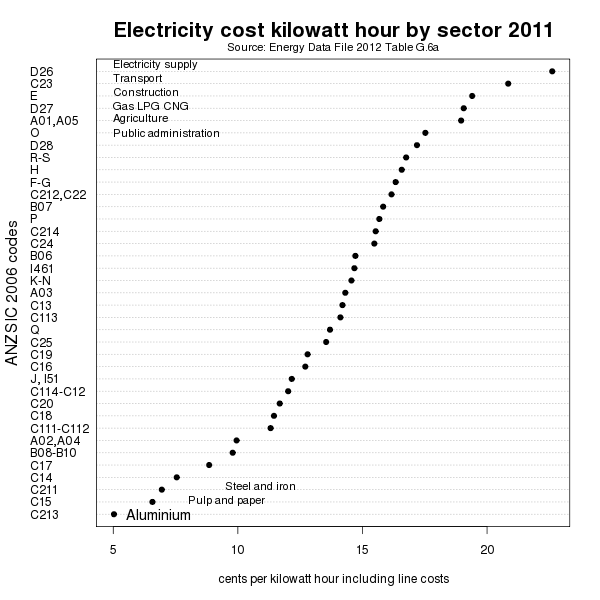
Electricity sales price by sector 2011

This chart shows industrial electricity sectors sorted by average rate (including line costs) in cents per kilowatt hour (i.e. its MWh divided by sales $$ times 100). You need to look at the bottom left hand corner for aluminium smelting, not the top. Thats because NZ Aluminium Smelter Ltd pays the very lowest average rate for electricity in New Zealand; 5.03 cents! Residential users pay 22.6 cents per KWh, or four times as much.

No industry in New Zealand uses more electricity than New Zealand Aluminium Smelters. No industry pays less per unit for electricity than they do. They even get excessively allocated emissions units to help with the lowest priced power contract in New Zealand. And now New Zealand Aluminium Smelters are going for "Godfather" gold by trying to bully their power price even lower.

Wednesday, November 2, 2011

New Zealand Minister Nick Smith fails the smelter spin test

Robin Johnson's Economics Web Page cross posts about New Zealand Climate Minister Nick Smith's spin over emissions trading subsidies to an aluminium smelter.

What does New Zealand's Minister for Climate Change Issues, Nick Smith, say when the New Zealand Green Party accuses him of subsidising greenhouse gas polluters?

Well it seems he denies it and he produces instructive soundbites of spin. I am informed that at Wellington's Oxfam election and climate change debate he said that New Zealand's sole aluminium smelter at Tiwai Point is the only aluminium smelter in the world exposed to a carbon price.

He has said this soundbite a few times. For example, in response to NZ Green MP Kennedy Graham on 29 September 2011:
"..the aluminium smelter in Bluff is the only aluminium smelter in the world to face any price at all for its greenhouse gas emissions".
On TV One's 'Q and A' programme:
"the New Zealand Aluminium Smelter in Bluff, it is the only one in the world that pays any face at all for carbon pricing." (1)
In Parliament in September 2009,
"...the Bluff smelter, on 1 July next year, will be the very first to face a carbon price for its pollution. The European scheme excludes aluminium smelters until 2013..."
Does Dr Nick's soundbite stand up to scrutiny? Not really. The European Union Emissions Trading Scheme, which started in 2005, excludes the European aluminium smelters until 2013. But it included electricity generation from 2005. And aluminium smelting is very electricity intensive. As the International Energy Agency says: "Although the primary aluminium sector is not directly covered by the (EU) ETS, the impacts of the CO2 price are felt through increases in electricity prices" (p 8). (2)

So, Europe's smelters are exposed to a carbon price through their power bills.

Another example of a Smith soundbite is saying that the overly-generous free allocation of emissions units to industry in the NZ ETS is not a cost to the taxpayer. For example: Parliament on 29 September 2011:
"This member and other members make the gross error of trying to claim that not exposing industries or consumers to the full price of carbon over all their emissions is somehow a subsidy. A subsidy implies that there is a cost to taxpayers. That is not true.."
Unfortunately for Dr Nick, that's not what the New Zealand Auditor General, Lynn Provost, says in her accounting and auditing advice for emissions units in the public sector
"NZUs have a market value and the issue of NZUs without charge to participants is an expense to the Government and creates a liability".
Sorry Dr Smith, the Tiwai Point smelter is not the only aluminium smelter exposed to a carbon price in an ETS. And the European smelters probably pay a higher carbon price through their electricity costs as the Tiwai Point smelter owner is compensated for electricity costs as well as emissions through excessive free allocation of emissions units.

Sorry Dr Smith, you can't just create and give away a permit to emit greenhouse gases that has a clear market value and say there is no cost to taxpayers as Treasury did not write out a cheque. The Auditor General confirms what we taxpayers already know that there is a real cost to taxpayers of giving emissions units away to big emitters.

Footnotes
(1) NB By 'pay any face' I think he means 'face any price'.)
(2) IEA, 2008,'Climate Policy and Carbon Leakage - Impacts of the European Emissions Trading Scheme on Aluminium'

Friday, October 21, 2011

NZ ETS 120% Pure Subsidy Part 2

Robin Johnson's Economics Web Page cross posts about the very generous free allocation of emissions units under the NZ emissions trading scheme to Rio Tinto Alcan NZ's Tiwai Point aluminium smelter.

Over on Gareth's Hot-Topic blog I had a go at estimating how free emissions units had been allocated for free to New Zealand's only aluminum smelter under the New Zealand Emissions Trading Scheme.

Tiwai Point Aluminium Smelter

A brief recap, Tiwai Point Aluminum Smelter is located near the town of Bluff, out on the edge of Foveaux Strait near the southern-most city of Invercargill The smelter is operated by NZ Aluminium Smelters Limited, which in turn is owned by Rio Tinto Alcan NZ Limited, a subsidiary of Canadian multinational Rio Tinto Alcan. Tiwai Point Smelter processes bauxite from Queensland into high-quality aluminium.

In response to my post, Simon Terry of the NZ Sustainability Council points out that we shouldn't be surprised at the high level of free allocation of units to big emitters. He documented this in June 2008, in the report Corporate Welfare Under the ETS, which looked at free allocation of units to eight energy intensive companies under the proposed NZ ETS.

In particular, he reminds us that in the NZ ETS the free allocation of units includes a factor to compensate for NZ ETS-related electricity price increases. As the NZ ETS will make some power generation more expensive to the extent that it uses fossil fuels (Huntly Power Station for example). This explains why the 'allocative baseline' factor for aluminium smelting is 2.645 units per tonne aluminium when the emissions factor for NZ's Ministry for the Environment's Greenhouse Gas Inventory is 1.67 tonnes CO2-e per tonne aluminium.

This feature of using free allocation of units to compensate emitters for electricity price increases is explicit in the 1999 - 2008 NZ Labour Government's original NZ ETS proposal Framework for a New Zealand Emissions Trading Scheme, released in September 2007. As indicated by this quote under the heading "Allocation of emission units"
"indirect emissions associated with the consumption of electricity, as well as direct emissions from ... industrial processes will be included in the concept of emissions from industrial producers...The basis for allocation for electricity consumption will be one that compensates firms for the cost impact".
Another regular commenter, Password1, says my analysis is totally incorrect because I have left out the indirect emissions from using electricity, that I am not comparing the same sets of data, and that I need to redo my calculations based on what is in the legislation. Further, my assertion that there has been an "overallocation" of units "is wrong, wrong, wrong".

Password1 concludes that
"The smelter is not getting a ‘refund’ – they are facing a proportion of the full cost of emissions both at the point of aluminium production and from being passed down from the electricity generator."
Okay maybe I will redo my calculations. So off I will go down the rabbit-hole and look into this electricity factor. So what is the proportion of the 'allocative baseline' factor for aluminium smelting, 2.645 units per tonne of aluminium, is to compensate for NZ ETS-related electricity price increases?

This idea of fossil-fuel-thermal power costs (increased by the NZ ETS) affecting a smelter that only exists because of hydroelectric dams on Lakes Manapouri and Te Anau seems a bit bizarre. Especially since the smelter's supply contract is with Meridian Energy, the 100% renewable power company.

However, the NZ wholesale electricity market works by preferentially using the lowest priced generation offer in any one half-hour trading period. This means that wholesale price is set by the most expensive block of electricity offered into the market which is needed to ensure demand is satisfied and that block may be from a coal or gas thermal generation.

When demand is high and hydro lakes are low, thermal power sets the wholesale price. As was the case through much of 2008. When demand is low and hydro lakes are full, then the coal-powered Huntly Power Plant may be on the substitutes bench and the NZ ETS costs won't flow through to NZ's wholesale electricity price.

So it does seem that there is some level of carbon price from the NZ ETS reflected through the wholesale price that ends up in the electricity price paid by the smelter. However, it is quite hard to quantify this price.

This issue was discussed in June 2010 in this Cabinet paper. Paragraph 37 tells us that the electricity allocation factor is 0.52 tCO2-e/MWh. Paragraph 40 tells us that an analysis of the smelter's electricity contract with Meridian Energy indicates that the use of this factor would result in over-allocation of units as the actual extra electricity costs are less than 0.52 tCO2-e/MWh.

Unfortunately the actual extra electricity costs, the degree of over-allocation and the fiscal cost of allocation to the smelter, have all been blanked out from the cabinet paper, apparently as 'the information is commercially sensitive'. I appear to be at the end of that rabbit-hole.

The next rabbit-hole is to check the emissions factor that gives emissions of CO2-e from tonnes of aluminium produced.

In terms of emissions reported and units surrendered, Regulation 35 of Climate Change (Stationary Energy and Industrial Processes) Regulations gives a 10-variable formula for the calculating the smelter's emissions from production. I am missing about 4 of these variables. So that's also a dead end for duplicating the emissions and the units to be surrendered.

But why don't I just use actual numbers? This Ministry of Economic Development report shows that the NZ aluminium manufacturing sector has only one NZ ETS 'participant' and that the sector, and therefore the one participant, the aluminium smelter, reported emissions of 615,814 tonnes CO2-e for the 2010 year and 312,294 tonnes CO2-e for the six months from 1 July to 31 December 2010.

So 312,294 tonnes were emitted in the six month period of obligation to surrender matching units. So we divide by 2 for the two-for-one unit deal, and that results in 156,147 units to surrender.

210,421 units were allocated to the smelter for the six months according to the NZ Ministry for the Environment.

That's 54,274 more units allocated than surrendered or alternatively the units allocated to the smelter exceeded the units surrendered by the smelter by 135%.

This result is pretty much a mid-point between my estimates which were from 147% to 122%, as summarised in this table.

Table 1 Low actual and high estimate of units to surrender
LowActualHigh
Units to surrender143,342156,147172,526
Units allocated210,421210,421210,421
Excess allocation (units)67,07954,24737,896
Excess allocation (per cent)147%135%122%


Summing up

  1. The Tiwai Point smelter was allocated 210,421 emission units in the six-month NZ ETS compliance period in 2010. Without any reasonable doubt, this represents 54,274 more emission units than it surrendered to match emissions.

  2. At today's NZ unit price of $NZ14, the value of the units allocated is $NZ2,945,894. The value of the excess of units allocated above units surrendered is $NZ759,836. That is the value of the taxpayer's gift to the smelter.

  3. An unknown (or undisclosed) proportion of the free units are intended to compensate the smelter for NZ ETS-related electricity price increases in a year characterised by highest level ever of renewable generation.

  4. I can't prove that the amount of free units allocated is more than the sum of the units to be surrendered for emissions plus some units as compensation for electricity price increases. But I think it is highly likely.

  5. In any case, it hardly matters whether the volume of free allocation is either just under 100% of costs or whether its 135%. Both options pretty much effectively negate the carbon price on the smelter and mean no real incentive to reduce emissions.

The bottomline for me is that if the smelter were not in the NZ ETS, they would at least be paying the some carbon price as a 'downstream' electricity user where some costs of fossil-thermal power generation are factored into the wholesale electricity price when fossil-thermal power is not priced out by cheaper hydro-generation.

Because of the allocation of units for power price increases, the smelter faces a lower carbon price than if it was exempt from the NZ emissions trading scheme and just paid its power bills.

There was an argument that the NZ ETS might be weak but at least it was better than nothing. In the case of the smelter, we can know discard that argument.

Friday, May 6, 2011

IPCC renewables report out soon.

Reuters has had a preview of an upcoming IPCC report on the impacts of renewables on climate change mitigation.

Renewable energies to leap, costs fall: U.N.

Renewable energies such as wind or solar power are set to surge by 2050, and expected advances in technology will bring significant cost cuts, a draft United Nations report showed on Wednesday.

The most comprehensive U.N. overview of the sector to date said renewables excluding bioenergy, which is mainly firewood burned in developing nations for cooking and heating, could expand by three to 20 times by mid-century.

"The cost of most renewable energy technologies has declined, and significant additional technical advancements are expected," the Intergovernmental Panel on Climate Change (IPCC) said in a draft obtained by Reuters, based on a review of 164 scenarios.

In 2008 renewable energy production accounted for about 12.9 percent of global primary energy supply and was dominated by bioenergy with 10.2 percent, followed by hydro power, wind, geothermal, solar power and ocean energy.

The projected expansion is likely to continue even without new measures to promote a shift from fossil fuels as part of a U.N.-led fight against climate change, it said.

Thursday, March 10, 2011

Taxing subsidised fossil fuels

John Watson at The Age (with help from the Australian Conservation Foundation) points out the meaninglessness of applying a carbon tax to a commodity produced by a heavily subsidised industry. See the original for the final details.

Twelve billion holes in plan to cut carbon
John Watson, March 10, 2011

[Given the current orthodoxy of fee market everything often espoused by Govt and others], why does Australia's government effectively promote fossil fuel use at a cost of about $12 billion a year?

A carbon price, in effect, would already be operating if only government did not feel the political need to insulate energy and road users from demand-driven prices.

Tax incentives to use fossil fuels are so great that their value exceeds forecast revenue from the Rudd government's rejected emissions scheme for years to come. The Gillard government has yet to finalise its resurrected carbon price, but it is unlikely to outweigh the entrenched carbon bias. The $12.2 billion in fossil fuel incentives dwarfs the $1.1 billion for climate policy in 2010-11, and the gap has grown by $1 billion since 2007-08.

The opposition is making wild claims about future power bills based on carbon price guesstimates of $26 a tonne. If all emissions were priced equally - they won't be - the total cost impact would be about $14 billion a year. That's little more than existing tax incentives for fossil fuel use.

It is not carbon pricing but the strain of soaring demand on ageing power infrastructure that has driven up Victorians' electricity bills by almost 60 per cent in five years, even with government price controls and subsidies.

One of the worst [political fixes ever] was driven by political panic in 2001, when John Howard ended indexation of the petrol excise. The bowser price fell all of 2¢ to 89¢ a litre, but the hit to the budget was enormous. Revenue losses have mounted to at least $3 billion and, by some estimates, as much as $6 billion this financial year. In 2001, the oil price had "soared" to $US29 a barrel. It's now above $US100. The near-doubling in the Australian dollar's value from US50¢ to parity has softened the blow, but finite supplies are driving up prices. No political fix can reverse that.

[Politicians] are suckers for compensatory fixes. The biggest is almost $5 billion a year in fuel tax rebates to producers. Much of this goes to the same miners who resisted a fair return to taxpayers on the soaring value of publicly owned mineral resources. How do they justify keeping fuel rebates as well?

Condensate exemptions will still cost the budget $580 million this year, while $1 billion is lost to aviation fuel excise exemptions. Fringe benefits tax concessions for company cars, which create an incentive to drive more, cost $1.1 billion a year. There's no tax incentive to use efficient, low-emissions public transport.

Where is the outrage at industry protection and price distortion? The principle of consumption taxes is the more you consume, the more you pay. Instead, the heaviest users feel less pressure to develop greater energy efficiency or more sustainable sources. The longer we put off this inevitable adjustment, the harder it becomes.

The Australian Conservation Foundation has a pdf with some figures and an interview with ACF Executive Director Don Henry;

Australia spends $11 billion more encouraging pollution than cleaning it up

New analysis shows the Australian Government spends $11 billion more on subsidies that encourage greenhouse pollution than it does on programs to tackle climate change.

Our analysis shows funding for programs to address climate change has increased by about $500 million since 2007-08, but incentives that encourage pollution have ballooned by more than $1.5 billion.

“There has been a lot of good talk about addressing climate change, but unfortunately the numbers tell a different story,” said ACF Executive Director Don Henry.

“In 2007-08 our government spent $480 million on programs to tackle climate change, but then it spent $10.6 billion on subsidies that promoted fossil fuel use.

“This financial year the spending on climate programs is up to around $1 billion, but the fossil fuel subsidies are up too, to a massive $12 billion, meaning the Australian Government is spending $11 billion more encouraging pollution than on cleaning it up.

“The Fringe Benefits Tax concession for company cars is like a virtual pollution factory, invisibly chugging out just as much greenhouse pollution every year as a medium-sized coal-fired power plant – only the fringe benefits tax break doesn’t produce any energy – it’s just a dead weight on the economy, the Budget and the environment.

“We need to stop putting taxpayers’ money into pollution promotion and start investing in clean energy, like wind and solar,” Mr Henry said.

Wednesday, December 29, 2010

Nearest Neighbor News

In Indonesia fuels (petrol, diesel, gas) are subsidized. The logic behind some of these subsidies is understandable; to assist the poor.

Subsidized LPG
As part of the Indonesian drive to phase out kerosene stoves, promoted as a safety measure to prevent fires1, 3 and 12 kg bottles of gas were subsidized. The Government anticipated that restaurants would not choose to use large numbers of these smaller bottles. However, most warung (restaurants)  opted to use the 12 kg bottles. The Government then removed the subsidy from these bottles so that only the small 3 kg bottles were subsidized for the poor. The result was nearly inevitable.

Unlike in Australia (and I suspect New Zealand) the fitting used in Indonesia is a quick-fit and release arrangement, not your ‘standard’ brass gas fitting. Moving large numbers of these small bottles in a “swap and go” system to satisfy the demand increased wear and tear, and lowered inspection standards (if they existed). Now instead of moving a lesser number of the more heavy duty bottles, truck loads of small bottles stacked 10 high became a common sight. Even so, I estimate that to carry the same amount of fuel around, nearly twice as much metal (by weight) is needed – thus the overall “efficiency” is probably decreased. The fires caused from damaged bottles and bad fittings injured hundreds around the country.
Suspected LPG gas explosion injures three
Study reveals more than 200 LPG explosions in three years
Pertamina needs Rp 1.7t to replace uncertified LPG canisters
Govt blames market for exploding canisters
Letter: LPG explosions
There were also some suggestions that resellers were refilling the larger 12 kg bottles with the smaller bottles to take advantage of the price disparity due to the subsidy!

Subsidized Petrol
While the same logic (i.e. helping the poor) is the rationale behind this subsidy it is more a populist measure the country can no longer afford.  The supporters of these subsidies claim that it enables poor people to access transport, the ubiquitous motor (scooter).  However, as the Indonesian economy has grown, scooters have given way to (frequently large) cars that are consuming Indonesia's dwindled supplies ever rapidly.  Government officials are aware that this situation can not last long, but the Yudhoyono Government can not move quickly on this out of fear of the electorate. Critics of the subsidies point out that those rich enough to afford large cars benefit most from this scheme.