Wednesday, September 26, 2012

New Zealand's Minister of Economic Development Steven Joyce goes ferally pro-coal and attempts to influence the Environment Court and Court of Appeal

Today I was absolutely gobsmacked by a statement by Steven Joyce, the New Zealand Minister of Economic Development, in an official New Zealand Government press release.

Joyce explicitly took the side of and promoted the cause of Australian coal miners, Bathhurst Resources, in two up-coming court cases.

Joyce said:

"The Escarpment Mine is an open cast mining project that is ready to go and would provide 225 jobs and incomes for workers and their families on the West Coast straight away. The developer is being held up from opening the Escarpment Mine by on-going litigation that has gone through the Environment Court, the High Court and the Court of Appeal. These on-going objections are to resource consents which were granted more than a year ago. The whole consenting process for this development has now taken a staggering seven years. I call on those objectors to the mine to reconsider their appeals and consider the economic future of the West Coast and its people."

I know Joyce is very pro-development, Joyce even has his own archive of posts on the Hot Topic blog, where Joyce's preference for fossil fuel developments is obvious.

But this time he has crossed a line. Joyce is using his position as a Minister of the Crown to explicitly try to influence decisions yet to be made by the New Zealand Environment Court and the New Zealand Court of Appeal on the resource consents sought by Bathurst.

Joyce is breaching the Sub judice rule.

Let me back up and start at the beginning. The resource consents for Bathurst's open cast Escarpment mine proposal were applied for in August 2010. Not seven years earlier as alleged by Joyce. Bathurst took over the project from L and M Coal Ltd.

In August 2011, the hearing commissioners acting for the West Coast regional and district councils considered with some anguish that resource consents could be approved.

This was in spite of the many adverse effects on native species habitat, water quality and the coal-measure limestone landforms within the Mt Rochfort Conservation Area. Yes the proposed mine is within a conservation area. The commissioners refused to factor in climate change effects from the eventual release of carbon dioxide from the coal. In other words, it was a pretty marginal decision.

However, the resource consents are not legally granted, as environmental NGOs Forest and Bird and the West Coast Environmental Network immediately lodged appeals with the New Zealand Environment Court. This is Joyce's second factual error; in an appeal of a resource consent, the council's decision ceases to exist. The Environment Court starts from a blank piece of paper, examines the facts and makes it's own decision. It considers consent appeals on a 'de novo' basis.

Then Bathurst started the cycle of litigation - by applying to the Environment Court, separately from the consent appeal, to have the effects of climate change barred from the consent appeal. Bathurst succeeded. So Forest and Bird and the West Coast Environmental Network appealed that decision to the High Court. Bathurst won that appeal. However, Forest and Bird and the West Coast Environmental Network have appealed the High Court decision to the Court of Appeal.

So there are two court hearings yet to happen.

1. The Environment Court is yet to decide on the facts; if the resource consents 'promote sustainable management' of resources as required by the Resource Management Act and may be granted.

2. The Court of Appeal is yet to decide on the law; whether it permits or prohibits the Environment Court considering the greenhouse effects of the carbon dioxide emissions from the downstream combustion of the coal.

Now Steven Joyce, a Minister within the Executive branch of Government, is expressing an opinion on what the outcome of the Court's process should be.

This is contrary to the 'sub judice' rule; which is simply speaking "Don't comment on undecided Court cases".

Or as set out in Parliament's Standing Order 112.

"112 Matters subject to judicial decision
(1) Matters awaiting or under adjudication in, or suppressed by an order of, any New Zealand court may not be referred to in any motion, debate, or question, including a supplementary question, subject always to the discretion of the Speaker and to the right of the House to legislate on any matter or to consider delegated legislation."

Or as set out in the Office of the Clerk of the House of Representatives document "Sub judice rule". Chapter 16 in 'Parliamentary Practice in New Zealand'. New Zealand Parliament (14 October 2010).

"The Standing Orders prohibit reference in any debate to any matters awaiting or under adjudication in a court from the time the case has been set down for trial or otherwise brought before the court, if it appears to the Speaker that there is a real and substantial danger of prejudice to the trial of the case...This is the implicit acknowledgment by the legislature that the proper forum in which to resolve legal disputes is the courts and that the legislature, above all other institutions, should take extreme care not to undermine confidence in the judicial resolution of disputes by intruding its views in individual cases...The House's sub judice rule takes effect in criminal cases from the moment a charge is made and in other cases from the time proceedings are initiated by filing the appropriate document in the registry or office of the court."

Or as set out by the Speaker, Margaret Wilson, on 16 October 2007, in "Speaker's Rulings Sub Judice Rule Operation.

"It seems to me that it is important in any consideration of it to emphasise the high constitutional nature of the rule. It stands as an expression of the relationship between the different branches of government; the legislative branch and the judicial branch. This House determines what the law should be, but it is for the courts to determine in each particular case how the law is to be applied. In criminal matters, it is not for this House to decide guilt or innocence. That is a matter for a court of law."

Obviously, Joyce and the rest of the National Government just don't give a stuff about anything of a high constitutional nature or the rule of law, or Joyce driving his Bagger 2000 coal excavator through the 'sub judice' rule. Clearly such things are just the concerns of those pesky people who obstruct progress when government tries to remove roadblocks in the way of business development.

Even not-so-stellar Minister of Energy Phil Heatley knew better than to comment on the Bathurst Environment Court appeal when he was asked about it on a Q and A interview.

"Well, you appreciate, Shane, this is before the courts. I'm a bit limited about how much I can discuss this. But the reality is Denniston, like any other application, has to go through a process, and there is a balance between the economic benefits and the- what impact it'll have on the environment."

Kevin Hackwell of Forest and Bird has responded promptly to Joyce's call and raised the issue of how independent other decision making may be, such as the Minister of Conservation's decision to grant Bathurst access for mining in a conservation area, which is also yet to be made by the Minister Kate Wilkinson.

"There would be a serious question, given his public advocacy, about whether such a decision has been influenced by government policy."

That's an important point. Especially since the Government wants to make stop the Minister of Conservation making the decisions on mining access to conservation areas on the basis of conservation purposes.

The Government has just introduced amendments to the Crown Minerals Act which add the Minister of Energy as joint decision-maker and add economic matters to the mandatory conservation purposes the Minister of Conservation must consider.

We will have to see how this 'sub judice' breach plays out for Joyce, given his party and Prime Minister have no problem with John Banks and his unknowingly non-anonymous donations.

However, I could not think of a better reason to reject the proposal for mining access over conservation land to be a joint Ministers decision based on economics and conservation criteria, than Steven Joyce's attempted interference in the Environment Court and the Court of Appeal cases concerning the Escarpment mine.

Solid Energy and the declining price of coal; neither unforeseen or dramatic or a crash

On Monday Don Elder the Chief Executive of New Zealand's Solid Energy confirmed that a major restructuring of the NZ coal miner would require closure of the Spring Creek underground mine and the loss of 460 jobs over the company.

This move had been signaled in advance, but it is still making most news broadcasts today. Elder attributes the need to downsize to trends in international coal prices. For example Elder told Radio New Zealand;

an unforeseen, and dramatic, global price crash had rocked the industry.
"In the second week of July the markets tanked, demand fell through the floor," he said. In up to six weeks the price plummeted 40 to 50 percent and did not show any sign of bouncing back anytime soon."
The new chair of the board of directors, Mark Ford, said in a press release;
“The price for Spring Creek’s semi-soft coking coal would need to be somewhere from NZ$180-200 a tonne for the operation to deliver a profit and pay off the investment made in it,” Mr Ford said. “International semi-soft contracts are now being made at around NZ$120 a tonne.”

New Zealand PM John Key seems to have accepted the Elder view that prices are to blame.

"The issue isn't that we're not on their side, the issue is that international coal prices aren't on their side."

"In the case of Solid Energy it's a victim of falling commodity prices."

The NZ media seem to have uncritically accepted the price explanation. In one story, Fairfax reported the reason for the mine closure and job losses as being due to a severe downturn in global coal prices

Not so, "Chalkie", of the Fairfax NZ business section. "Chalkie" took Solid Energy to task for blaming their troubles entirely on the international coal price. Chalkie also satirised Elder's cornucopian Think Big-style lignite and coal-gas proposals.

Chalkie says he doesn't believe Elder has credibility when he says current coal prices in NZ$ are 20% lower than at the bottom of the 2008 global financial crisis. Chalkie points out that Elder's quoting of a coal price of $330 USD per tonne, as the top of the price mountain that the price has now fallen off, is just unrealistic.

In June 2011, a record price of $US330 a tonne for Australian hard coking coal, was reached because of supply shortages following the January 2011 Queensland floods which drowned most of Queensland's coal mines.

Chalkie also notes that a coking coal price of $USD126 a tonne is still well above the norm before the GFC. I have complied some prices for Australian hard coking coal. Data at Google Docs. Coking or metallurgical coal is used in steel making, and usually trades at a premium price above 'thermal' coal supplied to power stations. I prepared a chart of prices per tonne in $USD from 2006 to 2012. Spring Creek Mine coal is 'semi-soft' coking coal, which I think means its price is not quite the same as coking coal, but still more than thermal coal.

The post Queensland flood price of $USD330 a tonne sticks out as a spike or outlier as does the 2008 high of $USD250 tonne, which also followed a La Nina mine flooding event. Coal producers might not want to know about global warming, but global warming certainly knows about Queensland's coal mines.

And here is a chart of 2012 monthly hard coking prices in $USD. The data.

The price for Aussie had coking coal has fallen consistently in 2012. However,there is no cliff the price has fallen off in July 2012. The hard coking coal price did not plummet 40 to 50 percent in 6 weeks as Dr Elder says. The price trend is neither "unforeseen" nor "dramatic" and nor is it a "crash".

It's not hard to find reasons for the decline in the price. of coal. Reuters reports a number of reasons. Demand for coal is down in China. While the floods stopped the Aussie supply, steel makers looked to substitute other suppliers. Mongolia is increasingly eating into Australia's share of coal exports to China.

Chalkie also notes that the Huntly East underground mine has had some safety issues. Work to install a $NZ40 million ventilation tunnel, the sort of thing Dr Elder criticised Pike River Coal for not having, stopped in August 2012. Could it be that Solid Energy is using the international coal price as an excuse to avoid spending the money needed to make its underground mines as safe as the public now expect in a post-Pike River Coal disaster world?

Chalkie also notes a "field of dreams" approach to the Taupo wood pellet plant, (later written down in value by $NZ30 million) and delays in the Mataura lignite briquette plant. Given the execution of these smaller projects, Chalkie questions Solid Energy's ability to deliver on the grander lignite conversion plans.

I will leave the last word to Chalkie.

Every day at 8.30am sharp, management at Solid Energy would gather for morning prayers at the company shrine.
The small room was dominated by a huge gleaming slab of coking coal, etched with phrases from an early foreign exchange hedge contract. The dozens of executives stood facing it, arms by their sides, palms turned towards the slab in unison.
It was always a brief, uplifting affair. The CEO would begin with a chant: "Every day in every way, we expect coal prices to rise."
The executives would respond: "And rise they shall."
CEO: "With wood pellets and lignite we will rule."
Response: "Nothing bad will happen."
CEO: "Our big ideas are worth squillions."
Response: "Yes, probably more."
CEO: "Gentlemen, make it so."
And with that they would shuffle out shiny-cheeked into the morn
.

Tuesday, September 11, 2012

New Zealand Aluminium Smelter Ltd do a Godfather; Nice smelter you got. Be a shame if something happened to it

The Godfather Robin Johnson's Economics Web Page argues that Rio Tinto-owned New Zealand Aluminium Smelters Ltd, the owner of the Tiwai Point aluminium smelter, is "Godfathering" the smelter, its workforce, the Southland economy, the NZ electricity market, Meridan Energy and the poor critically endangered slow-breeding kakapo, as well as "Godfathering" the NZ emissions trading scheme to get excessive free allocations of emissions units.

I have invented a new term for climate change blogging.

Godfathering!

Its a bit like Grandfathering, which is a bit of jargon from emissions trading. But different. Grandfathering in an emissions trading scheme (an ETS), is giving the emission units for free to the existing emitters in the ETS on a historic pro-rata calculation.

The units of course representing the desired cap on emissions. Alternatively the units could be sold by auction to emitters which is logical if we treat the units as shares in a public commons owned by the Government on behalf of citizens.

Of course our NZETS is not so simple. If our NZETS just applied simple "grandfathering" as outlined, then it would have a real cap, it would not allow importing of unlimited international units, and it would be impossible for any emitter to receive more units than their emissions.

Thats not the case under the NZETS, at least for some emitters. In 2010, the Rio Tinto Alcan subsidiary NZ Aluminium Smelters Ltd, which is roughly New Zealand's third largest point source of greenhouse gas emissions, was a net seller of units, not a net payer. Their free allocation of units was 135% more than the units they needed to surrender for their emissions.

That's excessive. The justification given for this is that in order to maintain their export competitiveness, NZ Aluminium Smelters Ltd needed to be compensated for the rather unfathomable and diluted ETS costs that may flow through their secret contract with Meridian Energy and the electricity wholesale market. I will come back to this later in the post.

Let me update the smelter emissions and unit allocations for the 2011 year.

In 2011, NZ Aluminium Smelter Limited produced 354,030 saleable tonnes of aluminium. The 2011 Ministry of Economic Development Chief Executive's Report shows that the New Zealand aluminium manufacturing sector (a.k.a. NZ Aluminium Smelter Ltd) reported emissions of 601,370 tonnes CO2-e for the 2011 year. We divide by two for the 'two tonnes for one unit' deal, and that results in 300,685 units to surrender.

The NZ Ministry for the Environment allocated 437,681 units to NZ Aluminium Smelter Ltd for the 2011 calendar year.

That's 136,996 more units allocated than surrendered or alternatively the units allocated to NZ Aluminium Smelter Ltd exceeded the units surrendered by 146%.

So that's even more excessive than 2010's 135% over-allocation!

How did NZ Aluminium Smelter Ltd achieve that beneficial treatment under the NZETS? Simple really. They threatened to close the smelter and move production offshore if the NZETS really imposed a real carbon price on them.

"Thats a nice aluminium smelter you got. Be a shame if something happened to it."

Now thats what I call "Godfathering"! But wait there is more.

In July, NZ Aluminium Smelters announced an annual loss.

The smelter CEO Ryan Cavanagh said the smelter's financial difficulties were due to falling world aluminium prices. And that they needed to revise their electricity supply contract with Meridian Energy to get input costs down.

A day later, the parent company Rio Tinto Alcan indicated what may happen to it's unprofitable smelters. They will be shut down. No pressure, Meridian Energy!

"Thats a nice aluminium smelter you got. Be a shame if something happened to it."

According to New Zealand Herald economics editor Brian Fallow, if the smelter closes, there could be a "seismic" knock-on effect on the electricity market. Supply would exceed demand by the 14% of New Zealand's electricity generation used by the smelter. Wholesale electricity prices would react. Some generation assets might be crowded out.

"Thats a nice wholesale electricity market you got. Be a shame if something happened to it."

Brian Fallow notes the electricity contract with Meridian Energy, that the smelter wishes to renegotiate, represents 40% of Meridian's sales. Closure of the smelter or renegotiation of the contract put the spanner of uncertainty into the Government's planned partial sale of Meridian and the other generators.

"Nice plan for partial privatising some state-owned power generators you got. Shame if something happened to it."

The closure of the smelter would also have an impact on the local Invercargill and Southland regional economy.

"Nice regional economy you got. Shame if something happened to it."

Next we hear that the smelter is fast-tracking the redundancies of it's highly-trained and highly-paid workforce.

"Nice well-trained professional smelter labour force you got. Shame if something happened to it."

Strigops_habroptilusAnd NZ Aluminium Smelter also wants to withdraw from partly funding the successful Kakapo Recovery Programme.
"Nice charismatic endangered species programme you got. Shame if something happened to it."

That's a lot of Godfathering!

Let's look at New Zealand Aluminium Smelter's electricity use and costs in 2011. How much do they use? How much do they pay? Does their power cost justify extra allocations of emissions units? Is it realistic for New Zealand Aluminium Smelter to try to get Meridian Energy to give them cheaper power?

New Zealand electricity use data is available from the Energy Data File 2012. The specific data is Spreadsheet G worksheet G.6.a. now at stored Google Docs.

Electricity use by sector 2011

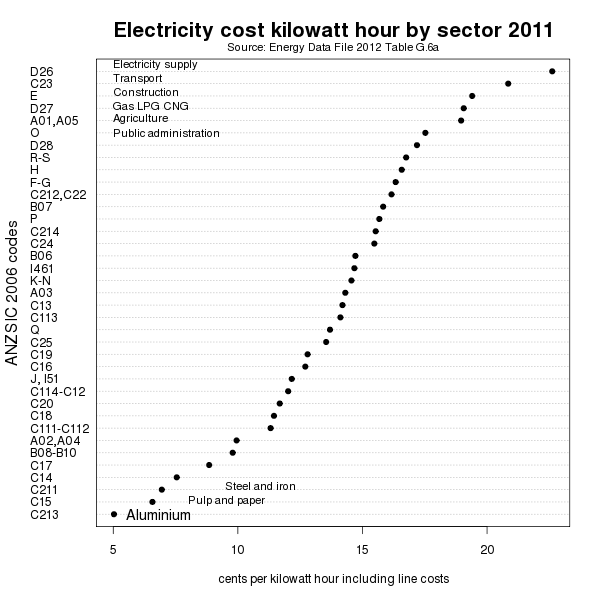
This dotchart is of electricity use data from the sheet G worksheet G.6.a.

The chart makes it very clear that the Tiwai Point Smelter is, by a huge margin, the biggest single consumer of electricity in New Zealand. A single company at a single plant used 5.3 million MWh out of 38.8 million MWh consumed in 2011, or 13.67% of the total consumption. Only the combined 4.4 million people in homes (the residential sector) used more, with 13 million MWh or 33% of the total. If we just look at industrial use of electricity, and leave out the residential sector, the smelter uses 20.6% of all electricity used by industry.

Electricity sales price by sector 2011

This chart shows industrial electricity sectors sorted by average rate (including line costs) in cents per kilowatt hour (i.e. its MWh divided by sales $$ times 100). You need to look at the bottom left hand corner for aluminium smelting, not the top. Thats because NZ Aluminium Smelter Ltd pays the very lowest average rate for electricity in New Zealand; 5.03 cents! Residential users pay 22.6 cents per KWh, or four times as much.

No industry in New Zealand uses more electricity than New Zealand Aluminium Smelters. No industry pays less per unit for electricity than they do. They even get excessively allocated emissions units to help with the lowest priced power contract in New Zealand. And now New Zealand Aluminium Smelters are going for "Godfather" gold by trying to bully their power price even lower.

Monday, September 3, 2012

How fast shall we drive over the cliff? More amendments to the New Zealand Emissions Trading Scheme

How fast shall we drive over the cliff

Robin Johnson's Economics Web Page looks at at the Government's amendments to the New Zealand Emissions Trading Scheme and concludes we are arguing about what gear to drive in as we speed towards the cliff. The Government has kindly given us the opportunity to make a submission about how fast fast we should go over the emissions cliff. Time to fasten your seatbelts.

Back in July, New Zealand Minister for Climate Change Issues Tim Groser announced more watering-down of the New Zealand Emissions Trading Scheme (NZETS).

About a week ago, on 23 August 2012, Groser introduced the amending legislation - the Climate Change Response (Emissions Trading and Other Matters) Amendment Bill.

Consistent with previous New Zealand emissions trading scheme legislation, the bill will be fully and rationally considered by Parliament's Finance and Expenditure Select Committee in an insultingly short period of time - ten working days. The closing date for public submissions is Monday, 10 September 2012.

What does this NZETS amending bill do?

  • It indefinitely postpones the entry of pastoral agriculture into the NZETS.
  • The 'two-for-one' deal, which halved the number of carbon credits each emitter had to surrender for a tonne of carbon dioxide equivalent greenhouse gases, is extended for another three years. It was to end on 31 December 2012, but will now run on at least to 2015.
  • The price cap of $12.50 per tonne ($25 for two tonnes) will also extended. It was to end on 31 December 2012, but will now run on at least to 2015.

What doesn't the bill do?

  • It ignores the recommendation from the 2011 ETS review committee to stop the unlimited use of international carbon credits by New Zealand emitters. Which as we know, makes the NZETS the weakest link.

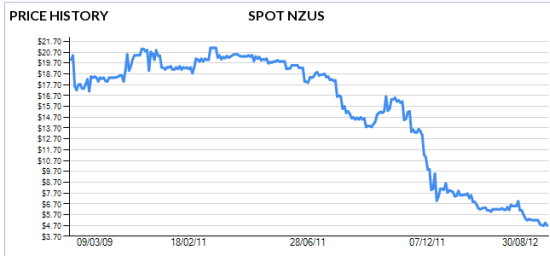
Whats the cliff we are driving off? Well, it's climate change. And it's the price of the New Zealand emissions unit.

NZ Unit price 2009 to 2012 from OMF Financial Ltd

Who said what about the bill?

Simon Terry of the Sustainability Council said that the NZETS is now in a state of eternal transition".

Former PM Helen Clark stated the obvious, that pastoral agriculture must be in the NZETS; “You can’t have your major sector generating greenhouse gases outside the scheme."

Federated Farmers said the deferral of agriculture was huge win for New Zealand's farmers

Business New Zealand seem unusually silent. I guess for them it is all going to plan. Back in July they welcomed Tim Groser's announcement of the delays to the NZETS. So why waste space repeating the message?

However, I do offer some relief from this dreary "business-as-usualism".

Green MP Kennedy Graham has given some strong speeches accurately reflecting both the scientific reality of the cumulative carbon dioxide emissions and the ethical challenge of the failure of politics and governance to respond.

None more so than in his 'first reading' speech in which he summed up the bill thusly.

"Today's bill will defer agriculture indefinitely, defer any increase in the price cap, defer the one-for-one surrender obligation, allow a greater switch from forestry to dairying, and enable importers to increasingly use dangerous synthetic gases. What remarkable, steel-like resolve!"

I do recommend you read Kennedy Graham's speech in full.

Graham, a much more experienced diplomat than Tim Groser, walks us through more than 20 years worth of futile international climate change negotiations, all the while as the relentless accumulation of emissions in the atmosphere uses up the carbon budget consistent with limiting warming to two degrees. And with no faux-realist "get people on the bus" cliches we have come to expect from Tim Groser.

Kennedy Graham concludes that we don't have to accept this state of affairs. He calls on us to make a submission to the Finance and Expenditure Select Committee.

Greenpeace are also saying get stuck in with a submission. What to say?

How about "the NZETS is completely ineffective in reducing GHG emissions due to it's many design flaws - the use of unlimited international junk credits, the delays and exemptions, the partial coverage, the lack of a cap, the price ceiling, the lack of revenue recycling due to the excessive free allocation to emitters."

Something brief and to the point.

However, I will leave the last word to Jeanette Fitzsimons speaking on TV Ones's Q+A: Panel after a Nick Smith/Russel Norman debate back in September 2011.

"Look, its like we are in a very fast car, we are heading towards a cliff, which is getting really close, and we are arguing whether to change from fifth to fourth gear".

Tuesday, August 28, 2012

Neil Armstrong the Moon landing and coal mines the NZ High Court moon-walks us to a hot place

Robin Johnson's Economics Web Page looks at Neil Armstrong, and the Moon-landing, and a NZ coal'n'climate change court case.

On the same day as the death of Neil Armstrong, the first astronaut to step onto the Moon, became public, the New Zealand High Court moon-walked its way to it's own off-the-world moment. It decided that greenhouse gas emissions and global warming are off-limits in the planning for an open cast coal mine. That's as just as 'out of this world' as denying that the Moon landings ever happened.

On Saturday, two bits of news struck home to me very strongly. The first was the death of moon-landing astronaut Neil Armstrong. The second was the decision of the New Zealand High Court that for new open-cast coal mines, their carbon dioxide emissions and global warming are legally and jurisdictionally unrelated in the Resource Management Act.

The moon landing. I remember very well as a seven year old listening attentively to the 'one small step' broadcast in 1969. The whole class was silent under the spell of our teacher's scratchy transistor radio.

It's one of my most strongly held memories of my child-hood. I guess that reflects well on that class of seven-year olds. They stopped playing bullrush, sniffing with colds, and fighting over play-lunchs to listen attentively to the unfolding of one of humanity's most historic moments.

While I was still fondly remembering the Moon landing, the next news item struck.

It was the New Zealand High Court decision barring discussion of carbon dioxide emissions when coal mines seek Resource Management Act consents (see Radio NZ, NBR and TV3 and the Otago Daily Times).

Of course this is about the Perth coal company Bathurst Resources and their Escarpment Mine Project.

Bryan Walker of Hot Topic has posted that this project represents New Zealand doing a Pontius Pilate and washing its hands of the emissions.

I have posted that the decisions by councils and the NZ Environment Court to date reflect the zombie ETS infecting the Resource Management Act with climate madness.

My Saturday morning reverie of the Moon landing was rudely stopped and I sort of grumbled to myself;

"Open-cast coal mines and global warming are unrelated!! Thats about as sensible as saying the Moon landings were faked by NASA. Neil Armstrong would just have smacked someone in the face!"

From small half-asleep reactions, blog posts do grow. With the wee footnote that it was actually Buzz Aldrin who punched the Moon landing denier.

I could do a review of the legal issues, but that would be just more legal-climate yadda yadda. I will just note that back in the early 1990s, the Bolger National Government considered the Resource Management Act to be one of the main tools to deal with global warming.

As for the science of it, I will just point to a couple James Hansen charts from his The Case for Young People paper.

The first is cumulative emissions of carbon dioxide. Approving new coal mines adds to cumulative global emissions of carbon dioxide. The second chart shows likely scenarios for temperature. The more carbon dioxide accumulates, the higher the likely temperature.

The facts are that each time a new coal mine is approved, we are just adding to the temperature overshoot above two degrees.

Why is it that the High Court can't apply this simple logic? Why are we even in a position where the High Court can sever the undeniable link between new coal mines, the volumes of carbon dioxide accumulating globally, and the inevitable temperature rise? What has has happened to our legal and planning systems to make this sort of decision possible?

To me this outcome - where the global effects of more GHG emissions are legally severed from approval of a new coal mine - is just as 'out of this world' as denying that the Moon landings even happened.

Monday, August 20, 2012

Nick Smith gases and fracks global warming for New Zealand

What has happened to the former New Zealand Minister of Climate Change Issues, the hon Dr Nick Smith? In March he resigned from all his ministerial offices when his conflict of interest in the accident compensation case of his National-insider friend Brownyn Pullar became public.

Well Nick Smith is back in the public spotlight and is promoting the extraction of unconventional gas via hydraulic fracturing.

Smith has written an op-ed in the New Zealand Herald Fracking the sensible choice for NZ.

Fracking technologies are underpinning an energy revolution in the United States. Huge unconventional shale gas resources in Louisiana and Pennsylvania are coming on stream, enabling gas to replace coal-fired electricity generation. Gas emits one-third the greenhouse gas emissions of coal.
If we do not find new natural gas resources in the next decade, energy prices will rise and we will inevitably burn more coal. New Zealand must be open to responsibly using fracking to access our unconventional gas resources.

So, according to Smith, from a global warming perspective, unconventional gas is implicitly okay as its emits one-third the greenhouse gas emissions of coal.

Smith concludes that NZ needs;

a strong economy and a clean environment. That will only be possible if we take a rational and science-based approach to our natural resources and risk management.

Hot Topic rightly calls this another Nick Smith fossil fuel fail.

Promoting unconventional gas development is not the an approach based on sound climate science.

Thats abundantly clear from James Hansen's talks in New Zealand in 2011. Did Dr Smith miss these?

Kharecha and Hansen, in their 2008 paper Implications of "peak oil" for atmospheric CO2 and climate. Global Biogeochem. Cycles, 22, GB3012, doi:10.1029/2007GB003142, have clearly told us that we can only keep carbon dioxide concentrations from exceeding about 450 ppm by 2100, if emissions from coal, unconventional fossil fuels, and land use are constrained.

The specific issue of whether a transition to conventional natural gas will actually reduce future greenhouse gas emissions is dealt with in Myhrvold and Caldeira (2012) Greenhouse gases, climate change and the transition from coal to low-carbon electricity.

The Carnegie Institute explains Caldeira and Myhrvold's conclusion; Only the lowest CO2 emitting technologies can avoid a hot end-of-century.

..in the case of natural gas—increasingly the power industry’s fuel of choice, because gas reserves have been growing and prices have been falling—the study finds that warming would continue even if over the next 40 years every coal-fired power plant in the world were replaced with a gas-fueled plant.

As Joe Romm says natural gas is a bridge to nowhere

Tuesday, August 7, 2012

New Zealand emissions trading scheme You are the weakest international link Goodbye!

Robin Johnson's Economics Web Page argues that the New Zealand Emissions Trading Scheme (NZETS) is "the weakest link" due to it's high exposure to the international carbon market. The strong "international linkage" is the the other side of the coin of the uncapped design of the NZETS. Both features reinforce just how ineffective the NZETS is in providing an incentive to reduce greenhouse gas emissions.

Who remembers the The Weakest Link? The quiz show with Anne Robinson the disciplinarian female host with the popular catchphrase "You are the weakest link. Goodbye!"

Yes that's today's bonkers metaphor for another wonky post on the New Zealand emissions trading scheme. In addition to the observation that I would love to say "NZETS you are the weakest link. Goodbye!" there really is a relevant connection to the economics literature.

"Linking" of emissions trading schemes means that units from one emissions trading scheme (ETS) can be imported and surrendered by emitters regulated by a different ETS. There are papers and blog posts about international linkage.

The key economic benefit claimed for linking two or more ETS, assuming that they are otherwise sensibly designed, is that the lowest-cost ways of reducing emissions within the linked schemes become available (via emissions trading) to the emitters of the linked schemes.

An example. Pastoral agriculture may or may not have low-cost ways of reducing emissions. If agriculture has relatively high mitigation costs, then you are doing agriculture a favour by including it within a national all-sectors ETS, rather than just in an agriculture ETS. Agriculture can then just buy 'ways of reducing emissions' in the form of units from the cheapest seller - the emitter who can reduce emissions at a lower cost.

Not surprisingly, New Zealand's Minister for Climate Change (and Trade), Tim Groser, is very keen on linking international emissions trading schemes. Groser also does not want the New Zealand price for emissions units to be "dislodged" from the international price. Well that wouldn't be lowest-cost, would it?

However, this is all context for two recent reports on the NZETS in the 2011 calendar year. Last Friday, the New Zealand Ministry for the Environment (MfE) released 'NZ ETS 2011 Facts and figures'. Earlier, in July, the New Zealand Environmental Protection Authority (EPA) released its report on 2011 unit surrenders and allocations, the Section 89 Climate Change Response Act report.

This table sums up the Ministry's report.

In 2011, 16.3 million units were surrendered by New Zealand emitters. Of which, 11.7 million units were imported international units (being 4.2 million CERs, 4.3 million ERUs and 3.2 million RMUs.)

Reaction to the report was swift. Carbon foresters decried the fact that foreign units were swamping the NZ ETS in 2011 at the expense of units from NZ forestry. "..foreign carbon was the credit of choice for emitters in 2011. International credits comprised a whopping 71% of all units surrendered for compliance.."

BusinessDesk noted the that big emitters had chased the cheap foreign carbon units in preference to NZ units as European carbon prices dropped to historic lows, dragging NZU prices as low as low as $4.50 to $5 per tonne of carbon last week.

Another forester said the NZETS was now a Claytons ETS (no doubt having forgotten that Colin James said 'Claytons emissions trading scheme' first).

Kennedy Graham of the Greens said there was no incentive for NZ polluters to reduce emissions. Kennedy hits the nail on the head.

I don't disagree with any of these sentiments. The importing of 11.7 million international units really spells out the "weakest international link" design flaw of the NZETS.

But for me the key point is not the number of units imported, it is that the unlimited importing of international units has been hardwired into the design of the NZETS since the Labour government's 2007 The Framework for a New Zealand Emissions Trading Scheme document.

And if a small market where the compliance demand is 16 million units can import units from the international market where 977 million units exist, then a cap on domestic emissions is never going to be possible.

Thats why the New Zealand Emissions Trading Scheme really is the weakest (international) link.