Showing posts with label australia. Show all posts
Showing posts with label australia. Show all posts
Sunday, February 19, 2017
The simple truth: Coal-fired generators have no future in Australia
Lots of high quality energy and climate articles in he Australian press this week.
* The simple truth: Coal-fired generators have no future in Australia
Thursday, January 26, 2017
Revisiting Australia's ground-breaking first commercial solar power plant at White Cliffs
The ABC has a look back at Australia's first commercial solar thermal power plant, at White Cliffs in NSW - Revisiting Australia's ground-breaking first commercial solar power plant at White Cliffs.

Located about 250 kilomtres east of Broken Hill, the $1.9 million plant generated electricity from 1982 until 2005, using two different technologies.Initially, the solar thermal power station concentrated the sun's energy to produce steam from water which was used to drive a steam engine/generator system. In 1997 it was transformed using the latest photovoltaic (PV) technology, with the cells directly converting the concentrated sunlight to electricity.
A look back at Australia's first commercial solar power plant https://t.co/Hff4Q1dzcu via @ABCNews
— Big Gav (@biggav) January 26, 2017
Thursday, December 8, 2016
Australian Government killed emissions scheme despite knowing it could shave $15 billion off electricity bills
The Australian government seems to be copping a lot of bad press over their failed energy policies, backflipping on a rare attempt at common sense on carbon pricing earlier this week and now being asked to explain why they are keeping energy prices artificially high.
* Australian Government To Reintroduce Carbon Pricing ?
* Australian Government killed emissions scheme despite knowing it could shave $15 billion off electricity bills
Sunday, September 15, 2013


Saturday, September 7, 2013
Australian Election 2013: Abbott government could be worse than we feared
Cross posted from Peak Energy.
Judging by the polls it seems that tomorrow's election is going to result in us having a turnip for Prime Minister for the next 3 years (barring some sort of miracle that results in Malcolm Turnbull replacing Abbott during that period). The Murdoch media and the sorry remnants of the Fairfax press have been fervently supporting this result for the entire campaign (with the lone exception of The Age) which I tend to think has tipped the outcome from closely fought to a comfortable win to the LNP coalition.
The result of the last election was pretty much perfect from my point of view, with Greens and principled independents like Rob Oakeshott, Tony Windsor and Andrew Wilkie (along with occasionally entertaining mavericks like Bob Katter and Nick Xenophon) holding the balance of power in both the lower and upper houses of parliament, preventing the Liberals from governing and ensuring that Labor couldn't give in to it's own worst instincts too often (though they did manage to backstab Wilkie along the way).
Things are still looking relatively hopeful in the Senate, with a reasonable chance of the balance of power still being held by the Greens and Independents which means the election will still be of some interest (and Abbott may yet be hobbled when he gets into power - I wonder if he'll be parroting Paul Keating's "unrepresentative swill" comments this time next week) - and if that doesn't work out you can always play a drinking game.
The Economist and The Guardian are the only other periodicals I could find recommending the current government be re-elected (which is unsurprising given their basically flawless economic track record over the past 6 years), though I don't imagine they'll be swaying too many voters tomorrow.
The Guardian has a last minute poll showing the gap is closing (hopefully its accurate) after the coalition released their policy costings a day before the election, trying as hard as possible to avoid any policy scrutiny beyond their endless "stop the boats" nonsense.
Its been a recurring dream of mine that someone would put billboards up along every freeway showing how many legal immigrants were allowed in under the Howard government compared to the number of refugees who arrived by boat - perhaps the 1 million+ legals to a few thousand illegals disparity might make the gullible closet racists of the outer suburbs realise they are being hoodwinked by this tripe.
The opposition leader, Tony Abbott, and the Coalition have chosen to treat the democratic process with contempt, presumably because the polls, clearly pointing to their victory, make them believe they can. They have comprehensively evaded scrutiny, with no policy costings until 48 hours before the ballot. For months, there has been a blank space where their policies should be; candidates have been discouraged from speaking to the media and even from attending forums in their own communities; access has been denied to journalists who don’t toe the party line.ReNew Economy thinks that Abbott will eviscerate clean energy programs if he gets the chance - Election13: Abbott government could be worse than we feared.The Coalition has been steadied by a new Tony Abbott whose ruthless focus is in contrast to his past reputation for ill-discipline. His paid parental leave scheme, which rewards the wealthiest most, is at least an attempt to rectify his poor record when it comes to women. But really the Coalition has been relying on the exhausted electorate’s distrust of Labor after their self-obsessed infighting, and the view that it’s time someone else had a go. But do those voting for Tony Abbott really prefer Christopher Pyne to Bill Shorten, Andrew Robb to Penny Wong, Peter Dutton to Tanya Plibersek? Are they really happy to lay waste to Australia’s unique environment, just because it feels like someone else’s turn? Are they not alarmed by hints at spending cuts that go as far as austerity, which has wreaked such devastation in Europe?
Oh dear. This could be worse than we thought.Over the past year, RenewEconomy has been highly skeptical about the Coalition’s approach to clean energy and climate change policies. In July last year we wrote of “the scary vision of the right” regarding future energy policies. Two months ago, we caught Opposition leader Tony Abbott dog-whistling to climate change deniers. In August we warned people not to be fooled by bipartisan targets.
That was just a small sample of our reservations. This week came the proof in the pudding: The Direct Action policy is not designed to meet any emission reduction at all, and Abbott confirmed he still thought the science was crap, despite the various leaks coming from the IPCC. Renewables do not even get a single positive mention in the Coalition’s newly released energy policy.
Were we being too pessimistic, as many people suggested? Depressingly, we don’t think so.
The bitter frustration is that – with a very few exceptions – none of this was investigated or probed by the mainstream media, which has retained a myopic obsession over forward estimates, the outlying budget forecasts that surely must rank as the most irrelevant and unreliable metric that has ever been centre stage of an election campaign.
In the end, some of the main policies were indistinguishable between the major parties, to the point where Tony Abbott is now longer promising to stop the boats, just to slow them down (and to keep them off Sydney’s freeways). The budget savings outlined by Joe Hockey are so insignificant it makes a mockery of the budget scare campaign that obsessed the media, and provided cover for Abbott’s empty rhetoric. The only real difference came in climate and clean energy, and Labor was so terrified of playing that card that nobody noticed.
This myopia was reflected in the editorial endorsements published today. Extraordinarily, the Australian Financial Review, the Sydney Morning Herald, and The Australian (along with every other Murdoch tabloid) endorsed Abbott without making a single mention of climate change or clean energy policies. So much for it being a referendum on the carbon price. Only The Age made mention of it, noting the Coalition’s disgraceful “back-tracking” on climate. It endorsed Labor.
Are we obsessed with niche interests? Maybe. But the cost of carbon and electricity were central to the cost-of-living scare campaign that will contribute to the Coalition’s victory. Climate change and the transition to a low carbon economy will be central to Australia’s future economic performance. ...
So now we find ourselves at the eve of an election victory and the introduction of a policy that remains a mystery. Does anyone know what Direct Action is? No. Has it been costed? No. Will it be able to meet more ambitious climate policies? Of course not. Was it ever designed to? Don’t be silly.
Of more immediate concern is the future of the large scale renewables industry, which could be worth more than $20 billion in the next few years, but which is now surely in limbo.
In July, we itemised five ways that Abbott could kill renewables in Australia. And he’s just about there. Repeal the carbon price? Tick. Review the renewable energy target with a view to diluting it or delaying it? Tick. Dissolve the Climate Change Authority? Tick. Dissolve the Clean Energy Finance Corporation? Tick. Slash funding for the Australian Renewable Energy Agency? Tick.
Abbott may not get to be able to achieve all those things immediately, but his intentions are clear. The energy document produced this week made no mention of renewables apart from a desire to do something about wind energy. Its focus was entirely on extractive fossil fuels – coal, gas, oil, LNG, and thorium. Dig, baby, dig. Burn, baby burn. And it wanted to make the coal-fired generators profitable again.
The energy policy document makes no mention at all of the major themes that are and will impact most on the energy industry (particularly the coal generators). They are: reduced demand, the push for efficiency, and the proliferation of rooftop solar and other forms of distributed generation. These will, as surely as night follows day, challenge the centralized business model so treasured by the incumbents and their conservative mouthpieces.
The entire power base of the Coalition seems wedded to a utopian dream from the 1960s. It seems the only thing that can deny them is their access to capital that the centralized generation and vast networks require. Residential-scale solar and distributed energy happens in increments that are, at most, a couple of tens of thousands of dollars. Australian households have already put $8 billion, and are prepared to invest billions more.
These bets are 100,000 times smaller, and it brings millions of competitors into the electricity game. This is where the issue of costs and equity will be fought in coming years. The fact that the Coalition does not even mention this in its flagship energy document suggests it is completely ill prepared. Or it will simply defend the conservative state owned governments that are trying to sell their impaired assets.
Sunday, September 1, 2013
A Floating LNG revolution in Western Australia
I've got a post at Peak Energy on Woodside's decision to build 3 floating LNG plants for the Browse basin project off northern Western Australia - Floating an LNG revolution in Western Australia.
Monday, December 5, 2011
Chart of Australian Oil Consumption and Production
This graph of Australian oil consumption and production is based on the BP Statistical Review of World Energy June 2011. I prepared it for a local government workshop later this week and thought I'd post it here for others to use.

Australia is one of very few OECD countries where oil consumption is still rising in this high oil price environment, albeit slowly. You can thank the resource economy for that (and the related strength of the Australian dollar).

Australia is one of very few OECD countries where oil consumption is still rising in this high oil price environment, albeit slowly. You can thank the resource economy for that (and the related strength of the Australian dollar).
Monday, November 21, 2011
Why solar parity scares big utilities
The Climate Spectator has another article on how renewable energy can bring power prices down - Why solar parity scares big utilities.
Thursday January 29, 2009, was a big money day for Victoria’s brown coal generators.
After a night of uncomfortably warm temperatures, and a dawn reading of 32°C, Victoria’s residents turned to their air-con and pedestal fans in near record numbers. By 9am, demand had spiked so high that electricity prices had soared to $10,000 a megawatt hour as utilities switched on every last generator they could find to meet demand. These wholesale prices are normally between $35-$50/MWh.
During that day, which reached a peak of 44.3°C in Melbourne in mid afternoon, the wholesale electricity price never fell below $1,000/MWh. For nearly four hours, it hovered around the $10,000/MWh price. The way the National Electricity Market works means that every generator switched on at that time receives that price, even though it still only cost the brown coal generators around $4/MWh to shovel the coal into their power plants. Over an eight-hour period, the state’s generators would have pocketed an estimated $550 million in revenue, near one fifth of their total revenue for the year.
It was, needless to say, an absolute jackpot for the generators. But while this was an extreme case, it was not an atypical event in the NEM. It is estimated that, on average, around one quarter of the revenue from electricity sales each year is generated from the prices gleaned from around 24-36 hours of peak production. The business models of the energy utilities depend on it. But now those models are under threat.
What, for instance, would have happened that day to electricity prices had there been large amounts of solar deployed along the eastern seaboard available to meet demand? According to modeling conducted by the Melbourne Energy Institute at the University of Melbourne, 5 gigawatts of solar PV would have been very effective in curbing peak demand. Prices would still have spiked, but not over $300/MWh, and for shorter periods. The total revenue for the day would have been just over $340 million – half of what it would otherwise have been.
This is what is known as the merit order effect: the effect technologies with a short-run marginal cost – i.e. with fuel that costs next to nothing, such as solar, wind – have on the market when they deliver electrons en masse to the grid. The overwhelming evidence from Australia and overseas is that they bring the wholesale cost of energy down, sometimes so much that the reduction in prices is greater than the cost of the subsidies that got them built in the first place. And established utilities with higher-cost fuel, such as coal and gas, don’t like it one bit, and are suddenly realising the extent of the threat to their business.
Normally, the overnight load in Victoria stands at around 5.5GW, not enough to even meet the output of all of the state’s coal-fired generators. Wholesale prices barely meet the cost of production. At 8.5GW of demand, an average high-load weekday, peaking gas generators are required and the wholesale price jumps to around $70/MWh. The coal-fired generators make money. But would this still be the case if 1.5GW of solar was available? The Melbourne Energy Institute says not; it would mean that gas-fired utilities normally brought into the grid would not be required and the wholesale price would remain at modest levels.
This might explain why state governments, in Victoria and NSW in particular, are happy to delay the rollout of renewable energy at a large scale. As noted here before, Victoria’s decision to defer an increase in its state-based renewable energy target was motivated by the potential impact of the merit order effect on the state’s coal-fired generators. Right now, the deployment in both wind and rooftop solar is at a virtual standstill because of policy uncertainty. That suits the established generators just fine.
Mike Sandiford, the director of the Energy Research Institute at the University of Melbourne, says that in the case of solar, this is simply delaying the inevitable. Grid parity – and the deployment of solar at a scale that the modeling contemplates – is coming whether the governments and the utilities like it or not, and it’s time policy makers faced up to the issues that it presents.
“We can either hide from grid parity or we can embrace the challenges,” Professor Sandiford said. “All we ever hear is that it is expensive, can’t deliver, or is not worth investing. We rarely hear of the opportunities.” The modeling of the 5GW solar scenario was extended to cover the entire 2009 and 2010 years. It found merit order savings of $1 billion in the first year and $600 million in the second, and avoided transmission and distributed investment.
As those figures show, it’s not just the generators that are impacted by this, it is the network operators as well. NEM data shows that while peak demand is growing, mean demand has plateaued and is now falling, possibly as a result of rising electricity prices, more solar PV, the merit order effect, or even the benefit of the pink batt program.
This divergence has meant that more infrastructure is being built to meet peak demand and is being used less during the day. And despite spending billions on network upgrades, and contributing well over half of the increased retail prices, the industry is losing productivity at a rate of 1 per cent a year. In most industries, this would be untenable. A dramatic increase in distributed energy such as solar would force the network operators to revisit the means to make money.
Professor Sandiford says most of the pubic discussion around feed-in tariffs and other green incentives is to pitch them as a form of regressive tax. That, he says, is way too simplistic. “There are other values here. It can shave peak demand, and it mitigates against extreme prices,” he says. “We are using less electricity at medium prices and more at the peak. It is important to know the answers to these problems before we go off spending. Whether we like it or not, it is going to hit us. We should try and understand what these issues are.”
Saturday, November 12, 2011
100% renewables, no hot air
Zero Carbon Australia's Matthew Wright has a response to a recent competing proposal for 100% renewable energy from UNSW's Mark Diessendorf - 100% renewables, no hot air.
The Zero Carbon Australia Stationary Energy project has paved the way for Australian researchers to contribute their best scenarios for transitioning to a 21st century renewable powered economy in a decade.
When we first set out on the momentous task to write the plan, recruiting dozens of engineers, physicists and scientists, we really hoped that we would create a competition around the goal on who could write the best scenarios for transition. We wanted to see reports like ours being written by state and federal governments, public and private research institutions and universities. We congratulate UNSW for being the first institution to take up the challenge.
As the community partner in the ZCA project, Beyond Zero Emissions welcomes the UNSW’s contribution with its soon to be released scenario for taking the economy to 100 per cent renewable energy.
Before we can discuss the merits of their proposal, we need to consider the two schools of thought on how to achieve a completely decarbonised economy: those who think we should have a fossil fuel powered "transition;" and those who think that transition using fossil fuel “lite” technologies – namely fossil gas – is a diversion, not a shortcut. Beyond Zero Emissions fit into the latter category while the UNSW fit somewhere in between.
Based on what is known about the UNSW plan, the research recommends building gas peaker plants to generate 14 per cent of Australia’s electricity needs. These plants would run on fossil gas – which would include petroleum gas and coal seam gas – and switch to gasified biomass at an unspecified point in the future.
We believe that it is simplistic and naïve to believe that fossil gas feedstock will be replaced with biomass feedstock, and think that future scenarios from universities and environmental organisations will send a green light to oil and gas companies Origin Energy, AGL, Santos, etc, to proceed with their massive expansion of coal seam gas in the food producing areas and forests of NSW and QLD; not to mention their intentions for Tasmania, Victoria, West Australia and their shale gas dreams in SA.
Even if the switch to biomass was contemplated on the studies' proposed scale, BZE’s research team had already looked seriously into biomass burning for the specific task of addressing reduced solar and wind resources in the winter. After diligent analysis, it was decided that a combination of overcapacity and biomass co-firing would be the best, least environmentally damaging and cheapest way to meet the more challenging winter demand.
The UNSW team, by their own admission, hasn’t done the economics on their transition plan, and so Beyond Zero Emissions can’t actually comment on the costs directly. What we do know is that our researchers ruled out the gasification of biomass due to the lack of demonstrated commercial-scale projects, the lack of project pipeline and known cost curves, and the fact that storage wasn’t demonstrated on any scale.
The UNSW use of biogas or biomass gasification was investigated, however research found that no technology existed on the scale needed and the costs quoted were as much as 10 times the cost of transporting biomass pellets. Palletisation as chosen by the Zero Carbon Australia team is a very well known process, with a significant scale industry operating in Europe and the US.
The challenge for the UNSW team is to either size their gas production for the maximum peak demand of their turbines, which I would expect would be in the order of 20-50GW of capacity, or to add storage for their gasified biomass, which is a costly option. The UNSW proposals might combust hydrogen and carbon monoxide directly, or alternatively reform the gasified biomass into methane, but both these options would prove to be very expensive. We are confident that our plan will be cheaper than the UNSW plan if they decide to stick to their choice of gasified biomass.
Gas generation is the most notable difference between the Zero Carbon Australia plan and the UNSW scenario but it’s not the only one.
The ZCA included a significant energy efficiency program, the most ambitious one proposed to date, which shows how we can deliver half the end use energy we currently deliver. How we do that is being comprehensively detailed in the work of the Zero Carbon Australia Buildings plan, which will be published in February next year.
Then there’s our plan to link the main electricity grids in Australia: the Mount Isa mine grid in the north and the eastern seaboard grid with the West Australian grids. This proposed updating of infrastructure is on par with what’s happening in China, in South America, and serious plans to connect North Africa and the Middle East to Europe. Our plan to link eastern and Western Australia with HVDC, creating a national grid, is consistent with the recommendation of Siemens Australia. The cost of this technology has come down since we researched and produced our report.
In his article last month, UNSW's Mark Diesendorf questioned whether Australia has the available labour force to build the renewable energy system, even though it is adequately addressed in the ZCA plan. When the coal industry is set to triple in size, we hear a bit about capacity constraints, but nobody concludes it’s a showstopper. When the gas industry decides its going to build $100, $200 or even $400 billion worth of LNG trains, no one says that it can’t be done because of capacity constraints. Not only does the same logic apply to a rapid rollout of renewables, but workers are crying out for jobs in the renewable powered cleantech economy.
Tuesday, November 8, 2011
Oz Carbon Tax Passes Senate
The Australian "Carbon Tax" has been passed in the Senate and will become law. It remains to be seen if Tony Abbott, should he get elected, follows through with his hubristic and dogmatic threats of repealing the law.

The Greens are understandably pleased.
Mining interests and The Australian have predicted this will trigger the imminent demise of the entire Australian economy, even though the more likely threat is due to financial problems in Europe. Piers Akerman (hat tip Deltoid) dredges up the old Dark Ages analogy to describe the horror that is about to befall us all at the hands of the "Green Cultists" who, for some unexplained reason want to rain doom on us all.
I guess we all have our own favourite falling sky to fret over...
I guess we all have our own favourite falling sky to fret over...
Finally, carbon tax becomes law
The Age, Nov 8.The Labor government has finally got its carbon price plan through the Senate — on a vote of 36 to 32.Carbon facts: how the package will roll out
The Age, Nov 8.How the clean-energy package will roll out:
Carbon emissions tax for the 500 biggest polluters starts on July 1, 2012.Tax moves to an emissions trading scheme in 2015.
Tax begins at a fixed price of $23 a tonne and rise by 2.5 per cent a year until 2015.Tax will not apply to agricultural emissions or light on-road vehicles.Electricity generation, stationary energy, some business transport, waste, industrial processes and fugitive emissions will be covered by the initial tax.
Average households will see a $9.90 weekly cost rise.Average households will receive assistance of $10.10 weekly.Free carbon permits will be the given to the most emissions-intensive and trade-exposed industries.
The government wants to cut pollution by 80 per cent by 2050.
Monday, November 7, 2011
Wind like Spain? It's a no-brainer
The Climate Spectator has an article from Matthew Wright urging Australia to follow Spain's example in the adoption of wind power - Wind like Spain? It's a no-brainer.
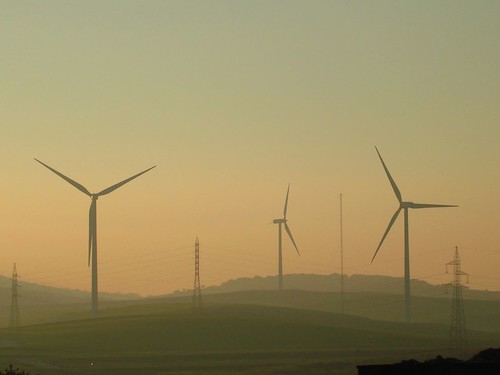
Wind power has the support of the majority of Australians, so it's painful to hear a small minority, most of them backed by fossil fuel interests, undermining one of the great universally available energy sources to power the world out to 2100. It is telling that the technology has very few detractors in those countries that aren't big net fossil fuel exporters.
As of this year, Spain has 20,000 wind turbines. If these were transplanted to Australia they would easily power our biggest state. That’s because wind turbines in Australia produce twice as much electricity as those installed in Spain, due to our superior resource.
With over 21,000MW capacity installed, Spain is 18 per cent wind powered and, with annual electricity demand the same as Australia's, is doubling their wind capacity by 2020. It's still full steam ahead on Spain's renewables program, despite a housing boom/bust that has sent their economy into a tailspin and caused over a million construction workers to lose their jobs.
Spain enjoys lower wholesale energy prices thanks to wind power, due to the merit order effect. Wind power significantly drives down electricity prices – and Australians, in 2011, are still missing out on the benefits of the price-lowering effect that large-scale wind deployments can deliver.
Using a fleet of modern Enercon E-125 or Siemens 6MW wind turbines, for the same installed capacity we would generate twice the amount of annual electricity generated, and we'd get twice the annual contribution of wind to our electricity mix. In other words we'd be on 35 per cent renewable electricity today.
It's a no brainer; to achieve the same amount of electricity as Spain from wind would come at a 75 per cent discount to what the Spanish have invested. That's because of the combination of "buy one get one free" – our wind resource generates twice as much as theirs and we're starting in 2011, 15-20 years after the Danes, Spanish and Germans who have done the heavy lifting and got the technology down the cost curve. Add to that the bonus that comes from the much cheaper turbines coming out of China exerting downward pressure on European turbine prices and you have a very cheap, well tested renewable resource. Time to get on with the job.
I’d hate to call it bludging, but we are also benefiting from the heavy lifting of countries like Denmark, Germany and Spain through their deployment programs to date. These European leaders have really got wind turbines (along with other renewable technologies) down the cost curve through the optimum combination of deployment – learning through doing and public and private research and development.
Many of Spain's turbines are older models. The new ones are more efficient, taking up as much as a third less space on the ground than much of the fleet in Spain, leaving more area for existing uses such as cropping. Australia, with 15 times the land area, and a huge choice on wind resource, could achieve 50 per cent wind with as few as 7,000 modern turbines. Or, with the same installed capacity as Spain, we would be getting 40 per cent of our electricity from wind and at a 75 per cent discount.
The potential for Australian wind doesn't stop there. Spain is on target to double their wind capacity to 35 per cent by 2020. With a practical near-term target like that we know that Australia could easily be getting 50 per cent of our energy from wind in a similar timeframe, with our combination of favourable conditions, less turbines, better sites, twice the output, half the cost, much bigger land area, better opportunities geographical distribution leading to better meteorological diversity, as well as much lower density of population and easier to access sites.
But Spain will actually have enough wind turbines to produce 70 per cent of our electricity by 2020. So what would happen if we installed that much capacity of wind here? Studies have already been done that give us an idea: they show that in the UK and Denmark, with 40 per cent penetration, 4 per cent of wind is actively curtailed and at 50 per cent, 7 per cent is to be curtailed.
That is, if we install wind turbines across the grid with an annual capacity factor so they are able, theoretically, to deliver 54 per cent of our electricity, due to a number of hours of oversupply and some transmission constraints, 7 per cent active curtailment would mean that 50 per cent of our energy would actually come from wind.
Thursday, October 13, 2011
Trans-Tasman Emissions Trading Scheme Challenge Part Two
Robin Johnson's Economics Web Page cross posts on a trans-tasman emissions trading test.
Yesterday the Australian Parliament adopted legislation for its greenhouse gas emissions trading scheme.
So I thought I would write another post on the theme of the "Trans-Tasman Emissions Trading Scheme test series", this time looking at the key differences between the New Zealand Emissions Trading Scheme and the Australian Emissions Trading Scheme. The number one key difference between the two emissions trading schemes is in how clearly each scheme sets the carbon price.
Unequivocal carbon price vs volatile carbon price.
Unlike the NZ ETS, the Australian ETS will set an absolutely clear and unequivocal price on greenhouse gas emissions.
The price will be $AU23 per tonne from 1 July 2012, then $AU24.15 in 2013-14 and $AU25.40 2014-15 (Securing a Clean Energy Future, The Australian Government's Climate Change Plan, p 26). From 1 July 2015, the carbon price will float within and upper and lower ceiling with the Government setting an overall 'Cap' or limit on GHGs (Securing a Clean Energy Future p 27).
The price for "New Zealand Units" under the NZ ETS is being set at a discount to the price of international Kyoto units in the volatile international carbon. So the NZ price is ...well...it's yeah whatever. As in this chart for 2010. Note that the Australian minimum carbon price of 23.00 Australian Dollars converts to 29.50 New Zealand Dollars? The price of 29.50 NZ dollars is off the vertical scale of this chart!

And as in this updated chart for September, showing the fall in the international price driven by the Euro-Zone debt crisis is further pushing the NZ unit price down.

This direct importing of the international price into the NZ unit price is because of two intrinsic design features of the NZ ETS.
The NZ ETS has no cap on domestic GHG emissions and no cap on free allocation of units to emitters. The NZ ETS is highly linked to international markets. It allows almost all international Kyoto units to be imported and surrendered by emitters.
So an emitter would say to a seller of NZ units "Why should I buy your NZ units instead of international units, which I could sell in a much wider market, unless the NZ units are at a discount?"
Of course, the Australians, influenced by Ross Garnaut and Bob Brown of the Green Party, are not having a bar of this price volatility. In terms of the economics literature, this is absolutely the right way to go.
A clear and consistent carbon price out for several years will clearly signal to emitters which emission reduction technologies to adopt - ones that will break even at the set carbon price! The same goes for developers of windfarms and producers of biofuels. A clear carbon price into the future will give investors confidence that they will not lose their shirts putting capital into windfarms and biofuel plants. Carbon price volatility, like in New Zealand, just makes investment in either mitigation or substitution of fossil fuels a bad bet.
So why on earth would a big industrial emitter want to have an emission trading scheme like New Zealand's where they have an unpredictable and volatile liability to pay a carbon price instead of an unequivocal and consistent-over-time carbon price as set out in Australia's scheme?
The only answer I can give is that if like Rio Tinto NZ Alcan Limited, you are given more emissions units than you need for your actual emissions then it just doesn't matter what the price is.
Yesterday the Australian Parliament adopted legislation for its greenhouse gas emissions trading scheme.
So I thought I would write another post on the theme of the "Trans-Tasman Emissions Trading Scheme test series", this time looking at the key differences between the New Zealand Emissions Trading Scheme and the Australian Emissions Trading Scheme. The number one key difference between the two emissions trading schemes is in how clearly each scheme sets the carbon price.
Unequivocal carbon price vs volatile carbon price.
Unlike the NZ ETS, the Australian ETS will set an absolutely clear and unequivocal price on greenhouse gas emissions.
The price will be $AU23 per tonne from 1 July 2012, then $AU24.15 in 2013-14 and $AU25.40 2014-15 (Securing a Clean Energy Future, The Australian Government's Climate Change Plan, p 26). From 1 July 2015, the carbon price will float within and upper and lower ceiling with the Government setting an overall 'Cap' or limit on GHGs (Securing a Clean Energy Future p 27).
The price for "New Zealand Units" under the NZ ETS is being set at a discount to the price of international Kyoto units in the volatile international carbon. So the NZ price is ...well...it's yeah whatever. As in this chart for 2010. Note that the Australian minimum carbon price of 23.00 Australian Dollars converts to 29.50 New Zealand Dollars? The price of 29.50 NZ dollars is off the vertical scale of this chart!
And as in this updated chart for September, showing the fall in the international price driven by the Euro-Zone debt crisis is further pushing the NZ unit price down.
This direct importing of the international price into the NZ unit price is because of two intrinsic design features of the NZ ETS.
The NZ ETS has no cap on domestic GHG emissions and no cap on free allocation of units to emitters. The NZ ETS is highly linked to international markets. It allows almost all international Kyoto units to be imported and surrendered by emitters.
So an emitter would say to a seller of NZ units "Why should I buy your NZ units instead of international units, which I could sell in a much wider market, unless the NZ units are at a discount?"
Of course, the Australians, influenced by Ross Garnaut and Bob Brown of the Green Party, are not having a bar of this price volatility. In terms of the economics literature, this is absolutely the right way to go.
A clear and consistent carbon price out for several years will clearly signal to emitters which emission reduction technologies to adopt - ones that will break even at the set carbon price! The same goes for developers of windfarms and producers of biofuels. A clear carbon price into the future will give investors confidence that they will not lose their shirts putting capital into windfarms and biofuel plants. Carbon price volatility, like in New Zealand, just makes investment in either mitigation or substitution of fossil fuels a bad bet.
So why on earth would a big industrial emitter want to have an emission trading scheme like New Zealand's where they have an unpredictable and volatile liability to pay a carbon price instead of an unequivocal and consistent-over-time carbon price as set out in Australia's scheme?
The only answer I can give is that if like Rio Tinto NZ Alcan Limited, you are given more emissions units than you need for your actual emissions then it just doesn't matter what the price is.
Thursday, October 6, 2011
From brown coal to solar thermal
The Climate Spectator has a report on some positive thinking in South Australia, where Alinta is considering converting an old coal fired power station to a solar thermal power generator - From brown coal to solar thermal.
The owners of Australia’s most polluting coal-fired power station, the Playford plant in South Australia, are considering converting it to a solar thermal facility if it is closed as part of the government’s proposed buyout of brown-coal generators.
Jeff Dimery, the head of the now privately owned Alinta, said solar thermal technology was one of two options being considered after the closure of the 240MW Playford, and may be an easier option than trying to source gas for a gas-fired peaking generator, as there is no gas pipeline to Port Augusta.
“We’re exploring the idea of building a renewable facility and integrate that with baseload (from the remaining northern station) and solar thermal would be ideal, as there a good sun resource in the region,” Dimery told Climate Spectator in an interview. “The technology requires funding, and it’s a case of needing to convince government that it is one of better projects. We intend to explore it.”
Playford is one of four brown coal generators eligible to make a tender for the government’s proposed buyout, which intends to remove 2000MW of brown coal generation from the grid by 2020 in order to reduce emissions, and create room for gas-fired generation or renewables to be built in their place.
The solar thermal idea will not form part of Playford’s submission – apparently it matters not what the owners of the retiring generation plant intend to do with the funds (and some may be expected to expatriate those funds overseas), but Dimery is confident that Playford would be an attractive option in any case. For a start, it’s the most polluting, at 1.7t of Co2e/MWh, the early closure of 240MW would have little impact on the National Energy Market, and the workforce could be absorbed at the neighbouring 520MW Northern Power Station without any forced redundancies. That could save on government funds.
The other attraction of solar thermal is that it could be integrated into the Northern Power Station, pre-heating boilers in the same way that a solar booster plant will be designed to do at the Kogan Creek power station in Queensland, and/or putting electricity directly into the grid.
Thursday, September 15, 2011
Australia to host geoengineering conference
The Brisbane Times reports that a geoengineering conference will be held in Canberra later this month - Australia to broach radical global warming solutions.
Cross-posted from Peak Energy.
Clouds could be made more reflective and oceans fertilised to increase carbon dioxide absorption under ideas to be discussed at Australia's first high-level climate engineering conference later this month. International interest in climate engineering – also known as geoengineering – is increasing as efforts to curb the world’s emissions of greenhouse gases continue to falter.
Scientists said the event was an important step for Australia into the controversial geoengineering debate but expressed grave concerns some proposed technologies could have dangerous and far-reaching side effects.
The two-day science symposium, starting in Canberra on September 26, is being hosted by the Australian Academy of Science and the Australian Academy of Technological Sciences and Engineering. Among the more controversial ideas being discussed is the injection of sulphur particles into the stratosphere to reflect sunlight and slow global warming.
Other technologies include fertilising oceans to increase uptake of carbon dioxide and spraying aerosols into the atmosphere to increase the reflectiveness of clouds. But the meeting will also cover relatively benign ways to pull greenhouse gases from the atmosphere, including planting more trees and using climate-friendly agricultural techniques.
Cross-posted from Peak Energy.
Thursday, September 8, 2011
The thin ice of modern life
(pinched from Peak Energy)
Scientific American has a post on the decline of arctic sea ice - Total Arctic sea ice at record low in 2010: study.

The figure above is from the Arctic Sea Ice Blog and shows [modelled] sea ice volume. The figure below (from The Cryosphere Today) shows the sea ice extent in millions of square kilometers.

The anomaly for this time of year is a loss of about 1.8 million square kilometers. What does that mean?
The maximum total sea ice area in winter is about 13 - 14 million square kilometers (also falling) or about 2 Australias. So the deficit in area at the end of the summer melt compared to the long term average is equivalent to 1 Queensland, 2 NSWs, 7 New Zealands or 20 Tasmanias.
Tassie often goes missing in stylised maps of Australia, but I think people might notice if Queensland did.
Scientific American has a post on the decline of arctic sea ice - Total Arctic sea ice at record low in 2010: study.
The minimum summertime volume of Arctic sea ice fell to a record low last year, researchers said in a study to be published shortly, suggesting that thinning of the ice had outweighed a recovery in area The study estimated that last year broke the previous, 2007 record for the minimum volume of ice, which is calculated from a combination of sea ice area and thickness.
The research adds to a picture of rapid climate change at the top of the world that could see the Arctic Ocean ice-free within decades, spurring new oil exploration opportunities but possibly also disrupted weather patterns far afield and a faster rise in sea levels.
The authors developed a model predicting thickness across the Arctic Ocean based on actual observations of winds, air and ocean temperatures. "The real worrisome fact is downward trend over the last 32 years," said Axel Schweiger, lead author of the paper, referring to a satellite record of changes in the Arctic.
"The real worrisome fact is downward trend over the last 32 years," said Axel Schweiger, lead author of the paper, referring to a satellite record of changes in the Arctic.
The researchers at the University of Washington in Seattle checked the model results against real readings of ice thickness using limited submarine and satellite data.
The approach has some detractors because it is focused is on modeling rather than direct observations of thickness, and therefore contains some uncertainty.
Sea ice area is easier to measure by satellite than ice thickness, and so has not needed a modeling approach.
The figure above is from the Arctic Sea Ice Blog and shows [modelled] sea ice volume. The figure below (from The Cryosphere Today) shows the sea ice extent in millions of square kilometers.
The anomaly for this time of year is a loss of about 1.8 million square kilometers. What does that mean?

The maximum total sea ice area in winter is about 13 - 14 million square kilometers (also falling) or about 2 Australias. So the deficit in area at the end of the summer melt compared to the long term average is equivalent to 1 Queensland, 2 NSWs, 7 New Zealands or 20 Tasmanias.
Tassie often goes missing in stylised maps of Australia, but I think people might notice if Queensland did.
Tuesday, September 6, 2011
Will NSW renewables be blown off course by Victoria’s winds of change ?
The Conversation has an article on the ever shifting sands of state renewable energy policy and the boom-bust cycles the shifts create in industry - Will NSW renewables be blown off course by Victoria’s winds of change?.
Not so long ago, Victoria was the poster child for renewable energy policy in Australia.
It had a Climate Change Act put in place to reduce greenhouse gas emissions by 20% between 2000 and 2020. It had a government-supported plan to get 5% of its power from the sun by 2020.
Victorian households were being paid 60 cents per kilowatt hour for solar power they pumped back into the grid. And wind farm proponents were queueing up to take advantage of the state’s excellent wind resources.
Then there was an election, and the wind changed in Victoria.
Could the wind power industry now turn to NSW for further development? Or will a Coalition-controlled NSW also prove to be hostile territory for wind power?
First, let’s consider the effects a change of government had in Victoria.
Ted Baillieu’s Coalition has backed away from its previous support for the Climate Change Act, describing its legislated targets – such as a 20% reduction in CO₂ – as “aspirational".
Then, in a horror week for renewable energy, the Victorian Government slashed its support for rooftop solar power and introduced restrictive new planning requirements for wind farms.
The planning changes mean wind farms can’t be built within two kilometres of a home without the written consent of the home owner. The ban also applies within five kilometres of 21 regional cities. Scenic locations, such as the Great Ocean Road and Dandenong Ranges, are also off-limits.
Unless you have an entire community on-side, the new planning regulations don’t leave many places to build.
Last year, the National Health and Medical Research Council found no published scientific evidence to link wind turbines with adverse health effects. Yet the Victorian decision allows a single opponent to veto a wind farm development even if the rest of the community wants it.
Is this how planning decisions should work? What happened to weighing up community opinion and making a decision in the public interest? Residents have no such right of veto over coal-fired power stations, new roads or mansions that block their view.
The Clean Energy Council claims the decision could cost Victoria $3 billion in wind farm investment. Some wind farm developers have already announced plans to look elsewhere.
So, will the wind power industry shift its focus to NSW for future developments? Not if NSW Premier Barry O'Farrell has his way.
O’Farrell recently expressed his personal preference for no more wind farms in NSW. While he later stressed his commitment to the NSW target of 20% renewable energy by 2020, investors would be worried.
Under the previous Labor government in NSW, most wind farm decisions were made by Minister for Planning, Tony Kelly, instead of local councils. This meant local concerns about wind farms could easily be overlooked.
The O'Farrell-led Coalition government is considering new planning guidelines for wind farms which are likely to give local communities more say in decisions regarding nearby wind farms. But there are indications the guidelines will be more flexible than those in Victoria.
Despite these indications, it is impossible to predict whether NSW will go down a similar path to Victoria, making renewable energy generation increasingly arduous. In fact, predicting future renewable energy policy anywhere in Australia is a challenge.
That is precisely the problem – renewable energy in Australia has been on a rollercoaster of boom and bust, driven by frequent policy changes.
Consider two examples.
In 2001, the Howard Government’s Mandatory Renewable Energy Target (MRET) led to a boom in wind power. The policy mandated that, by 2010, 2% of Australia’s electricity generation would be sourced by renewables.
When the target percentage was not increased in the years following the policy announcement, the wind power boom faded away. Wind companies that had set up manufacturing facilities in Australia pulled out, and have not returned since.
More recently, the NSW Government offered a generous premium tariff for households to install solar panels, only to slash the scheme when it became too popular.
Given these developments – and the policy decisions mentioned above – it’s a wonder that Australia has any renewable energy installed at all.
For investors and small businesses, the constant chopping and changing makes renewable energy a risky venture. The Gillard Government’s carbon price will deliver greater consistency for investors but it, too, is vulnerable to a change in government.
Australia has enough renewable energy resources to become a renewable energy superpower. To realise this potential, renewable energy needs consistent long-term policy to support its steady development as a response to climate change.
Unfortunately, climate change has become an ideological battle ground where consistency is hard to find.
Fortunately, we do have a consistent national mechanism to support renewable energy – Australia’s Renewable Energy Target, which requires 20% of our electricity to come from renewable energy by 2020.
Now we just need a consistent national planning approach to back it up.
Monday, September 5, 2011
How wind is cutting energy costs
Giles Parkinson at The Climate Spectator has some more real world validation of Jerome a Paris’ frequently made argument that wind power lowers power prices - Why wind is cutting energy costs.
The most common critique of wind energy, and renewables in general, in the mainstream media and anywhere the issue is discussed is that it is expensive.
The problem is, this is only half true. Or at least, it only tells half the story. While the levelised cost of energy from wind farms is higher than that of baseload coal and gas, the deployment of wind energy here and overseas is having a surprising impact on energy market prices: it is causing them to fall.
And it’s not the only myth that a new analysis of the South Australian market has busted: wind is succeeding in displacing coal, it is also having a dramatic impact on the state’s energy emissions, and it doesn’t need anywhere near as much back-up generation as some like to claim.
The International Energy Agency wrote on the price impact earlier this year – and we reported on it – when it cited the case of Ireland, where wind energy is causing wholesale prices to fall by around €74 million; the same as the cost of feed-in tariffs to support the financing of wind power and the associated balancing costs.
Now Windlab Systems, the CSIRO spin-off that has developed the world’s leading wind mapping technology and is now in the business of developing wind farms – including some in places in inland Australia where you wouldn’t expect them – has produced a similar assessment of how its proposed 700MW Kennedy wind farm in north Queensland would impact pool prices in the state. But it says the cost benefits could be even greater.
According to modeling presented at a seminar in Sydney last week, a 700MW wind farm – which would be the largest in the country – would cost consumers $120 million a year from 2013/14 from the amount of renewable energy certificates that are used to subsidise green energy under the renewable energy target. (That figure is based on a REC price of $55/MWh, compared to around $40 now).
But the modeling also suggests that the amount of electricity generated by the wind farm would cause pool prices to fall by up to 9 per cent, reducing the average price in 2013/14 from around $67/MWh (a carbon price would be included by then) to around $61/MWh. The savings in costs to consumers would be $330 million, nearly three times the cost of the subsidy. There is a further cost benefit from a reduction in transmission losses, because the wind farm would be situated far closer to customers than current generators. Windlab estimates these savings to be around 5 per cent from the cost of energy.
So how does “expensive" wind deliver cheaper energy prices? By a mechanism known as the merit order effect, which has successfully delivered cheap electricity prices to Australia (and other countries) by allowing those generators with the lowest variable marginal cost (mostly, the cost of fuel) to get priority. The final price is set by the last generator needed to meet demand – the higher the demand, the higher the price paid by all.
What the MRET and other subsidies do is allow the wind farms to jump to the top of the queue, meaning less of the expensive generators are needed, and so the marginal cost that sets the pool price is cheaper. “It is actually a very efficient mechanism to capture those benefits," says Richard Mackie, Windlab’s general manager in Australia.
(It should be noted that some funny things do happen at night, when demand is low and coal generators, which don’t like to be switched off, bid negative prices. The introduction of large amount of wind in SA has made this a more regular event, and this has added to the lower pool prices. Some wind farms have chosen instead to switch off capacity).
Unsurprisingly, the fossil fuel industry hates this. For decades, they have enjoyed a system where rising demand pushed prices up until a strong enough signal was given for more capacity to be built. Once it was, prices eased back again and so the process renewed itself.
The arrival of wind in the last decade, and the MRET, threw a spanner in these works. Apart from cutting their margins, it also means that significant baseload gas generation is less likely to occur unless coal capacity is removed, which is why some call for the MRET to be scrapped or reduced.
But doesn’t this mean that wind is simply displacing gas, rather than coal, and not achieving so much in the reduction of emissions – two other accusations (other than price) that are often thrown at the wind industry?
Not according to another analysis conduct by Windlab, using data from the Australian Energy Market Operator of the South Australian market, which has the biggest penetration of wind anywhere in the world apart from Denmark.
There are more than 1150MW of wind turbines in SA, accounting for 21 per cent of nameplate capacity. Normally, that might be translated into around 5-10 per cent of overall electricity produced, depending on the wind conditions, because wind doesn’t blow all the time.
But in SA, wind also accounts for 21 per cent of energy production – mostly because it has been displacing brown coal energy that is imported from Victoria. The brown coal generators know this, which is why they fought so hard to water down Victoria’s renewable energy target and to argue against an upgrade for the interconnector linking the two markets – too much wind power is bad for fossil fuel profits.
The increased penetration of wind also helped the state record a dramatic reduction in carbon emissions. In 2005/06, when wind contributed just 5 per cent of the electricity produced, SA’s emissions from electricity were 9.8 million tonnes of co2e. In 2010/11, when wind contributed 21 per cent, the emissions had dropped to 8mt/C02e, even though overall electricity production had increased around 6 per cent over the period. Windlab says most of this reduction, which translates into a 23 per cent cut in emissions intensity from from 0.72 to 0.55 tonnes of CO2e, can be attributed to wind.
But don’t wind farms need massive amounts of back-up power from expensive and comparatively heavy-emitting open cycle gas turbine (OCGT) plants, also known as peakers?
Not in the case of SA. Windlab says 200MW of OCGT has been added to the state’s grid over the last five years, compared to 763MW of wind, but much of that new peaking capacity is designed to cope with rising peak demand – driven by the increased use of air conditioners – which has risen by 370MW, or 23 per cent, over that period.
And here’s another surprising statistic: the amount of electricity produced from peaking plants has actually fallen in the past five years, from 501GWh to 325GWh, despite the increased capacity and the rising peak demand. Not only has wind reduced imports of brown-coal generation from Victoria, it has also, counter-intuitively, reduced the need for peaking plants for much of the year – although not, it should be noted, at times of the highest peaks caused by extreme heat waves, when wind has mostly absented itself.
Wind has not needed anything near like-for-like backup, as some of the more absurd analyses from the anti-wind brigade pretend. Indeed, some of the peaking plants last year were used less than 1 per cent of the time – little changed from before wind’s arrival.
There is no doubt, that a high penetration of wind energy like that which has occurred in SA is challenging to manage. But it can be done. In SA this is helped because there is a large amount of gas, baseload and otherwise, which offers more flexibility; and because there has been accurate wind forecasting (thanks to Windlab), which helps manage wind’s variability. And the wind industry says there are demonstrable benefits: wind energy does reduce emissions, it cuts the pool price (sometimes by more than the cost of the original subsidy), it reduces transmission loss factors, and, of course, it brings in investment and jobs.
EcoImagination: Water Recycling
GE's "Imagination Network" has a new video on water recycling from an Australian viewpoint (following on from their recent Smart grids video) - The Water Recycle".
The video can't be reduced in size and this blogger template isn't really compatible with large width embeds, so you might want to go to the link to watch it...
The video can't be reduced in size and this blogger template isn't really compatible with large width embeds, so you might want to go to the link to watch it...
Friday, September 2, 2011
PacPyro - A Landfill Listing ?
The Climate Spectator has a report on a company looking to exploit biochar production for carbon credits - Landfill listing.
Cross posted from Peak Energy.
Landfill energy and biochar specialist Pacific Pyrolysis has decided to push the go button on its backdoor listing on the ASX less than a week after the federal government got its Carbon Farming Initiative through parliament. ...
The company has developed technology that uses a process of slow pyrolysis to convert low value, non-food biomass, such as municipal green waste and industrial sludges into renewable energy and biochar, and says it has an extensive pipeline of projects with major corporations and councils. It has a demonstration plant north of Sydney and expects its business to be able to generate renewable energy certificates and also be included in the CFI, which will allow farmers and others to generate credits for carbon abatement initiatives.
PacPyro hopes to tap into the $10 billion landfill market, exploit rising landfill costs and energy prices to deliver its technology as a cheaper and more profitable option. It expects to deploy its first commercial scale plants from 2012, depending on its ability to strike commercial partnerships, and to potentially tap government funding, as well as its ability to generate renewable energy and carbon credits.
Cross posted from Peak Energy.
Thursday, September 1, 2011
Plane biofuel to be made from eucalypts
The SMH reports that Virgin Blue, looking to escape the squeeze from scarcer fossil fuels, is partnering with a consortium including GE to produce biofuel for aviation from eucalypts - Plane biofuel to be made from eucalypt.

The report mentioned above may be Sustainable Aviation Fuels Road Map: Data assumptions and modelling
Cross posted from Peak Energy.
A consortium of companies is taking action by using eucalypt trees to develop a commercial biofuel for the Australian aviation industry.
"Innovation and creativity will play enormous roles as part of the transition to a low carbon future," said Ben Waters, director of ecomagination, GE Australia and New Zealand.
GE on Thursday announced it was joining Virgin Australia and other partners to research and develop the commercial biofuel.
The focus will be on using a thermochemical decomposition of organic material - at elevated temperatures in the absence of oxygen - to covert mallee eucalypt trees to the biofuel.
Mr Waters said a pilot biofuel production unit would be opened in Australia next year. ...
A recent CSIRO report estimated the aviation industry could cut greenhouse gas emissions by 17 per cent, generate more than 12,000 jobs and reduce Australia's reliance on aviation fuel imports by $2 billion per annum over the next 20 years through the adoption of biofuels.
Other members of the consortium include Renewable Oil Corporation, the Future Farm Industries CRC, and Canadian biofuels company, Dynamotive Energy Systems Corporation.
The report mentioned above may be Sustainable Aviation Fuels Road Map: Data assumptions and modelling
Cross posted from Peak Energy.
Subscribe to:
Posts (Atom)