Report on Japan nuclear crisis said millions might need to leave homes; gov’t kept it secret
Associated Press, January 25
The Japanese government’s worst-case scenario at the height of the nuclear crisis last year warned that tens of millions of people, including Tokyo residents, might need to leave their homes, according to a report obtained by The Associated Press. But fearing widespread panic, officials kept the report secret.
It also casts doubt about whether the government was sufficiently prepared to cope with what could have been an evacuation of unprecedented scale.
Friday, January 27, 2012
Power in the rising sun
Thursday, January 26, 2012
And it was called 'Yellow'
Other approaches aim to reduce the cost of solar by using less efficient systems that can be cheaply applied on large easily manufactured surfaces that can be incorporated into existing buildings and construction systems.
However, I'm not so sure that re-marketing Cadmium Yellow as "a paste of semiconducting nanoparticles called solar paint" is the smartest approach.
Monday, November 14, 2011
Asian alternatives
Climate change to bring more floods: World Bank
AFP (via Google) 11/11
HANOI — Climate change will bring more floods and extreme weather to Southeast Asia, a World Bank official said Thursday on a visit to the region, where hundreds have died in severe inundation.
"What we are seeing is there are more floods, more extreme weather events, higher temperature, more variable rainfalls and we believe that is caused by climate change. And we should expect this to increase, sadly," Andrew Steer, the World Bank's special envoy for climate change, told reporters in the Vietnamese capital Hanoi.
Thailand's worst floods in half a century have killed 533 people and damaged the homes and livelihoods of millions around the country.
In neighbouring Cambodia, the deadliest floods since 2000 have killed at least 247 people while more than 100 have died in Vietnam, mostly in the southern Mekong Delta.
Steer, who cancelled plans to visit Thailand on his regional tour because of the disaster, said the floods there were "consistent with what we know to be true about climate change."
UN chief hails poor nations over climate change
AFP via Google 14/11
"Some of the countries most affected by climate change should be an "inspiration" to rich nations on reducing their emissions, UN Secretary General Ban Ki-moon said on Monday.
"In this time of global economic uncertainty, let (these countries') commitment to green growth be an inspiration to more developed countries -- the major emitters," he said.
He said it was unfair to "ask the poorest and most vulnerable to bear the brunt of the impact of climate change alone" and called for the release of agreed funds to help poor countries to adapt to global warming.
The meeting in Dhaka of 18 countries most affected by climate change hopes to agree on a united front ahead of UN talks in Durban, South Africa, in December, where a "Green Climate Fund" will be negotiated.
The forum reflected the fact that the pace of international climate negotiations was "very slow and inadequate" said Bangladeshi Prime Minister Sheikh Hasina, speaking at the opening on Monday.
"We are bearing the brunt of the damage though we made negligible or no contribution to the menace. This constitutes a serious injustice... and demands immediate rectification and remedy," she said.
China
China registers sharp drop in carbon intensity
China Daily 11/11
BEIJING - China has become the top emitter of carbon in the world after its emissions of greenhouse gases increased by 33.6 percent from 2006 to 2010, according to a report released by Tsinghua University on Wednesday.
At the same time, China's carbon intensity - a measure of a country's emissions compared with each unit of its economic growth - dropped by 20.8 percent, partly because of the country's work to become more energy efficient and rely more on renewable sources of energy.
Wednesday, June 8, 2011
Fine tuning photons
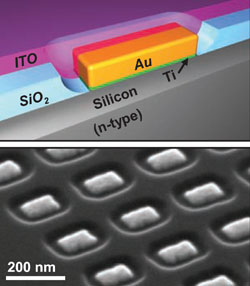
Last month I did a rough cut and paste overview (using papers available via google scholar) on the topic of rectennas or nantennas finishing on the topic of the possible capture of infrared light for power generation. Now an article published last month in Science (Vol. 332 no. 6030 pp. 702-704 ) has demonstrated the capture of infrared radiation using nantennas constructed using silicon based semiconductors. While this is a significant advance, hold the champers. The fabricated device, while useful as a sensor, only converts ~0.01 % of the absorbed photons into a photocurrent over the wavelengths for which it is tuned. The authors suggest some methods to increase this to 2%. What is significant is that because it uses mature silicon technology devices could be fairly rapidly mass produced IF the overall performance can be increased.
It's not solar nanvarna yet but… stay tuned!
Photodetection with Active Optical Antennas (free pdf)
Mark W. Knight, Heidar Sobhani, Peter Nordlander and Naomi J. Halas
Nanoantennas are key optical components for light harvesting; photodiodes convert light into a current of electrons for photodetection. We show that these two distinct, independent functions can be combined into the same structure. Photons coupled into a metallic nanoantenna excite resonant plasmons, which decay into energetic, “hot” electrons injected over a potential barrier at the nanoantenna-semiconductor interface, resulting in a photocurrent. This dual-function structure is a highly compact, wavelength-resonant, and polarization-specific light detector, with a spectral response extending to energies well below the semiconductor band edge.
More coverage at the Royal Society of Chemistry.
There's something about the mention of hot electrons that gets the chemist in me a bit excited.
Sunday, May 29, 2011
Rectify this
Below is a cut and paste “review” of the idea behind light rectification as an alternative method of deriving electrical power from solar energy. To preempt comments, this is not a magic bullet solution, it is some way yet before it may be useful (if ever) and I am not suggesting that “all our energy problems are over hip hip hooray”. However, IF advances keep apace, the possibility of being able to mass print such a device as envisioned below may be a welcome development.
Rectification is part of the process of converting an AC signal into a DC signal. Simple half wave rectification uses a diode that allows the forward going current to pass and blocks the reverse going current. Additional components are then used to “smooth” the resulting signal. Full rectification uses a bridge rectifier (essentially a collection of diodes) arranged in such a way that both the input forward and reverse currents appear at the output of the circuit in the same direction. Again, when smoothed this becomes a DC current.
Rectification is not a new technology. The simple “cats whisker” rectifier (a piece of wire in contact with a semiconducting crystal) of simple crystal radio sets – perhaps a novelty for the Nintendo generation – was the heart of the detector.
Rectification of microwaves is achievable at high power and is one of the technologies behind schemes to transmit solar power from space to ground based receivers. It has also been demonstrated as a means of wireless transmission.
In theory, the same principle should be applicable to shorter wavelength radiation, if some fundamental limitations can be overcome.
Saturday, May 14, 2011
SRREN Policy Makers Guide
Selected extracts from the Special Report on Renewable Energy sources policy makers summary.
The Message: The scenarios used to achieve CO2 stabilization may be achieved using renewable energy at a cost of 1% Global GDP per year.
I have tried to distill what I think are some of the most important statements from the 26 page summary, and to include some of the graphics not published in mainstream media. See the original (link above) for detailed explanations.
Integrating sustainable development with renewable energy adoption is a theme of the paper which I have highlighted.
The full report will be out at the end of the month.
On a global basis, it is estimated that Renewable Energy (RE) accounted for 12.9% of the total 492 Exajoules (EJ) of primary energy supply in 2008 (Box SPM.2) (Figure SPM.2). The largest RE contributor was biomass (10.2%), with the majority (roughly 60%) being traditional biomass used in cooking and eating applications in developing countries but with rapidly increasing use of modern biomass as well.
Traditional biomass (17%), modern biomass (8%), solar thermal and geothermal energy (2%) together fuelled 27% of the total global demand for heat.
Deployment of RE has been increasing rapidly in recent years (Figure SPM.3). Various types of government policies, the declining cost of many RE technologies, changes in the prices of fossil fuels, an increase of energy demand and other factors have encouraged the continuing increase in the use of RE.
Despite global financial challenges, RE capacity continued to grow rapidly in 2009 compared to the cumulative installed capacity from the previous year, including: wind power (32% increase, 38 Gigawatts (GW) added), hydropower (3%, 31 GW added), grid-connected photovoltaics (53%, 7.5 GW added), geothermal power (4%, 0.4 GW added), and solar hot water/heating (21%, 31 GWth added).
Of the approximate 300 GW of new electricity generating capacity added globally over the two year period from 2008 to 2009, 140 GW came from RE additions.
The use of decentralized RE (excluding traditional biomass) in meeting rural energy needs at the household or village level has also increased, including hydropower stations, various modern biomass options, PV, wind or hybrid systems that combine multiple technologies.
The global technical potential of RE sources will not limit continued growth in the use of RE. A wide range of estimates are provided in the literature, but studies have consistently found that the total global technical potential for RE is substantially higher than global energy demand. The technical potential for solar energy is the highest among the RE sources, but substantial technical potential exists for all six RE sources. Even in regions with relatively low levels of technical potential for any individual RE source, there are typically significant opportunities for increased deployment compared to current levels.
In the longer term and at higher deployment levels, however, technical potentials indicate a limit to the contribution of some individual RE technologies. Factors such as sustainability concerns, public acceptance, system integration and infrastructure constraints, or economic factors may also limit deployment of renewable energy technologies.
The levelized cost of energy for many RE technologies is currently higher than existing energy prices, though in various settings RE is already economically competitive. Ranges of recent levelized costs of energy for selected commercially available RE technologies are wide, depending
on a number of factors including, but not limited to, technology characteristics, regional variations in cost and performance, and differing discount rates. Some RE technologies are broadly competitive with existing market energy prices. Many of the other RE technologies can provide competitive energy services in certain circumstances, for example, in regions with favourable resource conditions or that lack the
infrastructure for other low-cost energy supplies.Monetizing the external costs of energy supply would improve the relative competitiveness of RE. The same applies if market prices increase due to other reasons.
The cost of most RE technologies has declined and additional expected technical advances would result in further cost reductions. Significant advances in RE technologies and associated long-term cost reductions have been demonstrated over the last decades, though periods of rising prices have sometimes been experienced (due to, for example, increasing demand for RE in excess of available supply).
As infrastructure and energy systems develop, in spite of the complexities, there are few, if any, fundamental technological limits to integrating a portfolio of RE technologies to meet a majority share of total energy demand in locations where suitable RE resources exist or can be supplied. However, the actual rate of integration and the resulting shares of RE will be influenced by factors, such as costs, policies, environmental issues and social aspects.
Renewable energy and sustainable development
Historically, economic development has been strongly correlated with increasing energy use and growth of GHG emissions and RE can help decouple that correlation, contributing to sustainable development (SD). Though the exact contribution of RE to SD has to be evaluated in a country specific context, RE offers the opportunity to contribute to social and economic development, energy access, secure energy supply, climate change mitigation, and the reduction of negative environmental and health impacts. Providing access to modern energy services would support the achievement of the Millennium Development Goals.
- RE can contribute to social and economic development.
- RE can help accelerate access to energy, particularly for the 1.4 billion people without access to electricity and the additional 1.3 billion using traditional biomass.
- RE options can contribute to a more secure energy supply, although specific challenges to integration must be considered.
- In addition to reduced GHG emissions, RE technologies can provide other important environmental benefits.
o Lifecycle assessments (LCA) for electricity generation indicate that GHG emissions from RE technologies are, in general, significantly lower than those associated with fossil fuel options, and in a range of conditions, less than fossil fuels employing CCS.
o Most current bioenergy systems, including liquid biofuels, result in GHG emission reductions, and most biofuels produced through new processes (also called advanced biofuels or next generation biofuels) could provide higher GHG mitigation.
o The sustainability of bioenergy, in particular in terms of life cycle GHG emissions, is influenced by land and biomass resource management practices. Proper governance of land use, zoning, and choice of biomass production systems are key considerations for policy makers.
o RE technologies, in particular non-combustion based options, can offer benefits with respect to air pollution and related health concerns.
o Water availability could influence choice of RE technology. Conventional water cooled thermal power plants may be especially vulnerable to conditions of water scarcity and climate change.
From this point on the report is uses projections based on scenarios.
Mitigation potentials and costs
A significant increase in the deployment of RE by 2030, 2050 and beyond is indicated in the majority of the 164 scenarios reviewed in this Special Report11. In 2008, total RE production was roughly 64 EJ/yr (12.9% of total primary energy supply) with more than 30 EJ/yr of this being traditional biomass. More than 50% of the scenarios project levels of RE deployment in 2050 of more than 173 EJ/yr reaching up to over 400 EJ/yr in some cases.
More than half of the scenarios show a contribution from RE in excess of a 17% share of primary energy supply in 2030 rising to more than 27% in 2050. The scenarios with the highest RE shares reach approximately 43% in 2030 and 77% in 2050.
RE can be expected to expand even under baseline scenarios. Most baseline scenarios show RE deployments significantly above the 2008 level of 64 EJ/yr and up to 120 EJ/yr by 2030. By 2050 many baseline scenarios reach RE deployment levels of more than 100 EJ/yr and in some cases up to about 250 EJ/yr.
The scenario review in this Special Report indicates that RE has a large potential to mitigate GHG emissions. Four illustrative scenarios span a range of global cumulative CO2 savings between 2010 and 2050 from about 220 to 560 Gt CO2 compared to about 1530 Gt cumulative fossil and industrial CO2 emissions in the IEA World Energy Outlook 2009 Reference scenario during the same period.
Scenarios do not indicate an obvious single dominant RE technology at a global level; in addition, the global overall technical potentials do not constrain the future contribution of RE. Although the contribution of RE technologies varies across scenarios, modern biomass, wind and direct solar commonly make up the largest contributions of RE technologies to the energy system by 2050.
Individual studies indicate that if RE deployment is limited, mitigation costs increase and low GHG stabilization concentrations may not be achieved.
A transition to a low-GHG economy with higher shares of RE would imply increasing investments in technologies and infrastructure. The four illustrative scenarios analyzed in detail in this Special Report estimate global cumulative RE investments (in the power generation sector
only) ranging from USD2005 1,360 to 5,100 billion for the decade 2011 to 2020, and from USD2005 1,490 to 7,180 billion for the decade 2021 to 2030.Increasing the installed capacity of RE power plants will reduce the amount of fossil and nuclear fuels that otherwise would be needed in order to meet a given electricity demand.
The annual averages of these investment needs are all smaller than 1% of the world GDP.
Policy, implementation and financing
Barriers to RE deployment include:
- institutional and policy barriers related to existing industry, infrastructure and regulation of the energy system;
- market failures, including non-internalized environmental and health costs, where applicable.
- lack of general information and access to data relevant to the deployment of RE and lack of technical and knowledge capacity; and
- barriers related to societal and personal values and affecting the perception and acceptance of RE technologies.
Although not explicitly stated in this summary, converting the traditional biomass faction of current energy production to some combination of modern biomass, solar, wind (etc) seems to be a priority for several reasons. Obviously to lower the GHG emissions, but also to reduce the health effects of particulate smoke and increase the transfer of technology to developing countries as part of the millennium development goals. As the populations using traditional biomass are frequently not connected to a centralized system, that objection/barrier is not a consideration in the implementation cost for adopting decentralized RE approaches. Obviously, nuclear is not an option for these people (numbering some 1.4 billion - see above).
Friday, May 6, 2011
IPCC renewables report out soon.
Reuters has had a preview of an upcoming IPCC report on the impacts of renewables on climate change mitigation.
Renewable energies to leap, costs fall: U.N.
Renewable energies such as wind or solar power are set to surge by 2050, and expected advances in technology will bring significant cost cuts, a draft United Nations report showed on Wednesday.
The most comprehensive U.N. overview of the sector to date said renewables excluding bioenergy, which is mainly firewood burned in developing nations for cooking and heating, could expand by three to 20 times by mid-century.
"The cost of most renewable energy technologies has declined, and significant additional technical advancements are expected," the Intergovernmental Panel on Climate Change (IPCC) said in a draft obtained by Reuters, based on a review of 164 scenarios.
In 2008 renewable energy production accounted for about 12.9 percent of global primary energy supply and was dominated by bioenergy with 10.2 percent, followed by hydro power, wind, geothermal, solar power and ocean energy.
The projected expansion is likely to continue even without new measures to promote a shift from fossil fuels as part of a U.N.-led fight against climate change, it said.
Sunday, April 24, 2011
Energy Easter Eggs
For those not away enjoying a little holiday here are some Easter energy links. I make no particular recommendations they just look interesting. There is no guarantee on the links, these things tend to expire after 3 months or so (or earlier). Most of these titles have been published in the last few years. The reviews are clipped from the site where I found the links – could be from Amazon.
| Nuclear Energy
| In order to understand the contribution that nuclear power makes today and its potential for the future, one must appreciate the various branches of physics, engineering, mathematics, economics, and the environment, as well as the way that power is supplied to the grid. It also helps to apply the same ideas and standards to the evaluation of competing technologies. Neither an endorsement nor a condemnation of nuclear power, "Nuclear Energy" provides objective information that is accessible - assuming only a modest knowledge of high school algebra on the part of the reader - and broad in scope. |
| Double or Quits: The Future of Civil Nuclear Energy
| This text, the culmination of a two-year study, provides a dispassionate and objective assessment of the major disputes on the future role of this controversial fuel. Decision makers and their advisers, as well as proponents and opponents of the fuel, should find that this book provides clarification of the main issues influencing the future of nuclear energy: relative economics, public perceptions and the process of decision making, nuclear research and development, waste management, reprocessing and proliferation, nuclear safety and nuclear power and the Kyoto Protocol. |
| Safety and Security of Commercial Spent Nuclear Fuel Storage | The information provided in this book examines the risks of terrorist attacks using these materials for a radiological dispersal device. "Safety and Security of Commercial Spent Nuclear Fuel" is an unclassified public summary of a more detailed classified book. A propagating fire in a pool could release large amounts of radioactive material, but rearranging spent fuel in the pool during storage and providing emergency water spray systems would reduce the likelihood of a propagating fire even under severe damage conditions. Although dry casks have advantages over cooling pools, pools are necessary at all operating nuclear power plants to store at least the recently discharged fuel. |
| Solar Energy: Renewable Energy and the Environment
| Covers solar energy resources, thermal and photovoltaic systems, and the economics involved in using solar energy. It provides background theory on solar energy as well as useful technical information for implementing solar energy applications. The book details the strengths, weaknesses, and applications of solar power generation technologies. It discusses the design and implementation of often-overlooked solar technologies, such as solar water pumping, distillation, detoxification, refrigeration, and village power. The text also examines photovoltaic power and how it is best suited for remote-site applications with small to moderate power requirements. Includes real-world case studies, and lessons learned from technical failures. |
| Drawing on both economic theory and the experiences of the United States and EU member states, Harnessing Renewable Energy addresses the key questions surrounding renewable energy policies. How appropriate is the focus on renewable power as a primary tool for reducing greenhouse gas emissions? If renewable energy is given specific support, what form should that support take? What are the implications for power markets if renewable generation is widely adopted? Thorough and well-evidenced, this book will be of interest to a broad range of policymakers, the electric power industry, and economists who study energy and environmental issues. | |
| Solar Energy Engineering: Processes and Systems
| The range of solar cells spans different materials and different structures in the quest to extract maximum power from the device while keeping the cost to a minimum. Devices with efficiency exceeding 30% have been demonstrated in the laboratory. The book includes all areas of solar energy engineering. All subjects are presented from the fundamental level to the highest level of current research. The book includes subjects such as energy related environmental problems, solar collectors, solar water heating, solar space heating and cooling, industrial process heat, solar desalination, photovoltaics, solar thermal power systems and modelling of solar systems including the use of artificial intelligence systems in solar energy systems modelling and performance prediction. |
| Wind Energy Engineering
| Comprehensive details on effectively using wind energy as a viable and economical energy source. Featuring a the book covers physics, meteorology, aerodynamics, wind measurement, wind turbine specifications, electricity, and integration with the grid. Filled with diagrams, tables, charts, graphs, and statistics, this is a definitive reference to current and future developments in wind energy.
|
| Wind Energy Explained: Theory, Design and Application | 2nd Edition Text book includes up-to-date data, diagrams, illustrations and thorough new material on:
This book offers a complete examination of one of the most promising sources of renewable energy and is a great introduction to this cross-disciplinary field for practicing engineers. |
| Renewable Energy, 4th Ed: Physics, Engineering, Environmental Impacts, Economics & Planning | A true shelf reference, providing a thorough overview of the entire renewable energy sphere, while still functioning as a go-to information source for professionals and students when they need answers about a specific technical issue. Structured around three parts in order to assist readers in focusing on the issues that impact them the most for a given project or question. PART I covers the basic scientific principles behind all major renewable energy resources, such as solar, wind and biomass. PART II provides in-depth information about how these raw renewable sources can actually be converted into useful forms, transmitted into the grid and stored for future utilization. PART III undertakes the aspects of energy planning, environmental impacts and socio-economic issues on regional and global levels. |
| Renewable Energy Cannot Sustain a Consumer Society | It is widely assumed that our consumer society can move from using fossil fuels to using renewable energy sources while maintaining the high levels of energy use to which we have become accustomed. This book details the reasons why this almost unquestioned assumption is seriously mistaken. Chapters on wind, photovoltaic and solar thermal sources argue that these are not able to meet present electricity demands, let alone future demands. The planet's capacity to produce biomass is far below what would be required to meet the demand for liquid fuel. Chapter 6 explains why it is not likely that there will ever be a hydrogen economy. Chapter 9 explains why nuclear energy is not the answer. The discussion is then extended beyond energy to deal with the ways in which our consumer society is grossly unsustainable and unjust. |
Just as a footnote, a search at Amazon for Molten Salt Reactor suggests that while this design is promoted as 'inherently safe', the required engineering talent to build and operate them is probably very thin. The few texts on this topic appear to be at least 20-30 (or more) years old. This suggests that, in spite of the scientific research this complex technology is very immature. By the time the first commercial prototype reactor is built 10 - 20 years may have passed. To go any faster would require the "learning by doing" approach adopted at Fukushima.
Also read the interesting perspective of Kurt Cobb: The Nuclear Industry's Wrong Turn.
Saturday, April 9, 2011
When The General Electric Talks
General Electric Announces Record Solar Efficiency, Plans To Build Largest U.S. Solar Factory
Reuters, April 8, 2011
General Electric (GE) has been reinventing itself as a green energy behemoth, beginning with a focus on wind energy, then the smart grid and more recently led lighting and solar. They've even developed an electric car charging station called the WattStation.
This morning they are announcing another big step along the path of its rapid push into the thin film solar market, taking direct aim at First Solar (FSLR). The push has been fueled by key acquisitions particularly of PrimeStar of which it acquired a minority stake in 2007, has had a majority stake since 2008, and today announced it has completed a full acquisition of the company. PrimeStar was developing the cadmium thin film solar panels which is the same technology First Solar is using.
GE is saying that its full sized thin film solar panel developed with PrimeStar has been independently certified to be the world's most efficient thin film solar panel at 12.8 percent aperture area efficiency. First Solar reported during its latest earnings report that it had reached 11.6 percent and that it expects to hit 12 percent within a few months. A 1 percent increase in efficiency results in a 10 percent reduction in energy cost, so the current spread isn't insignificant.
GE also announced that it will invest $600 million to build the largest solar panel production facility in the US. At full capacity the 400MW facility will produce enough panels each year to power 80,000 homes. The location of the plant is expected to be announced soon and it's great to see they will keep manufacturing in the US.
The good news for GE's solar business doesn't end there. They are also announcing more than 100MW in new orders for its thin film products which include the panels and inverters.
Fukushima No. 1 plant designed on 'trial-and-error' basis
Asahi Shimbun, 7 April 2011
While changes improved safety at the Fukushima No. 2 nuclear power plant, overconfidence, complacency and high costs stymied such action at the now-crippled Fukushima No. 1 plant, according to people familiar with the situation.
Tuesday, March 22, 2011
Nuclear Shake Ups
A few quick articles before I go off and do something more productive.
[Updated]Some newer articles added at end and then we need a change of topic.
Germany Plans Reunification-Style Speed to Build Grids for Cleaner Energy
Bloomberg, March 21
Germany may accelerate power-line projects to transmit more renewable energy to consumers after Japan’s nuclear disaster rattled voters in Europe’s biggest electricity market.
The Economy Ministry is preparing to use fast-track powers last exercised in 1990 when a newly united Germany had to build transportation infrastructure as fast as possible to replace crumbling roads in the east and improve connections in the country, according to a ministry document obtained by Bloomberg News. Control over power grids would be taken by Chancellor Angela Merkel’s government from states and local councils.
“The scale of the challenge is comparable with infrastructure needs after reunification,” according to the document, an outline for a draft to be presented to the cabinet in two days. Power storage sites will be exempted from paying grid fees for 20 years rather than the current 10.
Merkel last year agreed to extend the life of Germany’s nuclear reactors in return for receiving 15 billion euros from their owners to help build the grids. The plan also commits the four main utilities to pay a nuclear tax from this year through 2016 of 2.3 billion euros annually.
Another 5 billion euros was earmarked for offshore wind parks. The steps cumulatively aim to speed Germany’s target of generating 80 percent of energy from renewable means by 2050.
The US and Australia have similar geo-political attributes.
The Political Demise of Nuclear Power in the U.S
Huffington Post, March 21
While there may be good reasons for nuclear power to be used as a bridge fuel to a renewable energy future, I am confident that nuclear power is politically dead in the United States. This makes the research and development of alternative energy and carbon capture and storage that much more important and urgent. It also means that environmentalists who have either reluctantly or enthusiastically embraced nuclear power as a form of carbon free energy should move on to other solutions. The catastrophe in Japan will not soon be forgotten, and it will shape the politics of nuclear power plant siting for decades.
This analysis is based on a few fundamental facts of American political structure. Despite the strength of our national government, this remains a federal system of divided power. States retain sovereignty, and we have a deeply rooted tradition of local control of land use. Our national elected leaders pay a great deal of attention to geography and to opinion leaders at the community level.
The "Not-in-my Backyard" (NIMBY) syndrome is not a passing fad in American politics; it is a central element of land use politics in communities throughout this country. While it is true that the definition of a noxious facility varies from place to place, no one doubts the ability of an American locality to veto a land use they do not like.
The images of earthquake and tsunami damage will be combined with the nuclear accident and form a single image in the public's mindset about nuclear power.
And in a country that has trouble maintaining roads (at least where I am) never mind the drainage system…
Courting Chernobyl in Ring of Fire Is Lunacy: William Pesek
Bloomberg, 20 March
Here a word for Indonesia as it mulls a nuclear future: Don’t!
Monday, January 3, 2011
Salty Solar Storage
Solar Plant to Generate Power After Sundown
Rebecca Smith, WSJ, 31st Dec 2010
Abengoa's $2 billion Solana plant is expected to be the first major stored-heat plant in the U.S. when it enters service in 2013. Some already exist in Spain and a few more are on the drawing board for Nevada and California.
On Dec. 21, Abengoa, a unit of Spanish utility company Abengoa SA, cleared a major hurdle when it announced it received a $1.45 billion U.S. loan guarantee for the 250-megawatt Arizona project, planned for a site 70 miles southwest of Phoenix near Gila Bend.
The Solana plant will be able to meet winter heating and lighting needs by putting electricity on the grid early in the morning—before the sun is shining—and help satisfy summer cooling demand by producing power after sundown. The plant, which can power up to 70,000 houses, has signed a 30-year agreement to sell electricity to utility company Arizona Public Service.
Such utility-scale solar plants use mirrors to focus the sun's rays on a liquid, contained in tubes, which can be heated to very hot temperatures. The liquid is used to boil water and create steam. By using a conventional steam-turbine generator, electricity is produced.
Sunday, January 2, 2011
Regional Roundup
Asian hunger drives coal, oil price risePerhaps Lovelock is right and Gaia is striking back with some disruptive possibly climate change induced rain.
SMH, December 31, 2010
Strong demand from energy hungry Asian economies will drive the price of thermal coal even higher in 2011, as wet weather continues to shrink supplies of major global coal producing regions.
Oil prices are also expected to rise in 2011, while analysts have broadly slashed their outlook for natural gas due to an oversupply arising from American coal-seam and shale-gas projects.
Despite concerns about global warming, coal is still the fastest-growing energy source globally, with demand rising three per cent in 2010.
The economies of India and China are behind the surge, offsetting weak economic growth in Western economies that could otherwise have led to a slump on world energy markets.
"On the supply side, Indonesia is playing catch up," UBS commodities analyst Tom Price said.
"They have had very high, unusually high rainfall, well beyond their wet season.
"By the end of the year when the Chinese started restocking heavily on Indonesian coal, the coal just wasn't there."
In December, a severe coal shortage in China forced power cuts in the nation that relies on coal for 70 per cent of its energy needs.
Indian demand for thermal coal imports is expected to grow at nine per cent a year for the next five years as domestic supplies run out.
In Australia, uncertainty surrounding government policy on carbon pricing continues to hang over the energy sector, delaying investment decisions and projects.
Monday, December 27, 2010
The News on coal
Coal to remain backbone of power generationYes, that IEA... does that mean if the IEA made a lower projection then China and India wouldn't 'push'?
Geoff Hiscock, Dec 22nd.
Despite rapid growth in renewable power sources such as hydro, wind and solar, coal will remain the backbone of electricity generation for the next 25 years, according to the International Energy Agency (IEA).
A drop in coal-fired power generation in the advanced economies of the OECD between now and 2035 will be offset by big increases elsewhere, especially in China, where 600 gigawatts (GW) of new coal-fired capacity will be added. That figure exceeds the current capacity of the United States, Europe and Japan, the IEA says in its latest World Energy Outlook.
The IEA’s projections underpin the growing push by China and India to secure long-term coal supplies from around the world. As part of that drive, Chinese and Indian private and state-owned corporations are seeking to invest in Australian coal projects.
The world’s largest coal producer, Coal India Ltd, is also on the hunt for Australian mines, with Peabody Energy’s Wilkie Creek mine in Queensland a possible investment. CIL is held 90 per cent by the Indian government.
Late last year, China’s Yanzhou Coal Mining agreed to pay $3.5 billion for Felix Resources, which produces thermal and coking coal from four sites in New South Wales and Queensland.
Given that Felix means 'happy', it might be a good strategy for smaller miners to rename themselves to something including the words 'dragon', 'lucky' or the number 8.
Meanwhile, over at the Courier Mail we have;
Anna Bligh culls coal to fund solarBut The Australian, in an 'exclusive' no less, paints Anna Bligh as a nuclear advocate;
Patrick Lion, Dec 25th.
ANNA Bligh has secretly stripped $100 million from her highly touted clean-coal fund to bankroll a new solar push while publicly claiming she was still committed to cleaning up the state's coal industry.
The Sunday Mail has learnt the Premier recently redirected one-third of the clean coal allocation in the Queensland Future Growth Fund towards the development of two new commercial-scale solar power projects.
The move, a significant shift in Labor's energy policy, emerged one week after revelations the Government would walk away from state-owned clean coal company ZeroGen and scrap its planned $4.3 billion power plant in central Queensland.
In a statement, Ms Bligh yesterday confirmed the re-direction from the clean coal fund to the Solar Flagships Projects, saying it would help develop two new solar plants that power over 50,000 homes.
Defending the ZeroGen decision last weekend, Ms Bligh said she was still committed to clean coal and would "keep $50 million" in the clean coal fund.
Anna Bligh opens door to nuclear powerJamie and Imre must use a different dictionary to me, they (or their editor) seem to have interpreted Ms Blighs peek through the door in a very exclusive manner. However, notice that peoples concerns are not genuine, just genuinely held.
EXCLUSIVE: Jamie Walker and Imre Salusinszky
ANNA Bligh has backed calls for the Labor Party to review its policy on nuclear power.
The Queensland Premier has warned that renewable sources cannot meet the surging demand for baseload electricity.
Ms Bligh and ALP national president said development of the only other viable alternative energy, hydro-electricity, had been hamstrung by resistance to new dams.
Ms Bligh said pointedly that "parts of the environment movement" had shifted on the nuclear option, and now supported it as an abatement measure for climate change.
Ms Bligh said other renewable energy sources, such as wind and solar, could not produce sufficient baseload power. "I think it is perfectly understandable why nuclear comes on to the agenda . . . as people are genuinely looking for what is a cleaner alternative," she told The Australian.
"And I think it is quite interesting that's now coming as much from some parts -- not all, but some parts -- of the environmental movement, as it is from other parts of the energy sector..
However, Ms Bligh cautioned that any discussion about nuclear power for Australia remained theoretical, and not just because the cost was "prohibitive".
"I think there are still very genuinely held concerns about safety, and in an environment . . . where we have other alternatives then I think the prospect of one (a nuclear power plant) in an Australian context in the near future is very slim."
"It's not something on my agenda for the next election . . . it's the sort of thing, frankly, I don't have any intention of revisiting."